

Why Are So Many Republican Legislators Quitting?
The data suggests many still have safe seats. Unless there's a Democratic blowout.
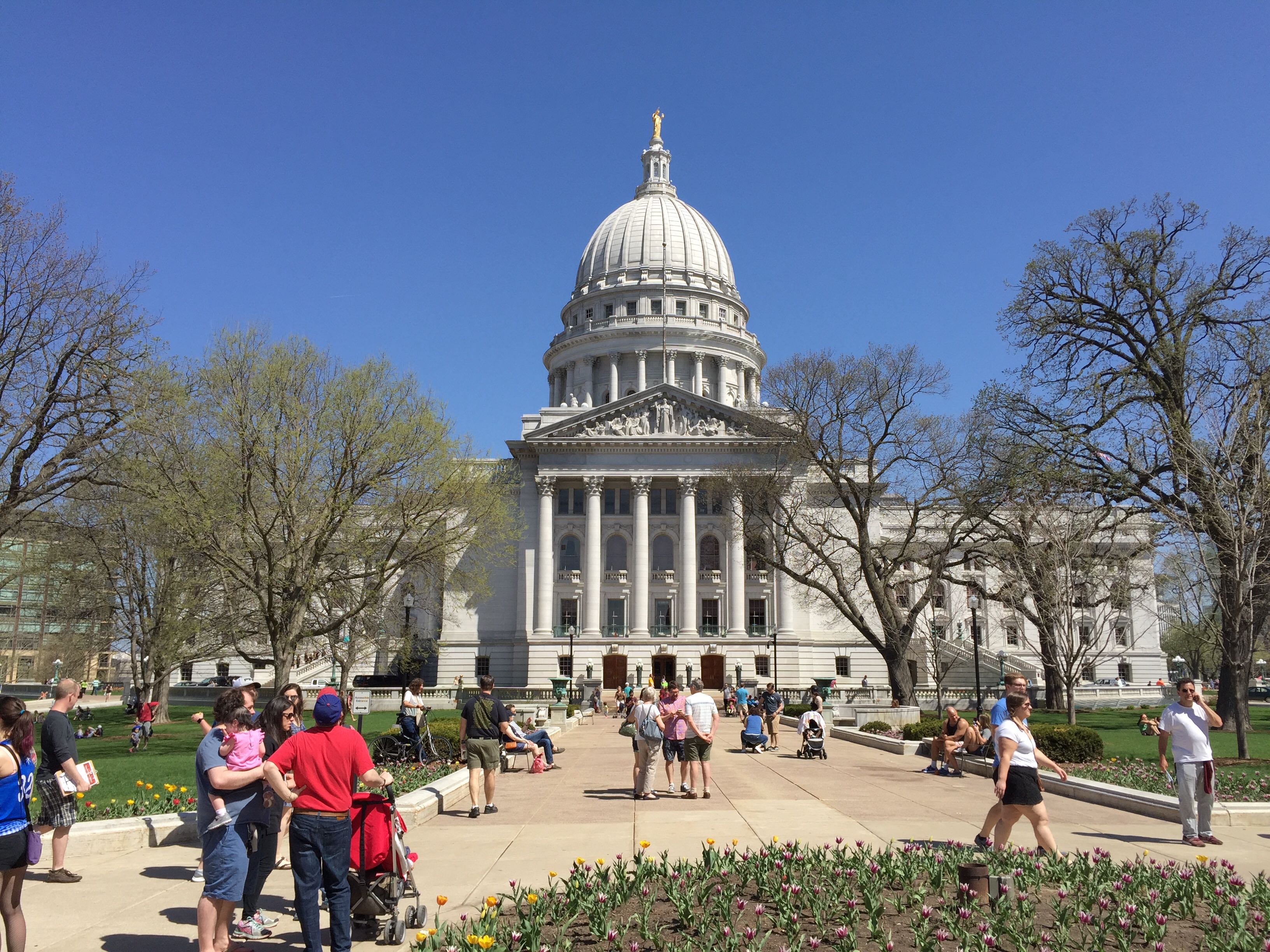
Wisconsin State Capitol. Photo by Dave Reid.
Why are Republican legislators abandoning the Wisconsin Legislature? One in five Republican lawmakers — six state senators and eight Assembly representatives — have submitted paperwork indicating that they will not be candidates for reelection this fall.
The green bars in the graph below show projected votes in the six districts whose senators announced that they would not run for reelection. The length of the bars shows the projected gap between votes for Democratic and Republican candidates in each district. This is based on the difference in each district between the expected vote for a Republican candidate and a Democratic candidate, as calculated by the website Dave’s Redistricting.
For example, 17.67% is the predicted difference between the percentage of votes expected for a Republican candidate and a Democrat in Senate District 1. It is based on a sample of previous statewide election results. Positive numbers show an expected Republican advantage; negative values indicate a Democratic advantage.
Only two of the six Senate districts indicate a Democratic advantage — Districts 5 and 21. Of the remaining districts, only one, District 25, has a gap of less than 10 percentage points. In other words, four of the six districts would be classified as safely Republican.
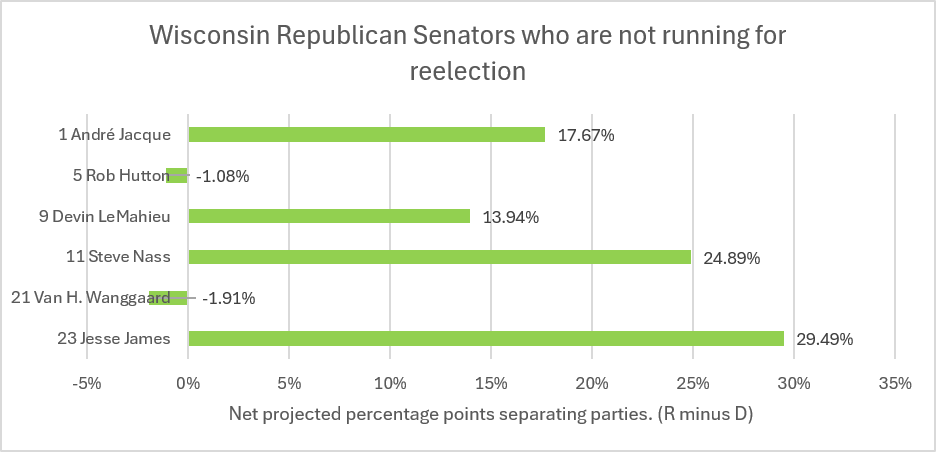
Wisconsin Republican Senators who are not running for reelection
In the state Assembly, a similar story plays out, as shown by the next graph. Of the eight Republican members stepping down, only two, the 12th and the 53rd, look competitive. The other six Assembly districts are safely Republican.
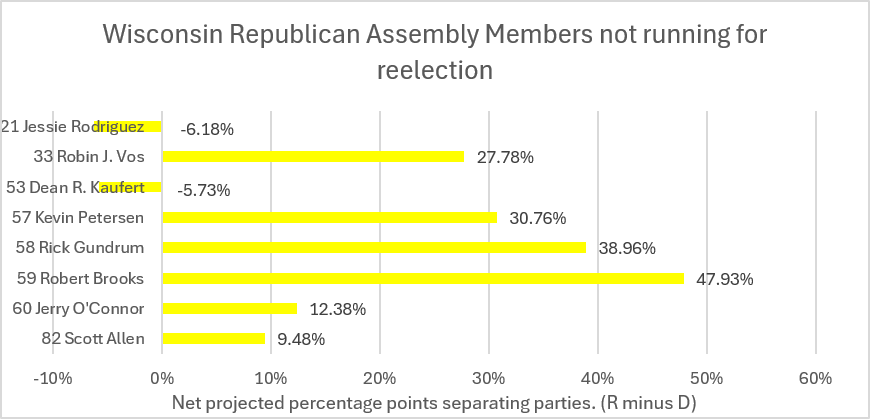
Wisconsin Republican Assembly Members not running for reelection
The data contradicts usual expectations. Normally, one would expect that people dropping out of an election would come from highly competitive districts and decide they don’t want to run the risk of defeat.
On the Democratic side, the story is quite different. Only three Democratic officials submitted the Notification of Noncandidacy (EL163) form. Robyn Vining, currently representing Assembly District 13, plans to run for Senate District 5. Francesca Hong, currently representing Assembly District 76, decided to run for governor. Sarah Godlewski, presently Wisconsin’s secretary of state, plans to run for lieutenant governor.
In contrast to the 14 Republicans, each of the three Democrats submitting noncandidacy forms did so to run for another elective office. The Republican legislators are through with elections. What accounts for the difference? Several factors have been suggested, including:
- Electoral Shifts and Redistricting: New state maps made historically safe GOP districts highly competitive, forcing many long-term incumbents into tough reelection battles. But that affects only 4 of the 14 GOP lawmakers stepping down.
- A possible Democratic blowout: the average increase in the Democratic margin in 2025 special elections was 13 points. That could make another two to three of the seemingly safe seats listed above vulnerable to a Democratic challenger.
- The prospect of a Democratic majority: The newly drawn maps have bolstered Democratic hopes of flipping control in both chambers. For several senior members, running simply to serve in the minority was viewed as far less appealing.
- Financial and Personal Issues: The burden of raising a family on a legislative salary has become the go-to explanation for retiring from legislative office.
- Seniority and Health: Long-serving legislators noted that they had spent decades in office and wanted to prioritize their families and health.
So-called “safe” seats are not truly safe. In contrast to competitive seats, where the danger of defeat comes from the general election, Republicans in so-called safe seats have to worry about attackers from the right who accuse them of not being sufficiently conservative or sufficiently MAGA. Retiring Assembly Speaker Robin Vos nearly lost to a primary challenger in 2022, winning by just 206 votes. Most of these GOP retirements were announced months in advance of the primary election.
For half of the state senators, the upcoming election is their first under the new district maps. After years of enjoying a safe district with little change, they would almost certainly have to go door to door to introduce themselves to the new parts of their district.
The Legislature has become notably more partisan in recent years, with tight leadership control by Republican leaders. This makes it much harder for members of one party to work with members of the other party to improve the lives of their constituents.
As a result, the legislators lose their independence to do what is good for their constituents. The party comes first. The mass decision of veteran Republican senators and representatives to quit could be a warning about the future of the Republican Party. We’ll know more about that when the results of the November election are tallied.
If you think stories like this are important, become a member of Urban Milwaukee and help support real, independent journalism. Plus you get some cool added benefits.


Data Wonk
-
The Trump Effect on Wisconsin
 May 28th, 2026 by Bruce Thompson
-
Who Pays Wisconsin’s Taxes?
 May 24th, 2026 by Bruce Thompson
-
The Impact of Two Cases Challenging Wisconsin’s Congressional Districts
 May 10th, 2026 by Bruce Thompson



















Bruce, I think you meant to say only senate districts 5 and 21 show a democratic advantage (not 1 and 21). Excellent analysis as always!
That’s because the decade plus of being useless grifters is coming to an end.
It’s interesting that the Republicans are not interested in elections. They chose their constituents 15 years ago so they would not have to sweat elections. After the disaster that is the current administration, they would have to do the hard work of seeking reelection. And then would have to negotiate in good faith with the other side of the aisle. Republicans, over the last 15-20 years, have not been interested in governing. No, what they wanted was power, the more the better.
jeff,
Thanks for catching that. At least the accompanying graph has it right.
Bruce
The paragraph has been corrected to say district 5 and 21.