New Elections Chief Wary of Disruptive Court Orders
Court cases changing how Wisconsin's fall elections handled could come too late, he warns.
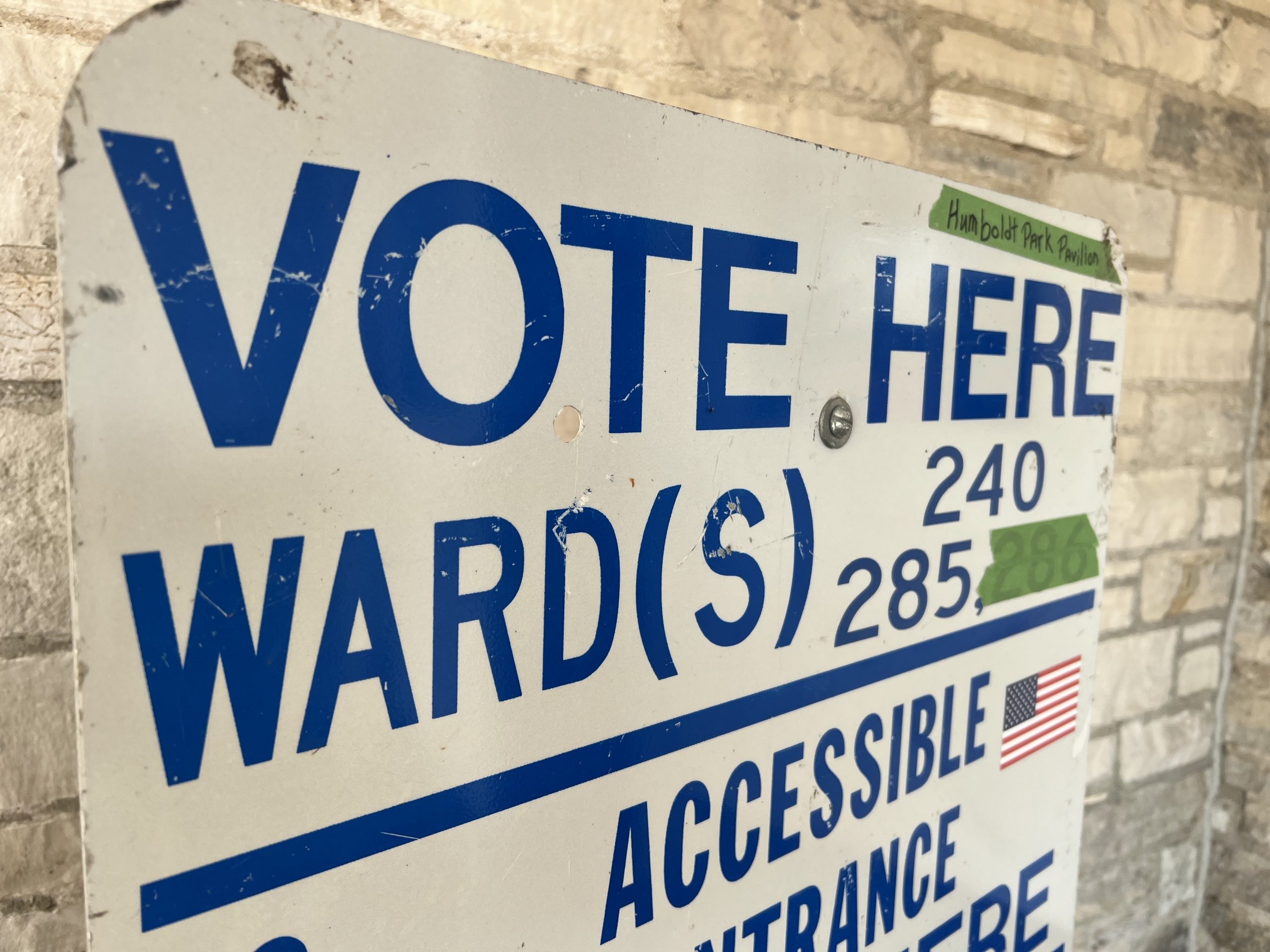
Vote here sign. Photo by Jeramey Jannene.
Don Millis, the new chair of the Wisconsin Elections Commission, says only potential orders from judges in pending cases could change the rules for the next two partisan elections — the Aug. 11 primary and the Nov. 3 general election.
There have been several attempts to make major election changes that did not happen.
President Donald Trump‘s order requiring a photo ID and proof of citizenship to vote has been blocked by federal judges. Absentee ballot drop boxes used by Wisconsin municipalities will still be used. And the Legislature and governor could not agree on allowing local clerks to count absentee ballots before the 8 p.m. closing of polls, despite repeated calls for that simple change to become law.
What changes in election laws did pass the Republican-controlled Legislature and were signed into law by Democratic Gov. Tony Evers?
“Not much of substance,” Millis said in an email. The Republican appointee to the six-member commission, elected as its chair last month, has worked with election laws for decades.
New state laws require the circulators of nomination papers to be Wisconsin residents, make it easier for third-party presidential candidates to nominate electors, allow some candidates — including presidential hopefuls — to withdraw from the ballot, and permit judicial candidates to not publicly disclose personal information.
Millis said Trump’s order requiring a photo ID and proof of citizenship to vote, if approved, would have been the greatest change in this year’s elections.
But, Millis added, “There are cases challenging the president’s executive order. While implementing the proof of citizenship would be very challenging on such short notice, based on what we have seen it seems the federal judiciary is likely to [rule] such a change cannot be accomplished via executive order.”
Still, Millis said he worries about the potential of judicial orders resulting from pending court cases.
“The case that has the greatest likelihood to impact voting in August and in November is likely the disability rights case pending in Dane County,” he said. “In that case, the plaintiffs are seeking a court order requiring that the Commission make it possible for disabled persons to receive ballots and cast votes over the internet.”
It would be very difficult — and maybe impossible — to comply with that order, Millis said.
“While Wisconsin has made great strides in making the voting process available to people with disabilities and plaintiffs’ motivations are laudable, Wisconsin law is not set up for internet voting,” Millis said. “The Commission would have no guidance as to how to set up internet voting.”
“Moreover, the Commission lacks the technology to accomplish this in such a short time and to get the necessary approvals from the federal government,” Millis added. “In my opinion, there is no vendor who has the technology that will guarantee voter confidentiality, so if the Commission is ordered to make internet voting available, we would have to develop the capability in-house.”
“The Dane County judge handling this case issued a temporary restraining order in 2024 mandating ballots be emailed to disabled persons,” Millis said. “That temporary restraining order was reversed by the Court of Appeals.”
Now, Millis noted, “The case is before the same judge.”
Another potential court ruling that the Commission and local clerks could have to deal with involves how absentee ballots are treated that arrive after the 8 p.m. election night deadline. Local clerks say the U.S. Postal Service has failed to deliver some absentee ballots by that 8 p.m. deadline and, in the April 7 election, 23 ballots that were to be hand delivered to Madison polling sites also missed that deadline.
Although the Elections Commission ordered the city of Madison to not count those 23 ballots, a Dane County judge ruled that they should be counted. Two pending lawsuits resulted from the city’s error.
“It is possible one of the cases will result in an order directing clerks to count ballots that, under certain circumstances, don’t reach the polling place by 8 p.m. on election night as mandated by state law,” Millis says. He hopes that, if judges set a new standard for how late arriving absentee ballots are treated, that the new rule “will not lead to future litigation.”
Although officials say that letting local clerks start counting absentee ballots before polls close would make results known earlier, especially in Milwaukee County, legislators have refused to make that change.
Steven Walters started covering the Capitol in 1988. Contact him at stevenscotwalters@gmail.com.
If you think stories like this are important, become a member of Urban Milwaukee and help support real, independent journalism. Plus you get some cool added benefits.


The State of Politics
-
One in Five Wisconsin Republican Legislators Are Retiring
 Jun 1st, 2026 by Steven Walters
-
Wisconsin Republicans Have Plan to Win in November
 May 25th, 2026 by Steven Walters
-
Why Legislature Killed Tax Cut, School Aid Plan
 May 18th, 2026 by Steven Walters