
Sheridan Park Bluffs Are Crumbling Away
Could threaten road, homes in Cudahy. Quick action needed, officials say, but funding an issue.

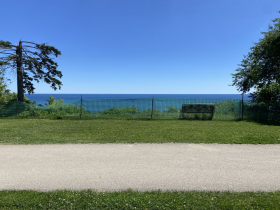
Bluff Erosion in Sheridan Park. Photo by Milwaukee County Parks.
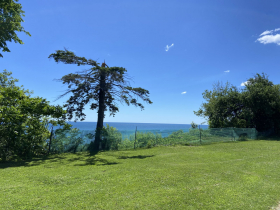
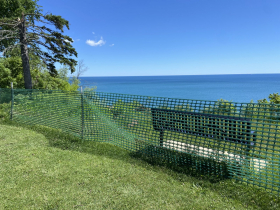
Milwaukee County Parks is in a race against Mother Nature to stabilize towering lake bluffs that are crumbling away, imperiling public infrastructure and nearby homes.
In Sheridan Park, powerful spring storms and older infrastructure further up the shoreline are creating a ticking time bomb. Near the north end of the park, the bluff is quickly eroding. Other bluffs along Milwaukee County’s south shore are in worse condition, but this bluff is the only one directly adjacent to the Oak Leaf Trail, a public road (S. Sheridan Dr.) and a number of homes.
“And the problem is that this is the only place in our whole park system where people live that close to the bluff,” Deputy Parks Director Jim Tarantino told Urban Milwaukee.
The City of Cudahy is responsible for S. Sheridan Drive and has already worked on a cost estimate for buying people out of their homes if there is a bluff failure that endangers them and public infrastructure.
The homes are part of a subdivision that was largely built in the 1930s. Around the same time, a groin field, composed of a series of concrete jetties, was built along the shoreline of Sheridan Park to stabilize the shoreline and the bluffs above, Tarantino said. At the northern end of the park, a municipal sewer pipe extends into the lake.
Between the pipe and the groin field, a “shadow zone” has formed where the shoreline is quickly eroding, destabilizing the base of the bluff, officials have said. Powerful spring storms have washed away sections of the bluff crest. The bluff is eroding at both the top and the bottom.
“The earth literally went downhill, taking trees and part of Sheridan Park with it,” Sup. Steven Shea told the Milwaukee County Board’s Committee on Finance Thursday. “The most northern [collapse] leaves the bluff just about 12 feet from the Oak Leaf Trail.”
Shea is pushing a resolution to pull approximately $1.12 million from the county’s rainy day fund to finance the complex engineering required for planning, design and permitting for a bluff stabilization project. The total cost of the project is estimated at as much as $20 million, Tarantino said. Funding just the planning and design could push the county budget into a deficit by the end of the year, according to the latest budget projection from the Office of the Comptroller.
To fund the total project, Parks plans to seek funding from a new Federal Emergency Management Agency (FEMA) program called Building Resilient Infrastructure and Communities, which provides funding for projects that prepare for and protect against natural disasters.
“So now Great Lakes communities can at least apply for that kind of FEMA support, where we couldn’t before,” Tarantino said, adding this caveat: “The recent politics that go along with that are true. We’ve been denied for multiple FEMA submissions for storm damage.”
The Trump administration has repeatedly denied Milwaukee County and the State of Wisconsin funding to repair public infrastructure damaged during storms in 2025.
Cudahy residents, including members of the Sheridan Park Friends group, are advocating for the emergency planning and design funding.
Colleen Grundy, chairperson of the friends group, said she has lived near the park for 18 years. “I’ve seen a lot of erosion, but never to the extent that the bluffs are starting to unravel now,” she said. Bari Svoboda, also with the friends group, said the organization has collected 800 signatures calling for action to protect the bluff.
“This is of utmost importance,” Cudahy Mayor Ken Jankowski told members of the Committee on Finance. The eroding bluff crest is now only 70 feet from S. Sheridan Drive, which is where all the infrastructure that services nearby homes runs.
“So, time is of the essence with this project,” said Sarah Toomsen, Parks director of planning.
If funding is approved, the county would immediately begin contracting for the engineering. The project would need permitting from the state Department of Natural Resources because it would alter the shoreline. Parks is working with Wisconsin Emergency Management to apply for FEMA funding. If that funding is secured, it would cover 75% of project costs and the county would have to cover the other 25%, Toomsen said.
Parks already has a number of conceptual plans to address the project, thanks to a previous coastal assessment funded with federal COVID-19 stimulus money. These concepts could include adding new groins or laying heavy rock at the base of the bluff to stabilize the shoreline. Bluff slopes in this area tend to stabilize at an angle of 22 degrees, Toomsen said. The goal of any project would be to help the slope get there.
Funding the project will be difficult for supervisors charged with minding the county budget. The comptroller’s office recently reported the county is projecting a narrow $300,000 budget surplus for the year. The surplus requires all of the county’s rainy day fund be available to backfill departmental budget gaps. Funding for the emergency bluff project could cause a budget deficit.
Sup. Shawn Rolland asked Toomsen whether they could delay funding until the 2027 budget.
“I can’t say how fast the bluff will continue to move, but we would begin the process of design if we had the money in hand,” Toomsen said. “I anticipate that both design and community analysis that would need to be done, as well as permitting, would take a year.”
Sup. Steve Taylor asked when construction could begin if funding was approved. 2028, at the soonest, Toomsen said.
Taylor said he would rather weigh the project against other county needs during the annual budget process. “I’d rather weigh this versus all the other projects that we have to do in the county. Frankly, you know, there’s no guarantee we’re going to get this FEMA money at all.”
Taylor was the lone member of the Committee on Finance to vote against releasing the funding. The measure will go before the full board for a final vote later this month.
Update: Story was updated to reflect that Sarah Toomsen’s title is Director of Planning.

Existing members must be signed in to see the interactive map. Sign in.
If you think stories like this are important, become a member of Urban Milwaukee and help support real, independent journalism. Plus you get some cool added benefits.


MKE County
-
Mayor, Congresswoman Moore Stump for Crowley As Early Voting Begins
 Oct 21st, 2026 by Graham Kilmer
-
Republicans Attack Crowley Over Wife’s Nonprofit Work
 Oct 19th, 2026 by Graham Kilmer
-
Zoo’s New Parking System Is a Success
 Oct 17th, 2026 by Graham Kilmer