Legislature Leaves Open Issues of Gerrymandering, Tax Relief
GOP leaders leave special session open, saying they want talks with Gov. Evers.
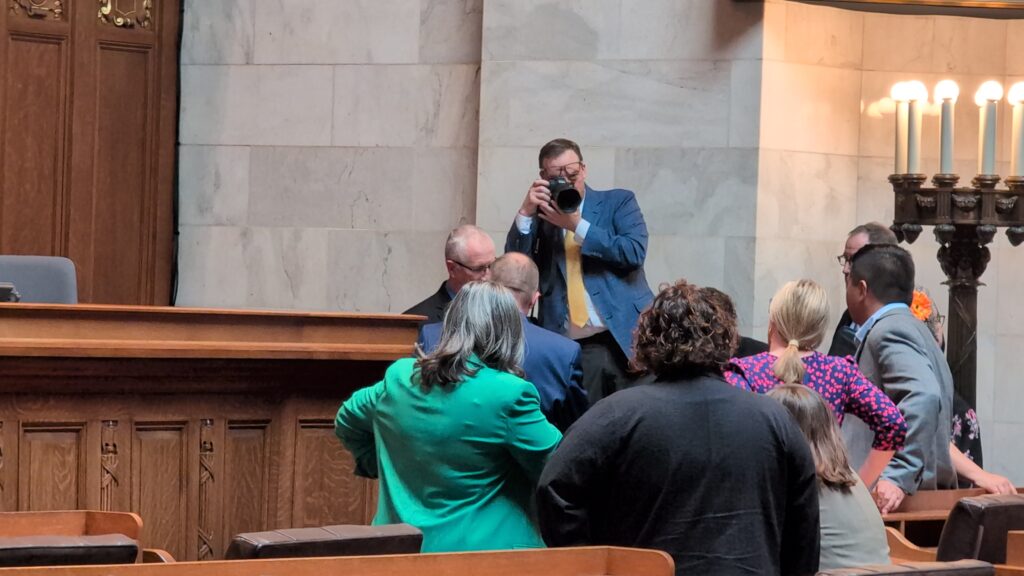
As the Republican leaders in the Assembly and Senate gaveled in and adjourned the sessions, Democratic members remained on the floor of each chamber to voice their opposition to Republicans’ lack of action. Rep. Kevin Petersen gaveling into the session in the Assembly. (Photo by Baylor Spears/Wisconsin Examiner)
Republican lawmakers left open Gov. Tony Evers’ special session on gerrymandering on Tuesday, saying they want to have further conversations with Evers about the issue. Evers and Democratic lawmakers criticized the lack of action. In a statement, Evers said “there’s nothing to negotiate.”
The open-ended special session began even as lawmakers and Evers continue to discuss a possible deal on property taxes and school funding.
Evers announced his intention to call the special session in February, urging lawmakers to pass a constitutional amendment to ban partisan gerrymandering. He officially ordered the session in March. The constitutional amendment would include language to expressly prohibit drawing districts that give a disproportionate advantage or disadvantage to any political party. It would not lay out a new process for drawing maps.
Wisconsin adopted new legislative maps in 2024 following a state Supreme Court decision that found the previous maps were an unconstitutional gerrymander. The maps will be in place until 2030 when redistricting happens again. Unless there is a change to the current process, lawmakers will again be in charge of drawing new maps in 2031.
Ahead of the noon start time for the session, Assembly Speaker Robin Vos (R-Rochester) and Assembly Majority Leader Tyler August (R-Walworth) announced their intentions to leave the session open in a statement. They said they did so in “an effort to continue meaningful dialogue.”
“We view the Governor’s proposal as a first step on which to build a more comprehensive, workable solution for Wisconsin,” the leaders said, adding that they want a face-to-face meeting with Evers to discuss ideas. “We’re committed to a transparent and balanced solution that reflects the interest of all Wisconsinites.”
Evers, who is serving his last year in office, has called special sessions many times over his two terms including on abortion, gun violence and the state budget. Republicans typically have gaveled in and out of them without taking action or have completely rewritten his proposals.
Senate Majority Leader Devin LeMahieu said in a statement that “any changes to the current process have to be made intentionally and specifically using normal legislative procedure” and that “leaving the special session open allows the legislature to gain public input in order to make an informed decision on how to proceed.”
“In nearly every instance in which Republicans did not immediately gavel out of the governor’s special sessions, Republicans simply quietly gaveled out months later, largely to avoid press interest, bad headlines, and public scrutiny and accountability,” Evers’ spokesperson Britt Cudaback wrote in a social media post.
The Senate and Assembly adjourned until Thursday morning.
Evers said in a statement after that there is “nothing to negotiate” and urged lawmakers to take action on the constitutional amendment.
“Rigging maps so that one political party stays in power is wrong, it’s anti-democratic, and it’s un-American — there’s nothing to negotiate because there’s no room for compromise when it comes to making sure Wisconsinites’ voices matter and their votes count,” Evers said. “This is a first step — if we don’t get a ban on partisan gerrymandering put in Wisconsin’s constitution, lawmakers will never be forced to create the independent and nonpartisan redistricting process Wisconsinites deserve. Lawmakers either want to ban partisan gerrymandering in Wisconsin or they don’t.”
As the Republican leaders in the Assembly and Senate gaveled in and adjourned the sessions, Democratic members remained on the floor of each chamber to voice their opposition to Republicans’ lack of action.
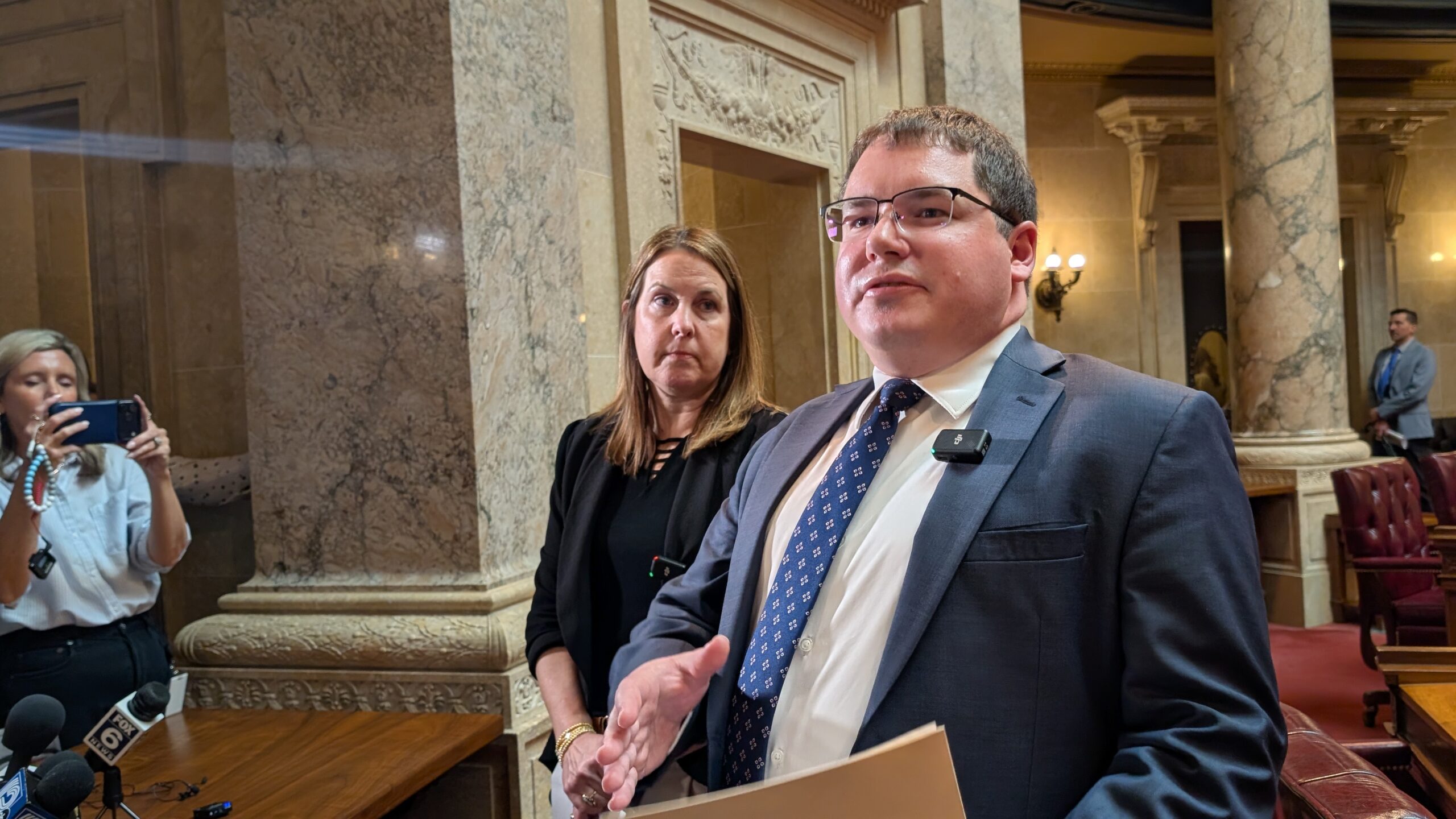
Senate Minority Leader Dianne Hesselbein (D-Middleton) and Sen. Mark Spreitzer (D-Beloit) held a press conference to criticize Republican lawmakers for not showing up to debate the measure. (Photo by Baylor Spears/Wisconsin Examiner)
Senate Minority Leader Dianne Hesselbein (D-Middleton) and Sen. Mark Spreitzer (D-Beloit) held a press conference to criticize Republican lawmakers for not showing up to debate the measure.
“It is a shame that Senate Republicans are refusing to do their jobs when the Senate Democrats are in the Senate chamber, ready to discuss, debate and pass the constitutional amendment banning partisan gerrymandering,” Hesselbein said.
Hesselbein said every Senate Democrat would have voted in favor of the proposal. She also said that none of her Republican Senate colleagues had contacted her and she didn’t know whether they actually planned to come back.
Spreitzer said that gerrymandering has led to elected officials ignoring issues that matter to voters.
“We’re seeing the last vestiges of that right now, as lame duck Republicans who are afraid to run on fair maps aren’t even coming in to take up this issue ahead of this coming election,” he said. “We only have fair legislative maps now because of court action, but our work is not done. There will be another redistricting cycle after the next census after 2030, and we need to lock in constitutional protections to make sure that our maps are never gerrymandered again.”
Spreitzer noted that the constitutional amendment would also provide legal grounds for a court challenge if there are gerrymander attempts in the future.
As a constitutional amendment, Evers’ proposal would need to pass in two consecutive sessions of the state Legislature before it would go to voters for the final say.
Bianca Shaw, the Wisconsin state director for Common Cause, told the Wisconsin Examiner that the lawmakers subverted expectations for the session, but that she hopes it isn’t just about “optics” and that policymakers will take the time to listen to Wisconsinites about the issue.
“I think that what the constituents want, what voters want, is most important,” Shaw said. “I think that it is constructive that it wasn’t outright dismissed but words alone won’t help reform, and so what I’m looking for is for legislative leaders to go into their communities and see what their constituents want.”
Shaw said she thinks there are some shifts happening in lawmakers’ openness in part due to upcoming elections and as many are facing competitive races.
“I think that what is happening right now in the state of Wisconsin is our legislators, on both sides, on all sides, are understanding that they have to earn their votes.”
Shaw said the constitutional amendment would be a valuable signal, but not the full solution. Common Cause, which is a part of the Fair Maps Coalition, supports an independent redistricting commission proposal, which would take the job of drawing maps out of lawmakers’ hands.
Negotiations on property taxes, school funding
Gerrymandering is not the only issue lawmakers and Evers are considering as they continue to seek a deal on tax relief and school funding.
Wisconsin has a surplus of more than $2 billion and policymakers are seeking to tap it to provide property tax relief to citizens, who have seen large increases in their bills, as well as to provide additional funding to school districts, which have seen a steady decline in state aid.
According to the Milwaukee Journal Sentinel, Evers told reporters on Monday that he and lawmakers were still talking about a potential deal.
“Before they disappear completely from Madison we need to get that done,” Evers said. “So we’re still talking.”
According to WisPolitics, Vos said in a social media post that he had been in discussions with Evers for nearly a month and “our proposal encompasses property tax relief, rebate checks, tax exemption on tips and overtime, and enhanced special education funding for schools.”
Other members of the Assembly Republican caucus, including Rep. Calvin Callahan (R-Tomahawk) also posted about the framework for the deal.
However, it is unclear whether Senate Republicans are part of those negotiations or whether they are close to agreeing. LeMahieu declared that he was excluded from previous negotiations and the Senate did not go along with what Vos and Evers agreed.
“Let’s hope we can convene the Legislature (we need the GOP State Senate to agree) soon so we can get this package enacted,” Vos said.
Lawmakers leave conversations with Evers on gerrymandering, tax relief, school funding open was originally published by Wisconsin Examiner.