

High Court Case Flips Script on Which Judges Strictly Interpret Law
WI Supreme Court could overrule decision by Judge Lazar on 2018 lame duck law.
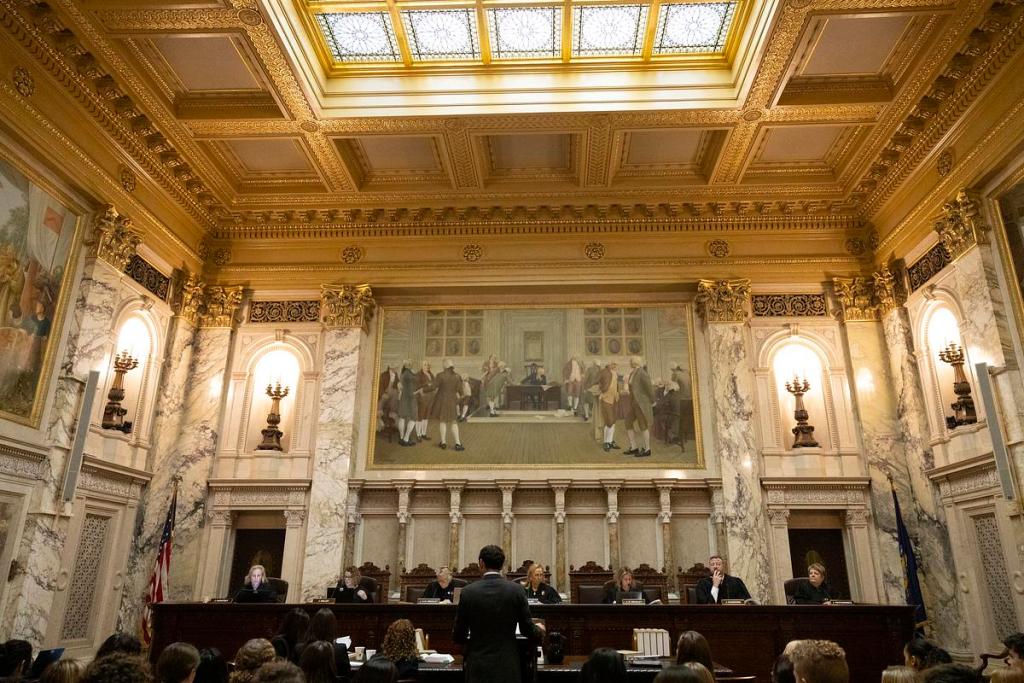
The Wisconsin Supreme Court hears oral arguments in a case at the Wisconsin State Capitol on Nov. 18, 2024, in Madison, Wis. (Joe Timmerman / Wisconsin Watch)
The Wisconsin Supreme Court is scheduled to hear oral arguments Wednesday in a case that highlights how judges can apply different interpretations of the law and constitution to suit their ideological viewpoints.
The case resulted from disagreements between the Republican-led Legislature and Attorney General Josh Kaul following the 2018 lame-duck session that limited the powers of the incoming Democratic administration.The lawsuit, which the Legislature filed in 2021 when there was a conservative majority on the state Supreme Court, focuses on who has oversight of the dollars the state receives from legal settlements. The Legislature argues the 2018 law requires the attorney general to put money from a financial settlement in the general fund, which state lawmakers control. Kaul argues that he can put settlement funds in accounts that the Department of Justice oversees and still comply with the law.
In December 2024, the 2nd District Court of Appeals in a 2-1 ruling reversed part of a circuit court decision that said Kaul could continue to direct settlement dollars into DOJ-controlled accounts.
The Appeals Court opinion was written by Judge Maria Lazar, a conservative who is running for a seat on the Wisconsin Supreme Court in April against liberal Appeals Court Judge Chris Taylor. Lazar ruled the language in the 2018 law aligns with the Legislature’s arguments that settlement dollars belong in the general fund.
“Despite the legislation expressly designed to bring all settlement funds under legislative control and despite the simple and plain language of that legislation, the Attorney General has continued to act precisely in the manner which the Legislature sought to end,” Lazar wrote.
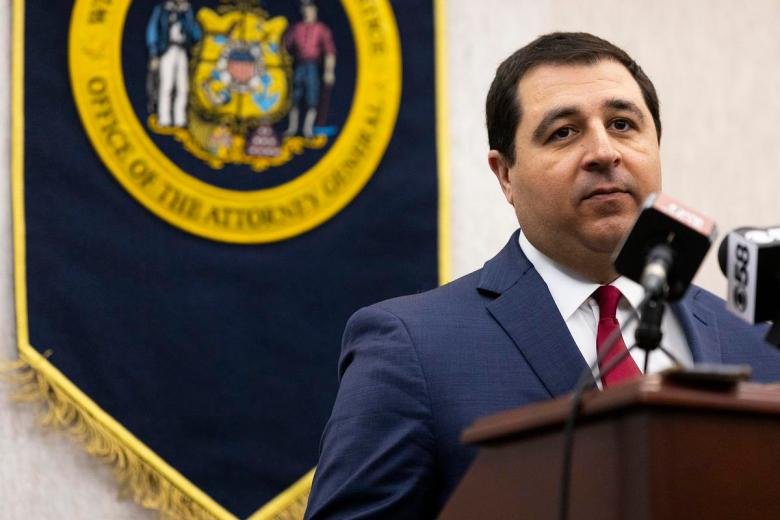
Wisconsin Attorney General Josh Kaul speaks during a press conference, April 2, 2025, at the Risser Justice Center in Madison, Wis. (Joe Timmerman / Wisconsin Watch)
But in a dissent, retiring Appeals Court Judge Lisa Neubauer, the only liberal on the Waukesha-based District 2 Court of Appeals, criticized Lazar for basing her decision on what the Legislature intended, rather than a strict reading of various clauses in the law that may give the attorney general wiggle room.
The oral arguments this week follow a series of decisions in recent years on lawsuits challenging the separation of powers between the Legislature and the executive branch. In June, the court unanimously struck down a portion of the 2018-era lame-duck laws that required the attorney general to receive approval from the Legislature’s budget-writing committee to settle most civil cases. For the 4-3 divided liberal-majority court, the rulings in these cases have shown agreement among the justices over the need for clear boundaries between the core powers of the branches of government, legal experts said.Where this latest lawsuit differs is the debate seems focused more on the language of the law than the separation of powers, said Chad Oldfather, a professor at the Marquette University Law School. Typically the conservative approach to statutory interpretation has been to focus on the basic meaning of the law while the liberal approach has been to examine the law’s intent. That has been the opposite in this case, Oldfather said.
“The advocates are kind of flipping a little bit the usual ideology of the statutory interpretation approach,” Oldfather said. “And all that’s going on while it’s clear that there are some people on the court who want to fundamentally shift the way the court does statutory interpretation. So there’s a real interesting mix of issues going on in this case.”
The law in question has been wrapped up in a yearslong debate over separation of powers that has made its way to justices in recent years, said Bryna Godar, a staff attorney at the State Democracy Research Initiative at the University of Wisconsin-Madison Law School. In many of those cases, the Supreme Court opinions have shown the justices interested in balanced branches of government.
“There seems to be an inclination to reinstate greater separation of powers between the branches and preserve the important roles of various actors, whether that’s the attorney general or the governor or the Legislature,” Godar said.For example, in a 6-1 decision in 2024, with Justice Annette Ziegler dissenting, the court ruled the Legislature’s Republican-led budget-writing committee could not block spending by the Department of Natural Resources for the Knowles-Nelson Stewardship Fund.
“While the legislature’s motivation for overseeing the public fisc may be well-intentioned, fundamentally, the legislature may not execute the law,” Justice Rebecca Bradley, a member of the conservative bloc, wrote in the majority opinion. “The people gave the executive alone this power.”
In the 7-0 decision last June on the Legislature’s approval of the attorney general’s civil case settlements, Justice Brian Hagedorn wrote that the constitution does not give lawmakers the ability to execute the law when there are financial decisions.
“If the Legislature has a constitutional interest in the execution of the laws every time an executive action involves money, there would be virtually no area where the Legislature could not insert itself into the execution of the law,” Hagedorn wrote.
There are still areas of disagreement among the court in these types of cases. Last July, the court reached a 4-3 decision in a lawsuit between Gov. Tony Evers and the Legislature, which determined 2018 lame-duck legislation that gave a legislative committee the ability to delay rules and policy changes from executive agencies was unconstitutional.
In that case, the court’s four liberal justices were in the majority. Hagedorn wrote an opinion both concurring and dissenting with the majority’s decision, while Bradley and Ziegler dissented.“The majority has created a grave constitutional imbalance by strictly construing, and thus confining, the constitutional powers of the legislative branch while not doing the same when it comes to the power of the executive branch,” Ziegler wrote.
This article first appeared on Wisconsin Watch and is republished here under a Creative Commons Attribution-NoDerivatives 4.0 International License.























VOTE for CHRIS TAYLOR.