

Key Committee Approves Changes to Knowles-Nelson Reauthorization Bill
'Killing a popular program out of spite does not make a great bumper sticker.'
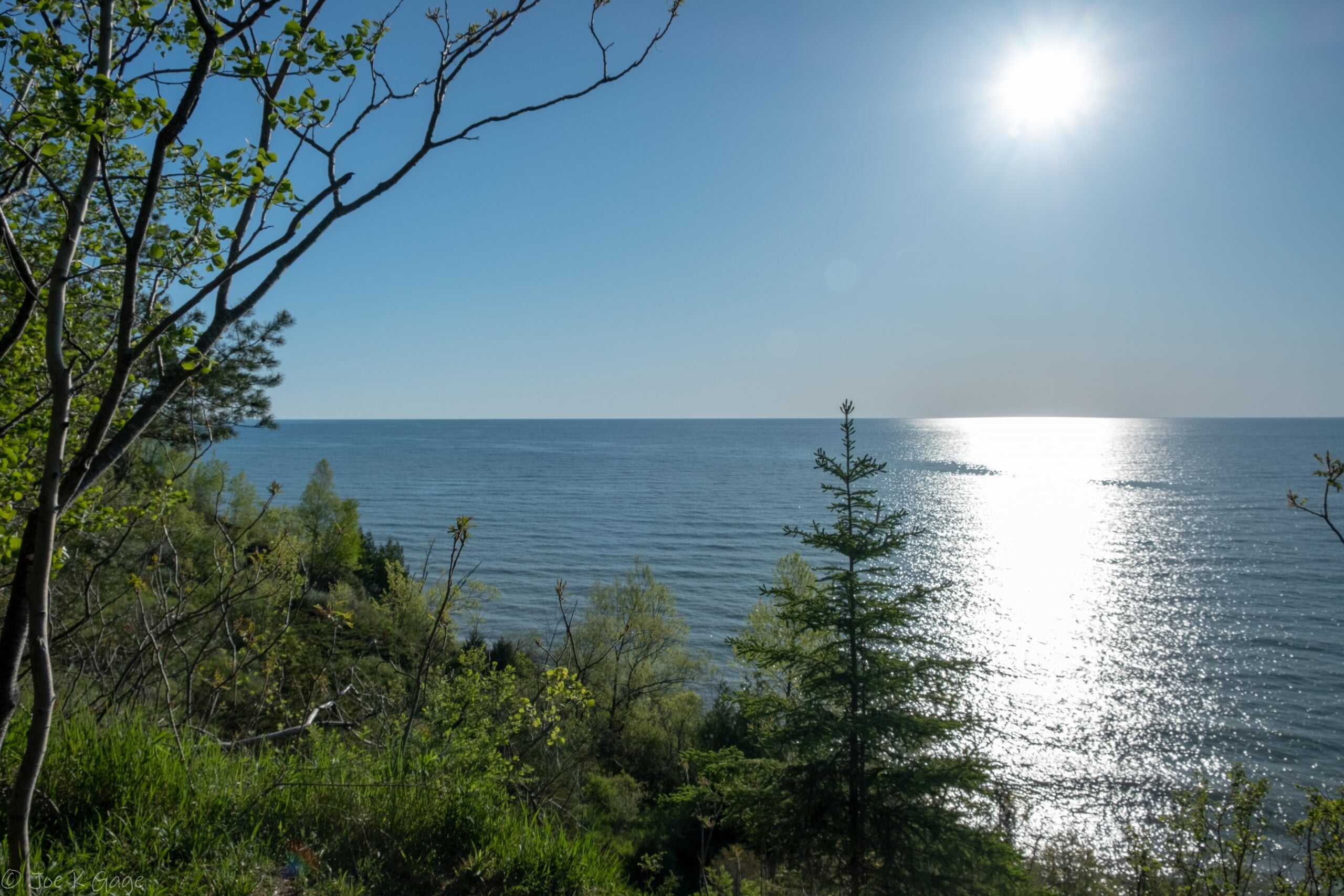
A view of Lake Michigan from Lion’s Den Gorge Nature Preserve near Grafton. The Ozaukee County Park, one of the few remaining undeveloped bluffs along Lake Michigan, was preserved with funding from the Knowles-Nelson Stewardship Program. Joseph Gage/ CC BY-SA 2.0
The Wisconsin Legislature’s Joint Finance Committee voted to advance a Republican bill that would reauthorize the Warren Knowles-Gaylord Nelson Stewardship program with additional amendments Monday.
The bill, SB 685, passed the committee with 11 Republican votes. Rep. Tip McGuire (D-Kenosha), Rep. Deb Andraca (D-Whitefish Bay) and Sen. LaTonya Johnson (D-Milwaukee) voted against advancing the bill. In conjunction with SB 316, the bill would continue the program for an additional two years, but in a limited form.
“When we start to dismantle programs that have been in place for 30 years that were built on bipartisanship, I start to seriously have my doubts,” Andraca said. She added that Republican lawmakers were willing to kill a popular program because of a state Supreme Court decision that removed their ability to anonymously veto particular projects.
For many years, Wisconsin lawmakers exercised control over the Knowles-Nelson program through the Joint Finance Committee as members could anonymously object to any project and have it held up for an indeterminate time. That ended last year after the state Supreme Court ruled 6-1 that anonymous objections were unconstitutional. Conservative Justice Rebecca Bradley wrote for the majority that the statutes “encroach upon the governor’s constitutional mandate to execute the law.”
“This is not the best that you could do. This is the best that you chose to do,” Andraca said. “Killing a popular bipartisan program out of spite does not make a great bumper sticker, but it does make it a whole lot easier for your constituents to know where you stand on conservation.”
The program is currently authorized at $33 million annually. The GOP bill will continue the program at a funding level of $28.25 million and limit land acquisitions for the two-year reauthorization period.
The Assembly passed its versions of the bills on a 53-44 party-line vote in January.
The Senate Financial Institutions and Sporting Heritage Committee approved changes to the bills on Friday. The recent amendments in the Senate mean the bills will need to pass a vote in both houses of the Legislature. The Senate plans to meet for a floor session on Wednesday.
One recent change to the bill eliminates a requirement that land-acquisition grants to nonprofit conservation organizations only be used for land south of U.S. Highway 8. Another change specifies that provisions related to minor land acquisitions will only be effective in 2026-27 and 2027-28. Under the bill, the department will only be able to make “minor land acquisitions,” defined as parcels of land that are five acres or less in size and would improve access to hunting, fishing or trapping opportunities, or are contiguous to land already owned by the state.
During the two-year period, the DNR would need to conduct a survey of all of the land that has been acquired under the stewardship program including an inventory of all land acquired with money. It would also have to report proposed project boundaries and land acquisition priorities for the next two to five years and proposed changes.
Another change in the amendments prohibits the DNR from acquiring land in 2026-27 and 2027-28 if it would result in more than 35% of the total acreage in a municipality being owned by the state, city, village, town or federal government, unless the municipality adopted a resolution approving the acquisition. That provision does not consider county-owned land in a given municipality.
Democrats wanted a more robust investment in the program. Sen. Jodi Habush Sinykin (D-Whitefish Bay) proposed a bill that would dedicate $72 million to the stewardship program and Gov. Tony Evers called for over $100 million for it in his budget.
The program, initially created in 1989, has allowed for state borrowing and spending for state land acquisition and for grants to local governments and nonprofit conservation organizations with the goal of preserving wildlife habitat and expanding outdoor recreation opportunities throughout Wisconsin. It has traditionally had bipartisan support and has been reauthorized several times throughout its history, including last in 2021.
The program’s funds will run out on June 30, 2026 if a reauthorization bill is not signed into law.
Bill coauthors Rep. Tony Kurtz (R-Wonewoc) and Sen. Patrick Testin (R-Stevens Point), who are both members of the budget committee, were critical of Democrats.
Kurtz said he supports conservation and said the bill had been “hijacked” by politics, including blaming the state Supreme Court decision for the current situation. He also preemptively blamed Democratic lawmakers for the potential end to the program.
Kurtz said he “wasn’t crazy” about the process, but asked the Legislative Fiscal Bureau what percentage of projects were approved under the program even with the anonymous objector process in place. An LFB staffer said 93% submitted to JFC were approved.
“93% that was submitted to the Joint Finance were approved — 93% — so basically, we’re bickering over 7% that you didn’t like,” Kurtz said.
Kurtz said there could also be other opportunities to acquire land by passing other bills.
“If there’s a piece of land that comes up next to Devil’s Lake, and the DNR wants to buy it, and they come to me and say, ‘Hey, Rep. Kurtz, we didn’t get the money in this authorization, but this is an opportunity that we can expand Devil’s Lake’ — I will be the first one to jump on that bill, because I know how important it is,” Kurtz said. “So when people say that it’s only $28.25 [million] they need to start thinking outside the box… If this fails, this is on the doorsteps of the Democrats in the state of Wisconsin, period, and I will sing that every day, 24/7, 365,” Kurtz said.
Johnson pushed back on Kurtz’s comment, noting that Republican lawmakers currently hold the majority in the state Senate and Assembly.
“[That] ultimately means that you can do whatever you want,” Johnson said, adding that she was confused by the Republican lawmakers trying to pass blame to Democrats.
Rep. Mark Born (R-Beaver Dam) commented that Evers will need to sign the bills for them to become law.
“This notion that this is somehow going to kill the program. That’s not accurate. We’re trying to save it because there are those of us up here who value conservation,” Testin said.
Budget committee approves amendments to Knowles-Nelson reauthorization bill was originally published by Wisconsin Examiner.




















I would still like to know who on the JFC voted against the Ozaukee County Clay Bluffs Cedar Gorge project in 2022? Supposedly some developer wanted to use the land to build high end condos or homes. The optics of this sure look like someone was bribed. The Republicans on the JFC had maintained this veto power with the legislator not having to be publicly identified. It is time to disband the JFC as it if always interfering with the functioning of the Executive Branch of the State and whose structure invited corruption.