
ACLU Asks Court to Enforce Program for Incarcerated Mothers
State law requires program for women inmates with children under 1 years old.
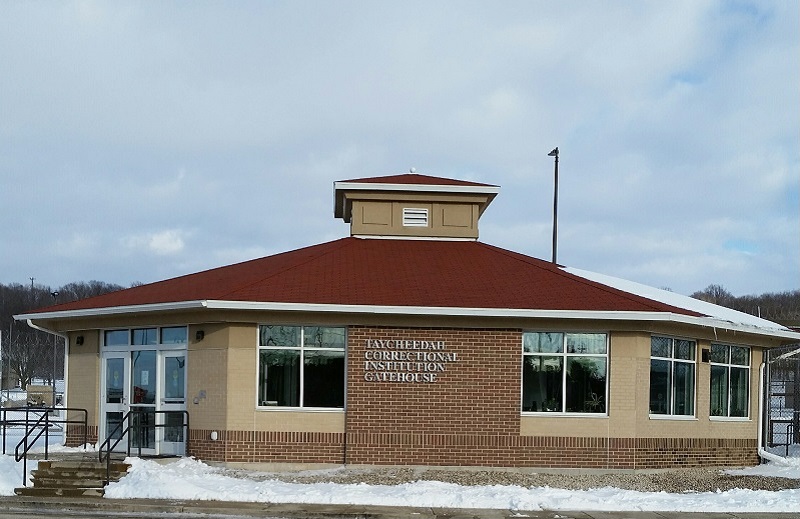
Taycheedah Correctional Institution , a women’s prison in Wisconsin.| Photo courtesy Wisconsin Department of Corrections
In the Wisconsin prison system, incarcerated mothers still lack a program that would allow physical custody of their children, a year after a court ruling affirmed that a state law requires the Department of Corrections to take steps to bring together incarcerated moms and babies. The ACLU is suing to try to force the issue.
Wisconsin statute 301.049 calls for a “mother-young child care program” allowing women to retain the physical custody of their children during participation in the program. It says a woman entering the program must either be pregnant or have a child less than a year old.
Alyssa Puphal and Natasha Curtin-Weber are plaintiffs in the case against the Wisconsin Department of Corrections (DOC), and are represented by the American Civil Liberties Union of Wisconsin and Quarles & Brady LLP.
While a judge sided with the plaintiffs last year, they are attempting to re-open the case, saying the DOC has not implemented the program required by law.
“At this moment, each and every woman in DOC’s physical custody with a baby under one year old sleeps apart from her child every single night,” the Feb. 4 filing stated.
Nine states have prison nursery programs, and a few others are considering or developing a program, Stateline reported in January.
According to Wisconsin Public Radio, DOC communications director Beth Hardtke wrote in an email that because the Legislature turned down a budget request from Gov. Tony Evers to expand earned release to allow mothers to spend more time with their children outside of prison, the department is now being required to expand the mother-child program to include incarcerated mothers despite a lack of additional funding and of statutory changes that would allow more incarcerated women to take part.
DOC had previously argued that it was meeting the requirements of the 1991 statute by facilitating contact between babies and mothers on probation, extended supervision and parole. But a year ago, in February 2025, Dane County Circuit Court Judge Stephen Ehlke disagreed, ordering DOC to provide a mother-child program inside Wisconsin prisons.
“Reforming the criminal justice system to make our communities safer is a key priority of (Gov. Tony Evers’) administration and that includes corrections reforms such as a mother-young child program for incarcerated women,” Hardtke wrote, according to WPR.
The ACLU motion called for remedial sanctions to get the agency to comply with the court order, including a daily fine for each day the contempt of court continues. The organization asked that the money from the fines be set aside to support the mother-child program, and claimed that a growing fine would ensure resources for the program.
“With each month that passes, Defendants’ failure to act violates state law and violates the Writ,” the motion stated.
When the lawsuit was filed in June 2024, Puphal had already given birth while incarcerated, while Curtin-Weber was pregnant. As of the filing of the lawsuit, their requests to participate in the mother-young program were refused or had not been responded to, according to a complaint published online by the ACLU.
Puphal and Curtin-Weber were released on extended supervision last year, according to online DOC records.
The state law enacted in 1991 states that the department shall provide the program for females who are prisoners or on probation, extended supervision or parole and who would participate as an alternative to revocation.
When a person is released from prison to supervision, they must follow certain rules. If their supervision is revoked, the person will either be returned to court for sentencing or transported to a correctional institution.
The department contended that it was in line with the law and that the word “or” in the statute indicated the agency could either provide the program for incarcerated mothers or for mothers on supervision.
DOC argued that it had a mother-child program for women on probation, extended supervision or parole who are pregnant or have a child under the age of one, and that it didn’t have to offer the program to incarcerated mothers. Wisconsin’s state budget includes $198,000 for a mother-young child program.
Ehlke sided with the plaintiffs. He said they had established a clear right to be included in the class of people the department must consider for the mother-child program.
The ACLU motion on Feb. 4 stated that the court had ordered the department to establish the program “forthwith,” or without delay, and moved to reopen the case, arguing there has been “no meaningful progress” since that order despite three meetings between department representatives and counsel for the plaintiffs.
“To avoid another year of excuses — or worse, another 35 years — Plaintiffs ask the Court to reopen this case for the purposes of enforcing the Court’s Writ,” the motion stated.
The plaintiffs’ filing includes a letter and a list of questions sent to the Department of Corrections in December. It states that the Ostara Initiative offered to create a mother-young child care program for DOC at no cost to the agency in April 2024 and has continued to approach the agency. It described the Ostara Initiative as “a credible non-profit that DOC has already partnered with for other services.”
The Examiner reached out to the Department of Corrections for a response to the plaintiffs’ filing, and also asked if the claims about Ostara were correct and if the department is planning to partner with Ostara on the program. Hardtke wrote that it is the department’s practice not to comment on ongoing litigation.
A telephone scheduling conference in the case is scheduled for March 2.
ACLU asks court to enforce program for incarcerated mothers was originally published by Wisconsin Examiner.