

How Wisconsin Ranks On Minimum Wage
Comparing to Midwest and the nation. A solution to affordability issue?

5739 W. Silver Spring Dr. Photo by Jeramey Jannene.
While campaigning for office, President Donald Trump promised that “when I win, I will immediately bring prices down, starting on Day One.” Unfortunately, that promise joined his many other unfulfilled promises. As a result, “affordability” has become the issue of the day.
Affordability depends on the intersection of two elements: prices and income. As Trump discovered, actually reducing prices may be unrealistic in many cases. Instead, it may be more realistic to concentrate on increasing income. One way to do this is to increase the minimum wage.
The next graph plots the nominal minimum wage in Wisconsin and in three neighboring states: Minnesota, Michigan and Illinois. As inflation over time decreases the value of the dollar, the states from time to time have raised the nominal value of the minimum wage.
The use of the word “nominal” in this case refers to the unadjusted value of something. “Real” values, by contrast, refer to numbers that have been adjusted to reflect the effect of inflation.
Wisconsin’s minimum wage was last raised in 2010, to $7.25 per hour and equal to the federal minimum. Since then, both the state and the federal minimums have remained fixed at $7.25.
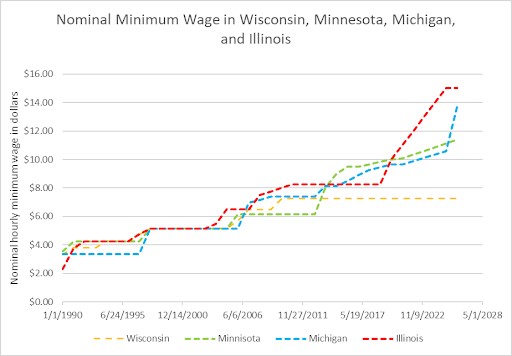
Nominal Minimum Wage in Wisconsin, Minnesota, Michigan and Illinois.
As the next figure shows, there is now a wide and growing disparity among states’ minimum wage laws, even among the four states: Wisconsin, Minnesota, Michigan and Illinois. Illinois’ $15 per hour is more than double Wisconsin’s $7.25. Although the difference is not as great as between Wisconsin and Illinois, Minnesota and Michigan are still considerably above the federal minimum wage.
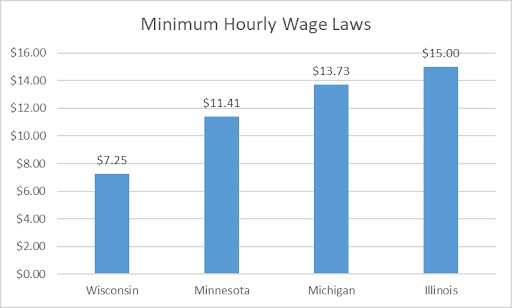
Minimum Hourly Wage Laws
The next chart plots the real value, using 2026 dollars, of the four states over the past 25 years. Note the repeated sawtooth pattern: a rise due to a state deciding to increase its minimum wage, followed by a descent caused by the value declining due to inflation.
The one major exception to this pattern is the long downward sloping yellow line reflecting the lack of any increase in Wisconsin’s minimum wage following its 2010 increase to $7.25.
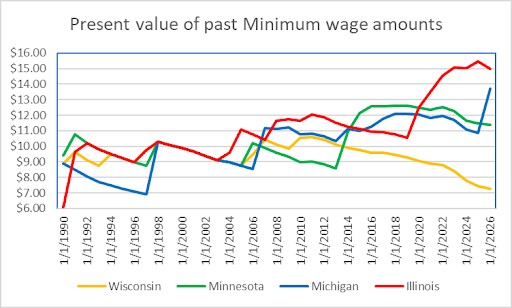
Present value of past minimum wage amounts
Classical economic theory predicts that increasing the minimum wage will cause the number of jobs to go down and demand for these low-paying jobs to go up, resulting in increased unemployment. Much to the surprise of many, a study of employment along adjacent states found that when one state increased its minimum wage while the other did not, the expected employment loss did not happen.
There then ensued a series of studies assessing the employment effect of increasing the minimum wage. Some found that jobs went down, others that there was no measurable effect, and some even found that jobs increased.
The next map summarizes where the minimum wage has grown and where it has not. States shown in the darkest blue have a minimum of $15 per hour or more. In the lightest shade are the states following the federal minimum of $7.25 per hour. In the middle are the rest of the states.
While the correlation between political parties and minimum wage is not perfect, it is certainly there, as confirmed by the map. States with the highest minimum wages are most likely to be found on the two coasts, while the heaviest concentration of states offering $7.25 is found in the South.
There is also something of a correlation between the minimum wage and the two parties. In general, Democrats and Democratic politicians like higher minimum wages while Republican leaders oppose them, as is the case in Wisconsin, where the Republican Legislature has opposed such proposals.
This year, 39% of workers will live in states with a minimum wage of at least $15 per hour, compared with the 37% living in states adopting the federal minimum of $7.25 or the 24% in the middle.
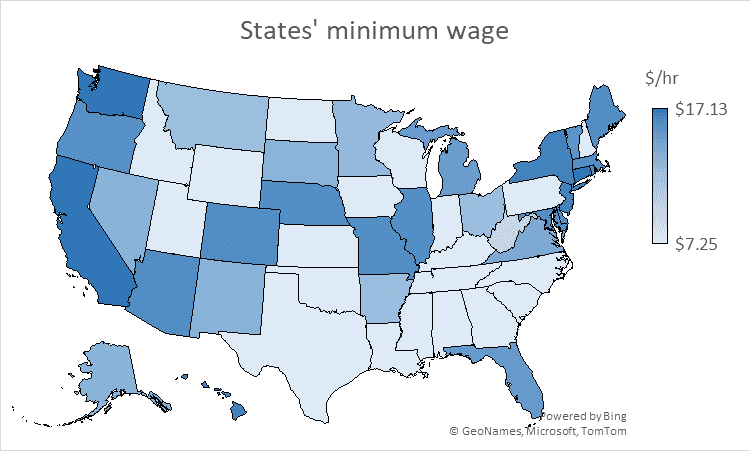
States’ minimum wage
Raising the minimum wage is good public policy. A job paying an hourly rate of $7.25 translates into pay of about $15,000 over a year, assuming 40-hour workweeks and no breaks in employment. This is slightly under the official poverty rate for an individual living alone.
It would also appear to be smart political policy, especially with the current concern about affordability.
If you think stories like this are important, become a member of Urban Milwaukee and help support real, independent journalism. Plus you get some cool added benefits.


Data Wonk
-
Who Do You Trust to Conduct Elections Fairly?
 Apr 6th, 2026 by Bruce Thompson
-
Is Non-Citizen Voting a Real Threat to Elections in Wisconsin?
Mar 18th, 2026 by Bruce Thompson
-
How Global Climate Change Affects Milwaukee
 Mar 11th, 2026 by Bruce Thompson


















What s shame! If my old $1.10 p/hr. High school job was adjusted for the COL, it would be over $20 an hour! Badger politicians continue to screw the most vulnerable workers.
Classic economists are actually wrong about increasing minimum wage causing a decrease in the number of minimum-wage jobs. The assumptions made upon which this theory is based, do not reflect what is really happening in the marketplace since 1975.
These assumptions were initially made in the 1960s. While they may have been accurate back then, there has been a lot of change in the last 60 some years. These assumptions do not take into account the growing wealth gap. They do not take into account the number of adults trying to provide for their families with minimum wage jobs, as well as COVID.
What is happening is, increasing the minimum wage puts more money into the local economy, which in turn causes more demand for goods and services. Increase demand causes an increase in production. For businesses to increase production they have to hire more employees.
Demand is the mechanism that drives job creation. Demand in turn is tied to increase spending. The more individuals with disposable spending is the fuel for economic growth.