Chief Judge Questioned About ICE Policy, Texts, Emails in Dugan Trial
Prosecution attempts to use his testimony to show Dugan disobeyed courthouse rules.
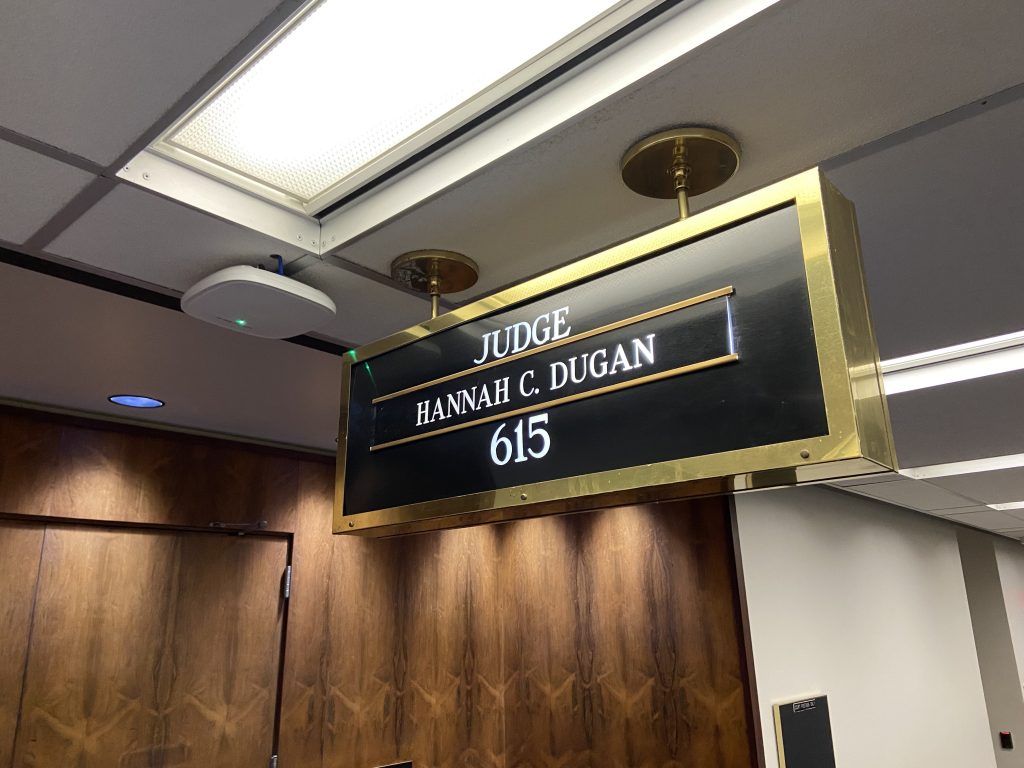
Judge Hannah Dugan’s courtroom on the sixth floor of the Milwaukee County Courthouse. Photo taken by Graham Kilmer.
Milwaukee County Circuit Court Chief Judge Carl Ashley was questioned Wednesday in federal court about his various communications — public and private — relating to Immigration and Customs Enforcement (ICE) actions at the Milwaukee County Courthouse.
His testimony came in the criminal case against Judge Hannah Dugan, where the federal government is attempting to prove Dugan knowingly obstructed an ICE arrest and concealed an individual from arrest on April 18 at the courthouse. The individual, Eduardo Flores-Ruiz, was appearing before Dugan on misdemeanor criminal charges.
Federal prosecutors are trying to prove that the ICE operation was routine and by the book, and that Dugan derailed it. Dugan’s defense is trying to demonstrate previous ICE arrests — which began after the new Trump administration took office — at the courthouse had sown confusion and disrupted normal operations at the courthouse, and that Dugan was trying her best under difficult circumstances.
The morning of the incident, Ashley spoke on the phone with an ICE agent. He told the court that, based on his conversation, he expected an arrest would take place and that it would occur after Flores-Ruiz’s hearing. The phone call occurred because Dugan told ICE agents to go to the chief judge’s office. Circuit Court Judge Kristela Cervera then walked Agent Joseph Vasconsellos to the chief judge’s office. But he wasn’t there. District Court Administrator Stephanie Garbo, who also testified Wednesday morning, called him on the phone.
A major piece of evidence brought up by both the prosecution and the defense was a “draft policy” outlining how personnel should react to immigration operations in the courthouse.
Prosecutors showed excerpts from the draft policy for ICE operations at the courthouse the chief judge was working on, with input from ICE officials working out of the nearby field office. An assistant U.S. attorney pointed out the policy said courthouse personnel would “notify” the chief judge of immigration activity at the courthouse, but does not direct personnel to send ICE agents to the judge’s office.
After ICE appeared in the hallway outside her courtroom that day, Dugan spoke to the agents and sent them to the chief judge’s office. Back in her courtroom, she rescheduled Flores-Ruiz’s case off the record and let him out of her courtroom using a door reserved for jury members and court staff. The door also leads to the public hallway, where ICE agents were waiting.
During questioning from prosecutors, Ashley also testified that he was concerned ICE operations at the courthouse would interfere with state court functions.
Later, after hearing about how the ICE operation occurred, Ashley texted Dugan, “Call me.” When she finally texted back and indicated she was not available, Ashley responded, “Never mind.”
Assistant U.S. Attorney Keith Alexander asked why Ashley responded that way. He replied, “I was concerned about what might have happened and I didn’t want to put her in a position to talk about it.”
The prosecutors then presented an email Ashley sent that day informing court personnel ICE agents had made an arrest at the courthouse, and “All the agents actions were consistent with our draft policies.”
Given a chance to cross-examine, attorney Steven Biskupic presented Ashley with a press release he sent out after ICE started making arrests in the courthouse. The statement announced his concern over the “chilling effect” and “erosion of trust” and disruption to court proceedings the arrests were likely to cause. The statement also called for the courts to remain “safe havens” for individuals engaging in the justice system.
In response to questions, Ashley said he wanted the public and his fellow judges to be aware of his concerns. Biskupic then went on to introduce excerpts from the judge’s draft policy, as well as other policies and communications, showing the jury what sort of information judges like Dugan were receiving prior to April 18.
Biskupic also introduced excerpts of the draft ICE policy for the courthouse that provided potential language for court personnel encountering ICE agents attempting to break the law or violate the courthouse policy. The suggestion was that court personnel state, “I do not consent, but because I have no choice at this time, I will not interfere with your order.”
He then introduced an ICE courthouse policy for San Francisco County. The language was nearly identical to the courthouse policy Ashley circulated, except for one detail: Ashley omitted language stating, “Immigration enforcement agents are allowed to conduct their operations in the court’s public areas.”
Biskupic asked Ashley if he took that sentence out of the draft policy.
“I did,” Ashley replied.
On redirect examination, Alexander asked Ashley if he told agent Vasconcellos that ICE could not make the arrest in the courthouse hallway. “I did not,” he replied.
If you think stories like this are important, become a member of Urban Milwaukee and help support real, independent journalism. Plus you get some cool added benefits.
More about the Judge Hannah Dugan Trial
- Forward Latino Statement Following Sentencing Hearing of Judge Hannah Dugan - Forward Latino - Jul 8th, 2026
- Prosecutors Suggest ‘Serious Sentence,’ Prison for Hannah Dugan - Graham Kilmer - Jul 2nd, 2026
- Sentencing Scheduled for Hannah Dugan - Graham Kilmer - Jun 19th, 2026
- Federal Judge Denies Dugan Acquittal, Again - Graham Kilmer - Jun 16th, 2026
- Judge Listens to Arguments As Dugan Case is Reopened - Graham Kilmer - Jun 3rd, 2026
- MKE County: Dugan Acquittal Motion Gets Hearing - Graham Kilmer - May 27th, 2026
- Prosecutors Ask Court to Disregard Dugan’s New Push for Acquittal - Graham Kilmer - May 7th, 2026
- Dugan Seeks Acquittal Ahead of Sentencing - Graham Kilmer - Apr 29th, 2026
- Sentencing Date Set in Dugan Case - Graham Kilmer - Apr 10th, 2026
- Federal Judge Won’t Vacate Dugan Conviction - Graham Kilmer - Apr 6th, 2026
Read more about Judge Hannah Dugan Trial here


MKE County
-
Mayor, Congresswoman Moore Stump for Crowley As Early Voting Begins
 Oct 21st, 2026 by Graham Kilmer
-
Republicans Attack Crowley Over Wife’s Nonprofit Work
 Oct 19th, 2026 by Graham Kilmer
-
Zoo’s New Parking System Is a Success
 Oct 17th, 2026 by Graham Kilmer