

Report Shows More Than 1 in 3 Wisconsin Students Need Reading Intervention
Problem is worst for 1st graders, new state report shows.
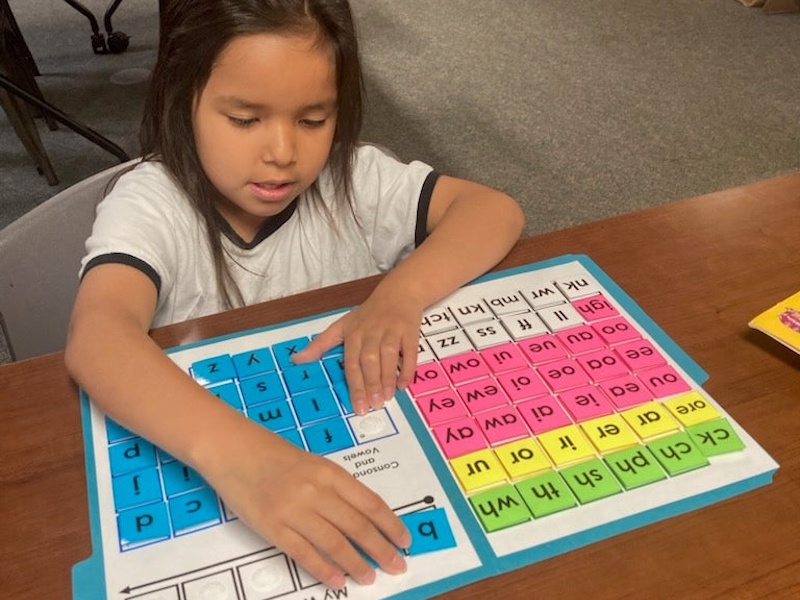
A student works on letters and spelling at the Oneida Reads Summer Reading Program. Photo courtesy of Oneida Reads
About 36 percent of Wisconsin’s youngest students are below the 25th percentile for reading, according to the Department of Public Instruction’s first literacy screening.
Act 20, the state’s reading reform law passed in 2023, requires school districts to provide literacy screenings to identify “at-risk” students.The law also requires DPI to release an annual report to the Legislature by Nov. 30 showing the results.
State Superintendent Jill Underly said the report provides a baseline of where students are performing.
“These data are critical in helping schools guide instruction and intervention — not to define a student’s potential,” Underly said in a statement.
The report includes district-, school-, and grade-level data — for 4K through third grade — on screening, diagnostic assessments and personal reading plans.
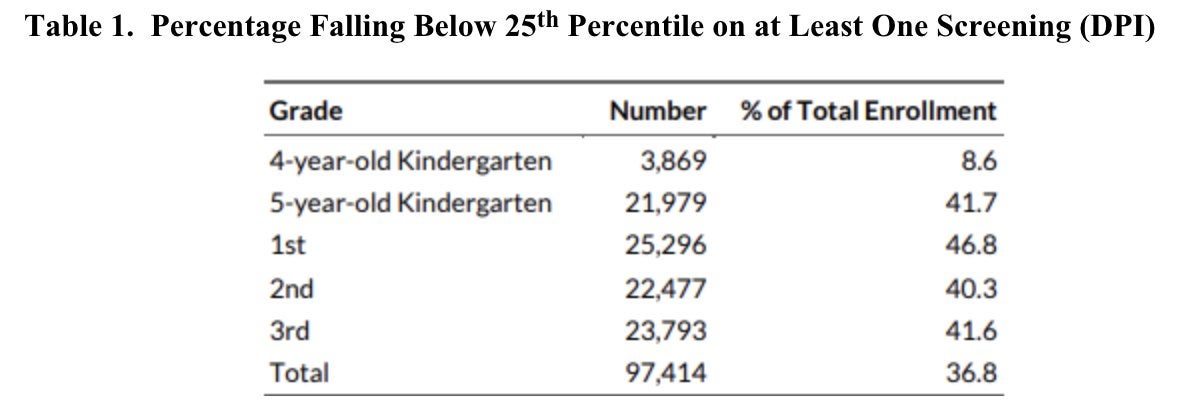
Per state law, the Wisconsin Department of Public Instruction released the first reading screening results last week. Graphic courtesy of DPI
Children who fall below the 25th percentile on the reading screener require additional support, including a personal reading plan.
Act 20 requires schools to shift away from “balanced literacy” curriculum to a phonics-based model known as “the science of reading” beginning this school year.
The law also prohibits the use of curriculum in kindergarten through third grade that uses three-cueing instruction, which means encouraging children to use clues like pictures to guess unfamiliar words.
Some districts across the state had already shifted to that model, but many hadn’t.Barb Novak, director of the DPI’s Office of Literacy, said school districts screened students before the science of reading was required.
“This is our entry point,” Novak said about the results released last week.
According to the report, 36.8 percent of students in 4K through the third grade — or 97,414 students — scored below the 25th percentile.
First graders are struggling the most, with about 47 percent below the 25th percentile. Novak said that doesn’t mean that 47 percent of first graders are failing, it means that 75 percent of other kids their age are doing better than them.
Will Flanders, research director for the conservative law firm, Wisconsin Institute for Law & Liberty, analyzed school district reading performance based on the DPI report and said those that have already adopted science of reading teaching standards are doing better.
For example, the Cudahy School District used federal pandemic money to overhaul its reading program in 2022 and has had impressive results.
Flanders’ report shows 23.7 percent of Cudahy students scored below the 25th percentile.
“There’s a wide variation in where districts and individual schools are in terms of early literacy, and a diversity of starting points,” Flanders said. “Unfortunately, demographics do tend to play a role in student outcomes.”
Cudahy is located south of Milwaukee. The school district has about 2,000 students and the majority — 63 percent — are considered economically disadvantaged.
Flanders said, given what has happened in Cudahy, there is reason for hope that Act 20 will help Wisconsin’s youngest children learn to read.“And those districts that are performing well on these metrics, the ones that rise to the top, can sort of be a model for some of those that are the other end of the spectrum, where they’re actually performing below expectations thus far,” Flanders said.
Report: More than one-third of Wisconsin’s youngest students need reading intervention was originally published by Wisconsin Public Radio.
If you think stories like this are important, become a member of Urban Milwaukee and help support real, independent journalism. Plus you get some cool added benefits.





















Head Start? Libraries?
Given the choice between a new aircraft carrier and improving reading and math, I believe the country should prioritize improving reading and math.
Understand the national debt. But investing in the future means improving education. Reading also improves a person’s ability to focus.
The new MPS Superintendent is making an effort. (More than can be said for the last Superintendent.) But this should be seen as a national emergency.
I’m glad that President Trump is actively doing something to stop drugs. And I understand that education is a state issue. Just need more focus. What did Ben Carson say about reading?
Appreciate the article! Need more articles holding the educational system accountable!