
Johnson Creek Weighs Smaller Data Center In Era Of Big Backlash
Developer says project would use far less power and water than megasites.
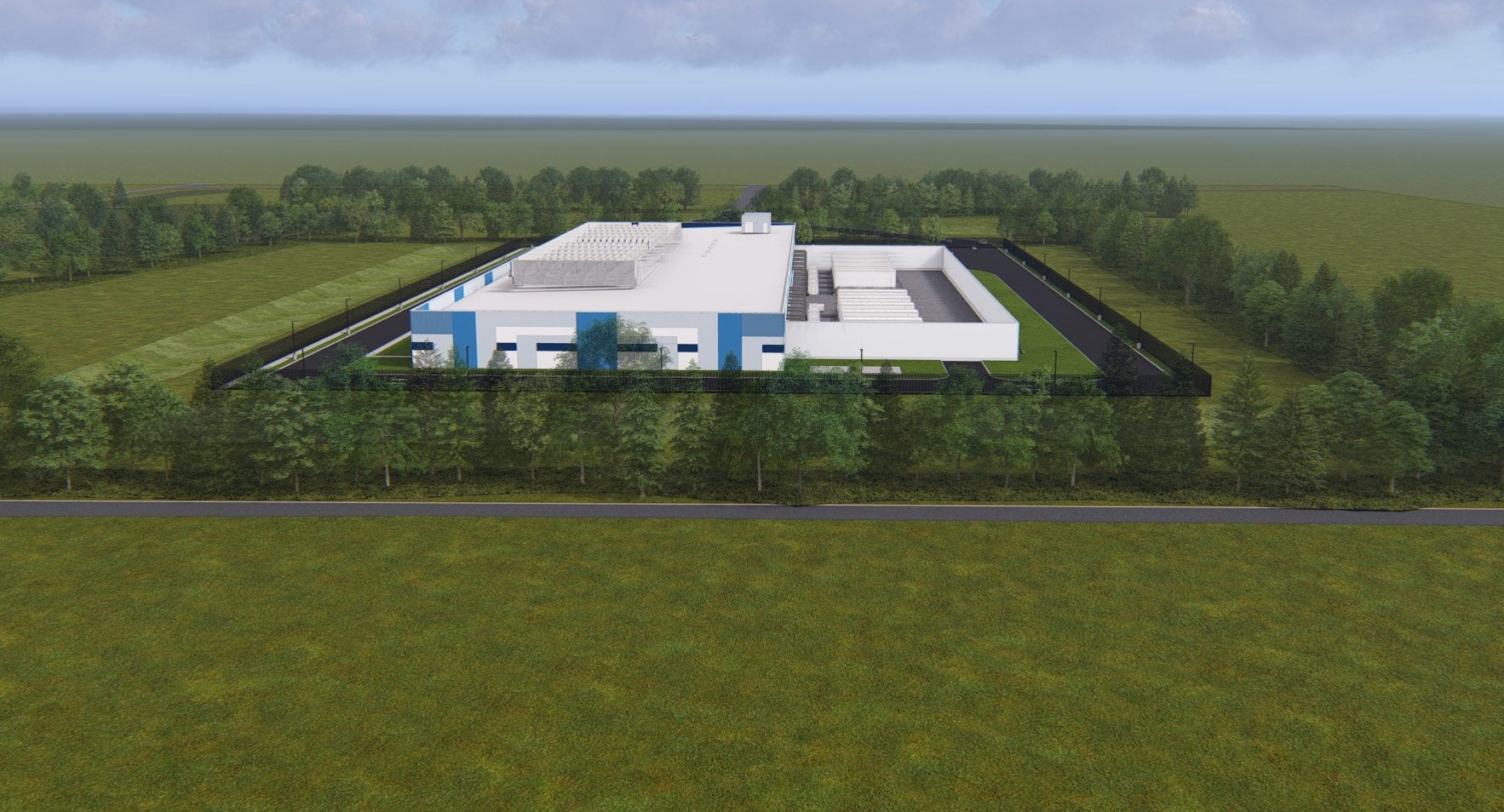
This is a rendering of what the data center in Johnson Creek, Wisconsin, could look like. Photo courtesy of RadiusDC
Residents in a rural community in southern Wisconsin are calling for the rejection of a new data center proposal. But the developer says the project would be much smaller than the massive data center campuses being built in other parts of the state.
Radius DC, a Colorado-based developer, hopes to build a 100,000 square-foot data center on nearly 40-acres in the village of Johnson Creek, located between Madison and Milwaukee. The village board had been set to vote on the proposal this week, but decided to put off making a decision after residents spoke out at the meeting.
Residents who spoke with WPR shared concerns ranging from what they described as a lack of transparency from the village to negative impacts to the environment and local wildlife.
“Everything came about way too fast, and the community wasn’t notified properly, in my opinion,” said Miranda Taylor, a community organizer. “That has created a lot of distrust in this business and the village board itself, and I think that’s where a lot of the opposition is also coming from.”
Lindsay Kinateder, who lives in Johnson Creek, said she had too many unanswered questions about the project.
“I think we need to slow down, we need to evaluate all of this and we need to make sure that there’s minimal risk and harm to the wildlife, to the environment and to the people that are living close to this area,” she said.
The village board is expected to take up the proposal again on Jan. 11.
Johnson Creek is in Jefferson County, which passed an 18-month data center moratorium this summer. But that moratorium doesn’t apply to municipalities in the county with their own zoning codes.
Jefferson County Board Chair Steve Nass said the county passed the moratorium to give itself time to craft local zoning and regulations on data centers.
“We felt that we didn’t have enough information to write a decent ordinance, or really to feel that we could competently regulate it without doing some more study,” Nass said.
Some residents feel the Johnson Creek proposal goes against the intent of the moratorium.
“It seems (like) a bad faith action to move forward with that, considering the moratorium,” said Cody Stark, who lives kitty-corner from the development site. “I understand the position that the county is in. They can’t actually make any decisions for cities or villages, but — to me — it does go against what I feel like the public wishes were intended to be on that.”
Johnson Creek Village Administrator Kyle Ellefson said the village has already passed an ordinance that sets regulations on these types of developments. He said those rules would prevent a hyperscale data center — like those under construction in Mount Pleasant or Port Washington — from coming to the community.
Ellefson said the proposed project would be located in a tax increment financing district created last year to support a separate manufacturing project, but would not receive incentives from the village.
The village’s proposed development agreement also includes language that would prevent the data center from expanding beyond its proposed 105,000 square feet.
Under the agreement, the developer would commit to creating at least $35 million in assessed property value on the site annually for 15 years.
“If they don’t meet that level, they will make it up with a payment in lieu of taxes, or a PILOT payment,” Ellefson said. “They also agree that they will not challenge the assessment if it’s at or below 45 million dollars.”
The proposal has come as data centers have become increasingly unpopular in Wisconsin.
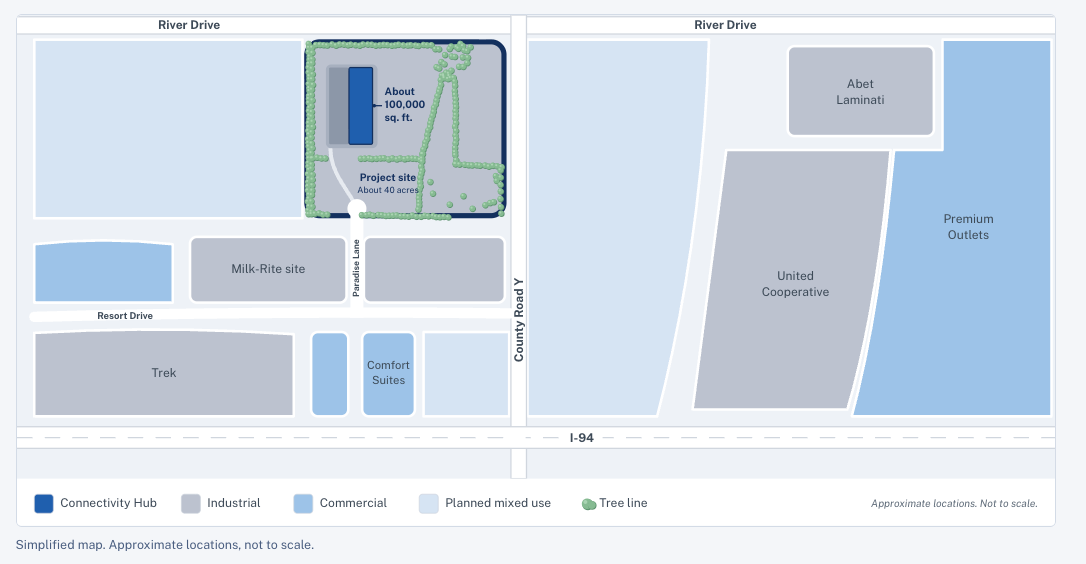
This map shows where the data center in Johnson Creek, dubbed the Johnson Creek Connectivity Hub, would be located. Graphic courtesy of RadiusDC
An October Marquette Law School poll found 75 percent of state voters believe the costs of data centers outweigh the benefits. Recent reports from state regulators have raised concerns about spiking electricity demand tied to the developments, while environmental groups have also raised concerns about water usage.
But the project in Johnson Creek would use far less water and electricity than two of the data center projects tied to spiking electricity demand, according to the developer.
RadiusDC says their data center would require 20 megawatts of power and would use a closed-loop cooling system that would be filled with 30,000-gallons of water. The company says water would be cycled through the system with only occasional top-offs.
For context, Microsoft’s data center campus in Mount Pleasant is expected to need 8.4 million gallons of water each year and could need 2.1 gigawatts by 2030.
Robert Marchant, a spokesperson for the Wisconsin Partnership for Progress, a pro-data center nonprofit that advocates for responsible development, said the type of facility being considered in Johnson Creek would be roughly the size of a Home Depot.
“These can go in existing industrial areas within communities, places that are zoned for business and industry already, and they’re really significantly low impact,” he said. “From a land use standpoint, it’s a relatively small development and building.”
The project would create 100 construction jobs, as well as 15 permanent jobs on-site once the facility is operational, according to the developer.
Keith Klesner, the vice president of development for RadiusDC, said the company began looking into the project over the summer. He said he’s heard the community’s concerns and that he hopes the company can answer as many of those questions as possible before January.
“A lot of the challenges that people think about with data centers on the large-scale may not have the same impact for a data center that’s sized like a big box retailer,” he said. “We’re definitely working to make sure that we’re respecting the watershed, we’re managing noise and any other development concerns for the community.”
Community opposition delays decision on Johnson Creek data center proposal was originally published by Wisconsin Public Radio.
If you think stories like this are important, become a member of Urban Milwaukee and help support real, independent journalism. Plus you get some cool added benefits.