
This Milwaukee Newspaper Was Firebombed. It Still Kept Publishing
New book chronicles history of scrappy underground weekly the Bugle American.
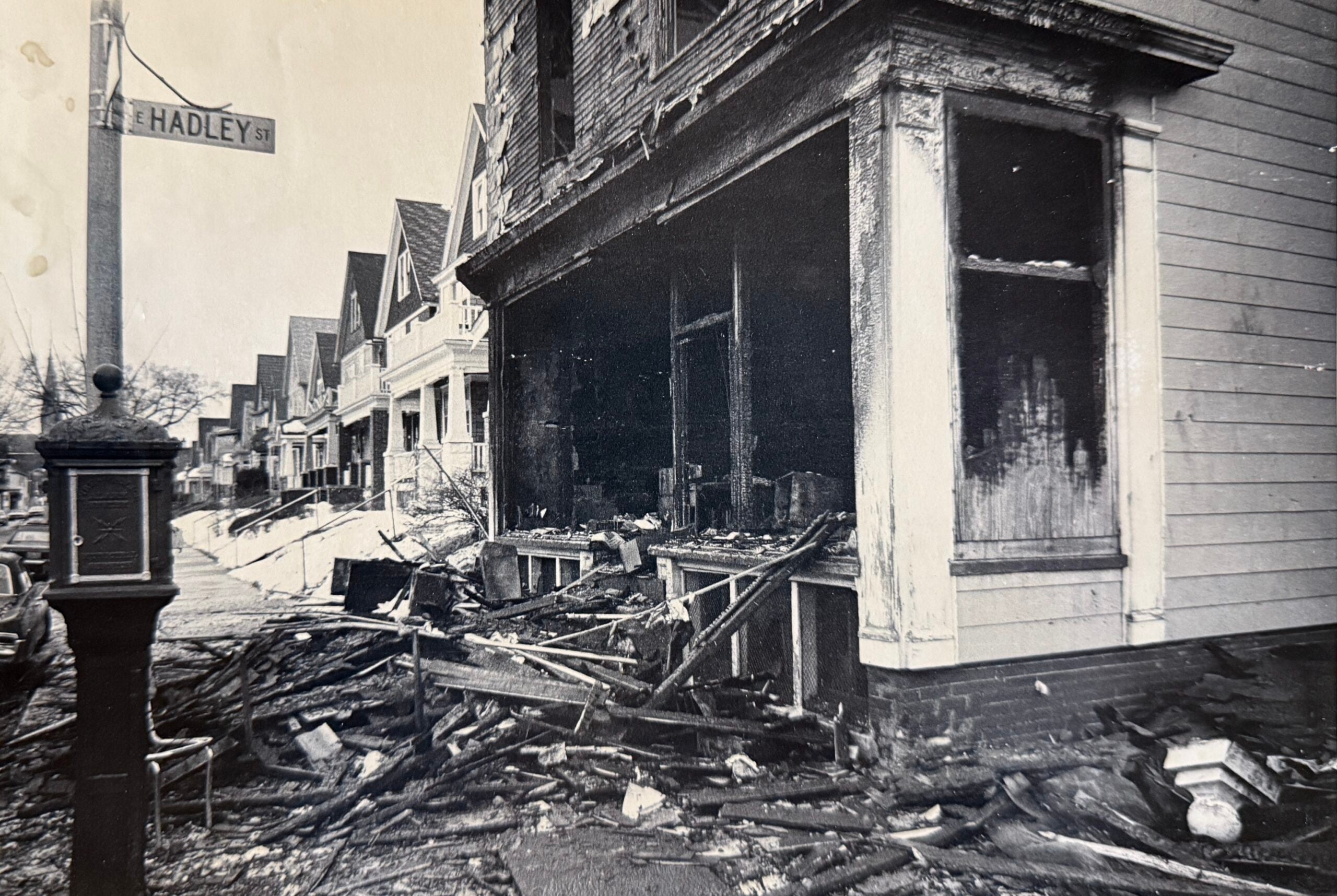
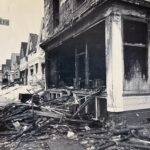
On Feb. 22, 1975, a firebomb tore through the front of the Bugle American’s office, leaving a gaping hole where two large windows had once framed the Bugle’s front door. Photograph by Mark Goff, courtesy of Mike Jacobi via Wisconsin Historical Society Press
One cold winter night in 1975, sleeping staff at the offices of the Bugle American in Milwaukee were awoken to the sound of broken glass and an explosion.
Someone had thrown a firebomb through a window, and fire quickly consumed the building. Every person within made it out alive, but the newspaper lost nearly everything it needed to operate.
With the help of Milwaukeeans, the scrappy underground paper returned to publish its next issue just one day late.
Wisconsin-born author Aurore Sibley wouldn’t be here without the Bugle — it’s where her parents met. She grew up hearing their fond memories from the paper, and when her father passed away, she became fascinated by the paper’s mark on Wisconsin history. So fascinated, in fact, that she wrote a book. It’s called, “Some Things Don’t Burn: Art, Activism and Arson at the Bugle American.”
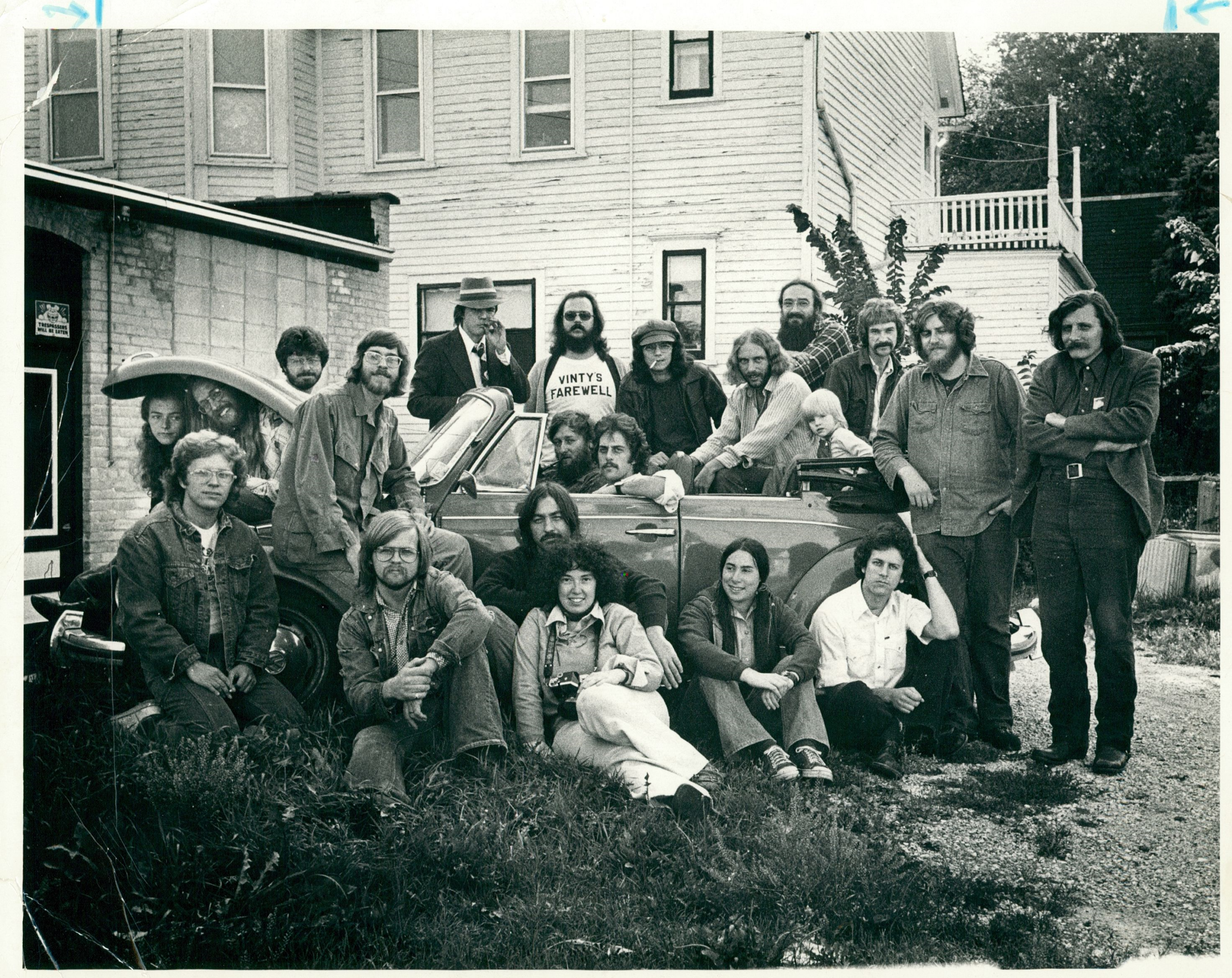
Bugle American staff and contributors in September 1975. Second from the left is the author’s father, Gary Peterson. Also pictured are founders Ed Goodman (back left, above hood), Dave Schreiner (center back, with cigarette), Mike Jacobi (car passenger’s seat) and Judy Jacobi (front, second from right). Photo by Mark Goff, courtesy of Wisconsin Historical Society Press
Police never found out who threw the firebomb — but as a voice for the counterculture during the politically volatile 1970s, the Bugle had some enemies. The paper covered war resistance, Wisconsin prisons and police, weed legalization and other topics that reporters saw as getting unfair coverage in bigger news institutions like the Milwaukee Journal or the Sentinel.
At the same time, the paper was documenting Milwaukee’s exploding music scene. So-called “Buglers” rubbed shoulders with some of the biggest artists of the time — like Black Sabbath, Bruce Springsteen and The Rolling Stones.
“The counterculture was really thriving,” Sibley told “Wisconsin Today.” “(It) culminated into this very politically active consciousness of the young generation, and they were really searching for ways to express themselves.”
The new voice of Wisconsin’s counterculture
In the early 1970s, there were many other counterculture publications in Wisconsin, including the famously radical Kaleidoscope. But a few former UW-Milwaukee journalism students had a different vision.
“They really wanted an alternative media source,” Sibley said. “Something that was more reliable than some of the underground papers and really journalistic in nature, but also an alternative to the conservative press.”
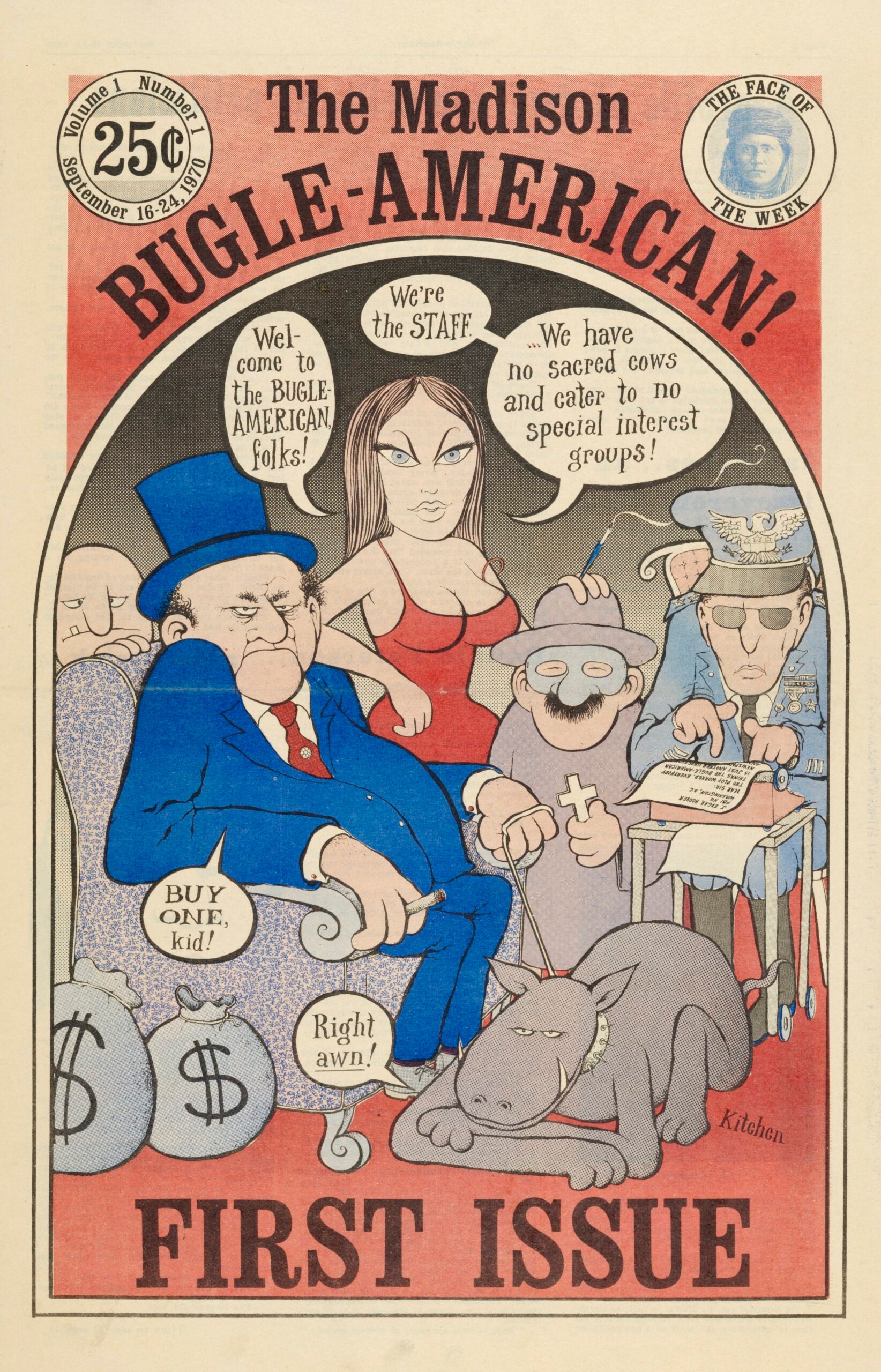
The Bugle American’s first issue, published Sept. 16, 1970. Denis Kitchen’s cover art depicted the Bugle’s founders as a capitalist, a sex worker and an army general, among others, poking fun at local rumors that the newspaper was secretly being funded by the CIA. Cover art by Denis Kitchen, courtesy of Wisconsin Historical Society Press
The Bugle American began in Madison. Its founders included Sheboygan Press staff writers Dave Schreiner and Mike Hughes, as well as Ed Goodman, Mike and Judy Jacobi, and Denis Kitchen — who illustrated for the Bugle and went on to become one of the most prominent underground cartoonists in the U.S.
Getting the paper up and running was a challenge.
“They all wanted to write, but they didn’t really have any business background or knowledge, and so they went into it blind and without much backing or funding to begin with,” Sibley said.
Schreiner spent all of his savings to get the paper started, and others gave what they could. They published the first issue of the Bugle in September of 1970. After getting their feet under them and moving to Milwaukee, the Bugle made the decision to give out the paper for free, hoping to increase circulation and ad sales. It worked, and the paper continued to be free for two and a half years.
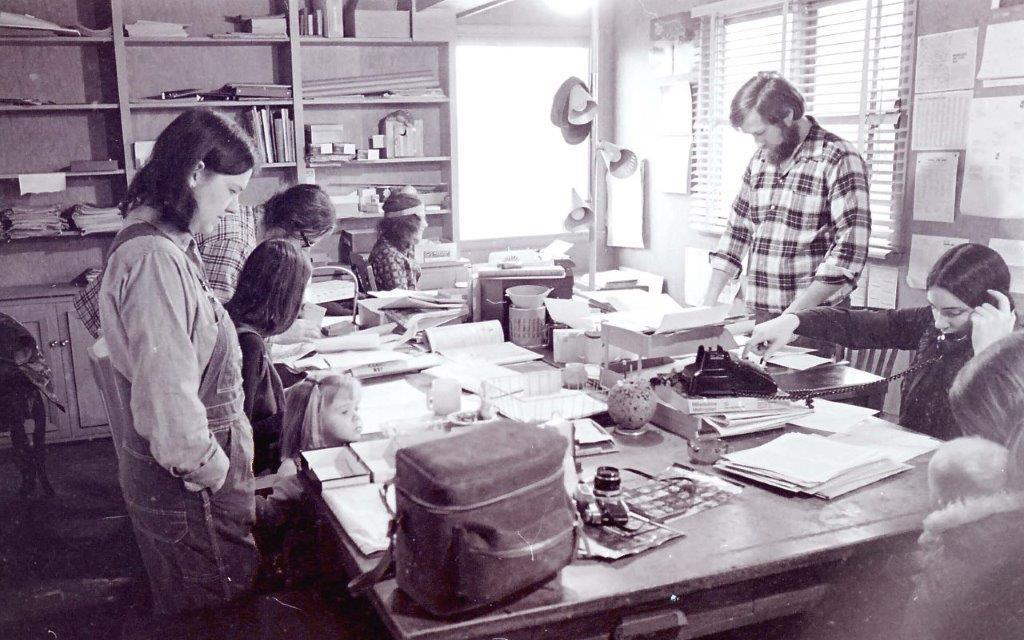
Bugle American staff at work. Photograph by Cathy Gubin, courtesy of Wisconsin Historical Society Press
The Bugle American became successful because it reported on what Milwaukeeans were most interested in: themselves. “It was a real community newspaper, so it really gave voice to the community in Milwaukee,” Sibley said.
The paper was known for its unique coverage of corruption and racism within Wisconsin’s prisons and police departments. It covered the Milwaukee police using brutal force against anti-war protesters, targeting civil rights activists and hippies, and planting weapons on (usually Black) suspects that officers killed for minor crimes.
Thus, the Bugle earned a standing police presence outside of its offices.
The Bugle American had many readers living in Wisconsin prisons and offered them free subscriptions. They published letters and articles written by incarcerated people about their experiences, and featured a special edition on jail and prison conditions.
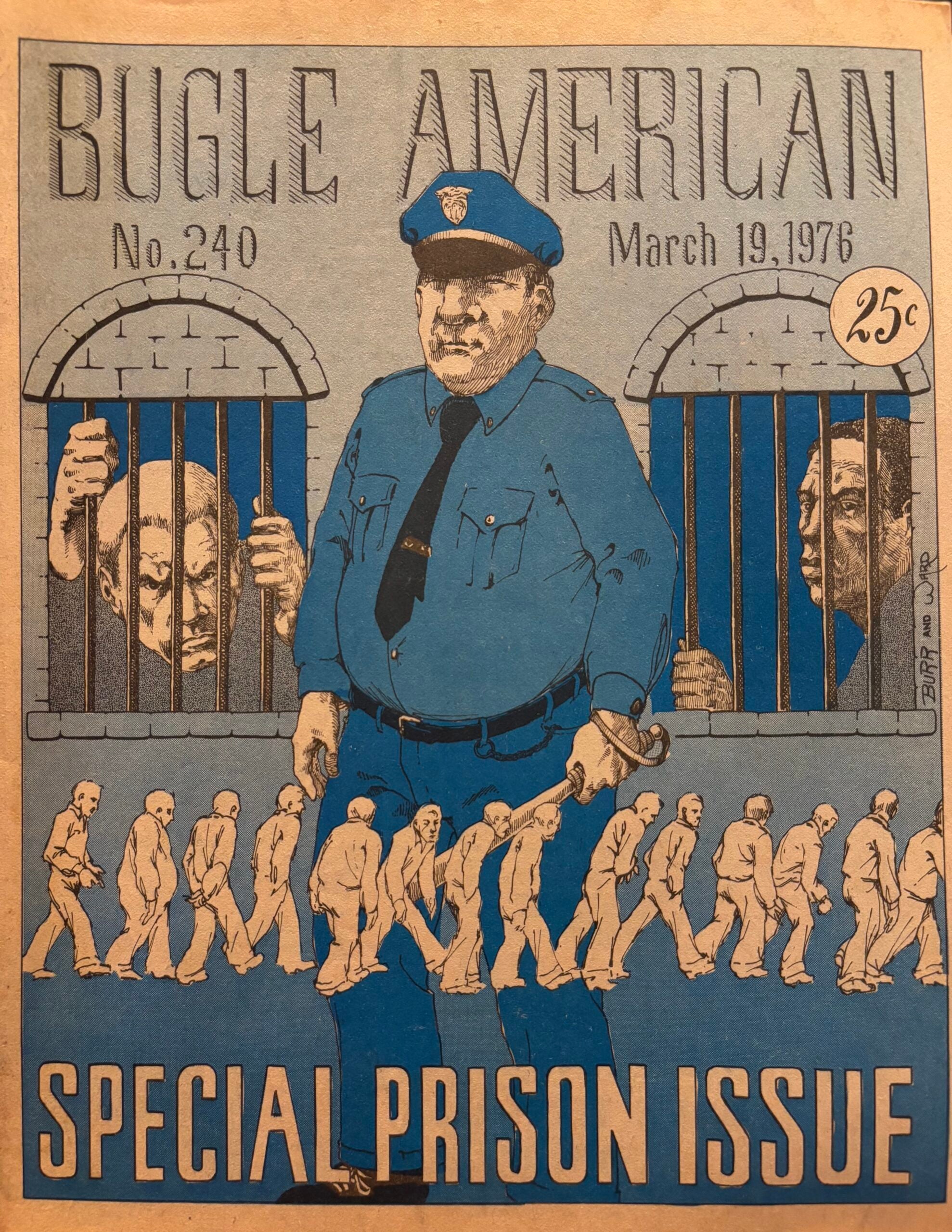
The Bugle American’s special prison issue, March 19, 1976. Cover art by Dan Burr, courtesy of Wisconsin Historical Society Press
After readers within Waupun State Prison wrote to the Bugle about alleged beatings, torture, racial insults, drugging, harassment, torture and even murder, the paper published a special investigation titled, “Cries from the House of the Dead.” Later, the Bugle published first-hand accounts of an under-reported uprising that occurred within, when 87 prisoners took 16 guards hostage, demanding better conditions.
The Bugle was eventually banned within Waupun’s walls.
Music coverage to rival Rolling Stone
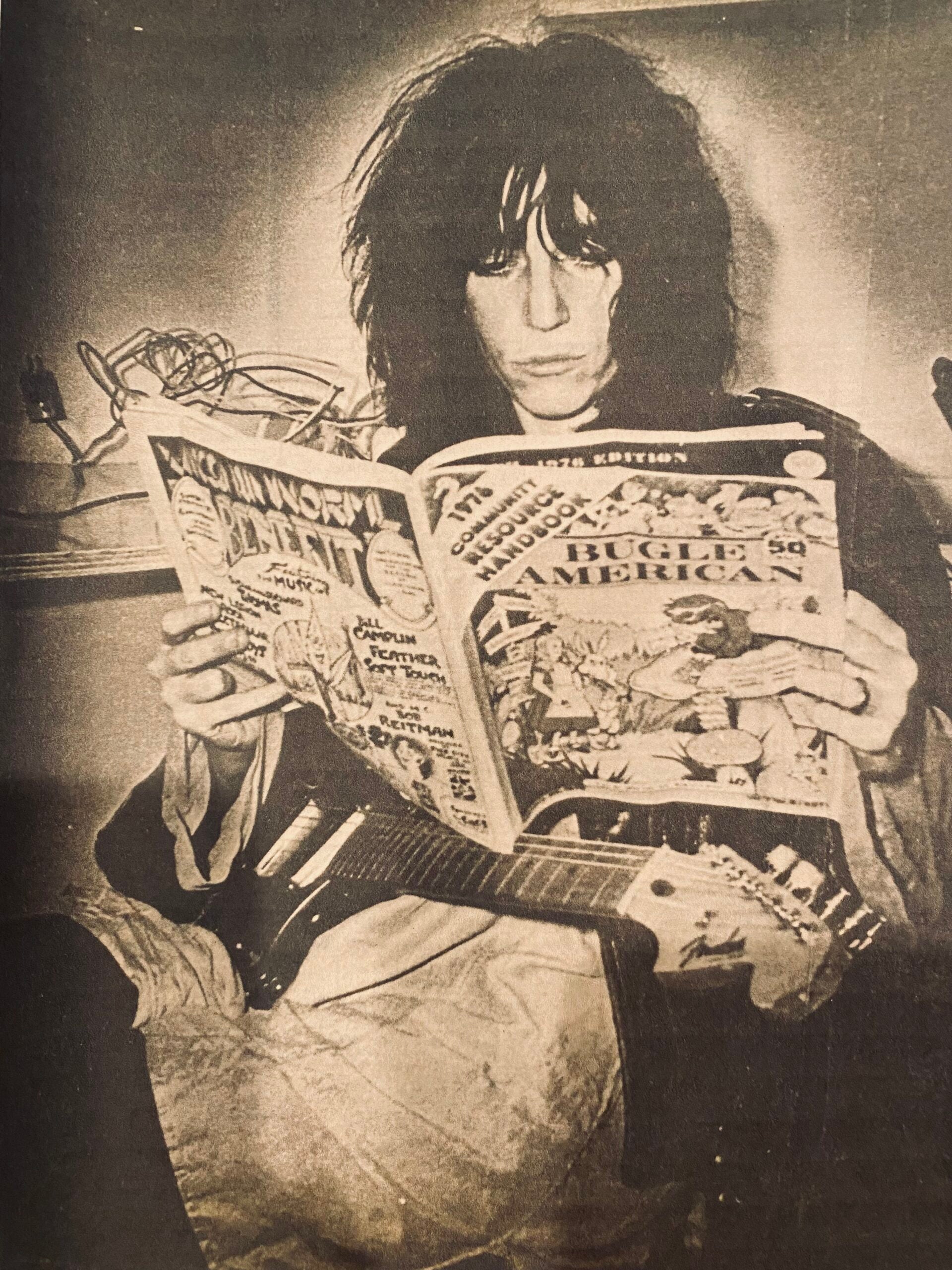
Patti Smith reads the Bugle American in March 1976 while on a tour stop in Milwaukee. “So there she was,” Gary Peterson wrote in his Bugle review of Smith’s concert. “And there we were. But were we ready? I doubt it, for we are never ready for a revolution.” Photo by Mark Goff, courtesy of Wisconsin Historical Society Press
As the Bugle American stood on the cutting edge of politics, its music section grew as well. That was thanks to Randy McElrath, an ad salesman for the Bugle who co-founded a concert production company that hosted some of the biggest artists of the day. It was called Daydream Productions.
“He was able to access backstage passes to all these shows and get the Bugle journalists and photographers in to speak with the big name acts that were coming through. They just had incredible access,” Sibley said.
At one point, Sibley said, the Bugle’s music coverage and photography was rivaling Rolling Stone magazine’s.
One Bugle writer got a three-hour sit-down with Frank Zappa on Thanksgiving Day. Another gave a young Ozzy Osbourne a ride back to his hotel in the trunk of his car. And 17-year-old Bugle photographer Rich Zimmermann found himself in a dressing room full of music legends: Linda Ronstadt, Ramblin’ Jack Elliott, Kris Kristofferson, Richie Havens and Earl Scruggs.
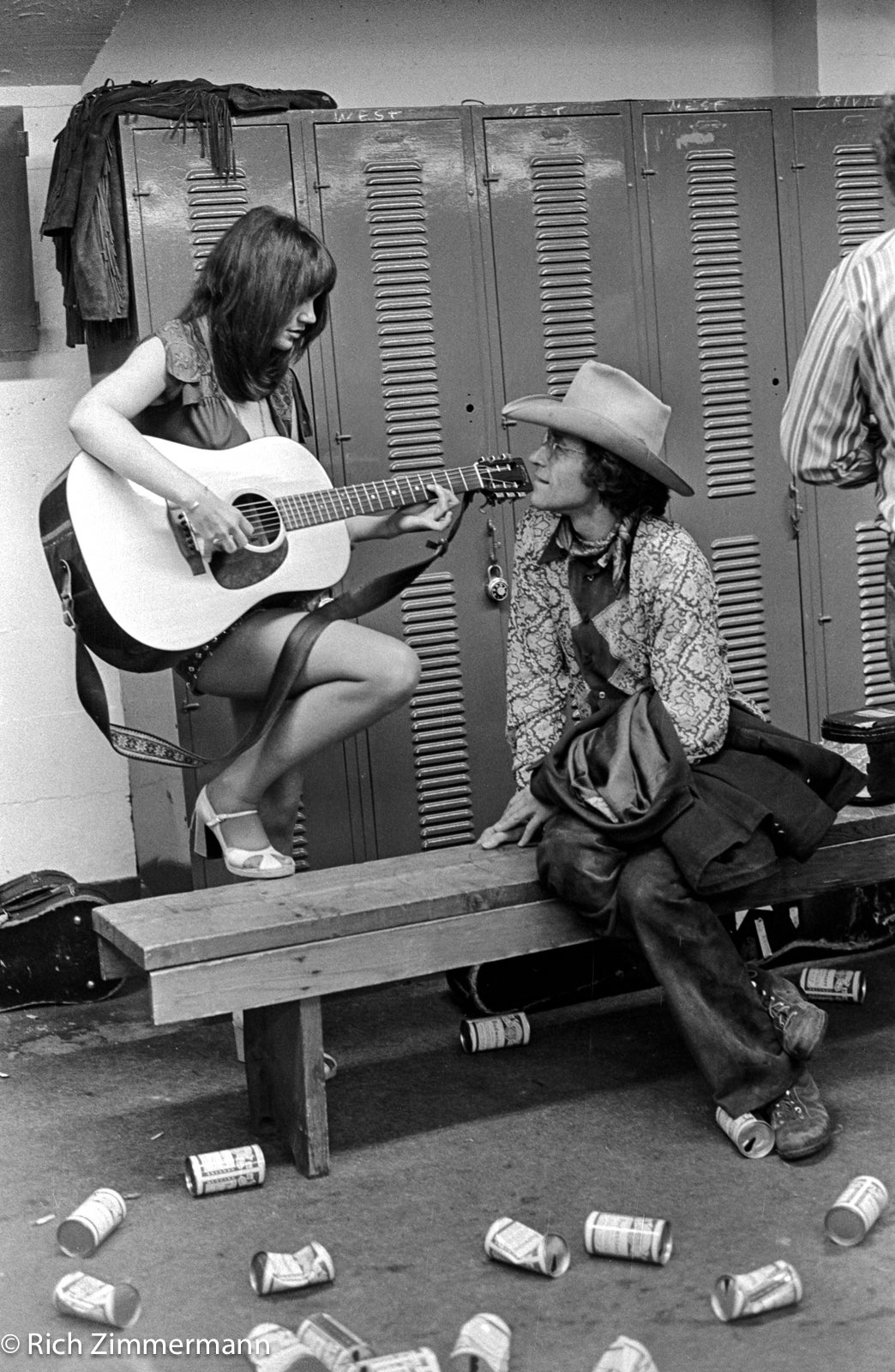
Bugle photographer Rich Zimmerman’s iconic photo of Linda Ronstadt playing to Ramblin’ Jack Elliott. Photo by Rich Zimmermann, courtesy of Wisconsin Historical Society Press
“I learned about tequila that night with Kris Kristofferson,” Zimmermann is quoted in the book.
Bruce Springsteen appeared in the Bugle in 1977 when he agreed to a rare interview — a special exception for 8-year-old Nathan Schaefer, the son of a Bugle staff writer. Schaefer had published a review of a Springsteen performance in the Bugle the previous year, and Springsteen was impressed.
“I don’t talk to nobody else on this whole tour except you. . . . You know that? . . . I ain’t doing any other interviews on the whole tour except with you. Anytime you want to do a story, let me know,” Springsteen told Schaefer in the interview.
Rising from the ashes
In days leading up to the firebombing of the Bugle American offices on Feb. 22, 1975, staff members noted that the Milwaukee police officers who usually watched the offices were no longer there, and someone found pro-Nazi pamphlets that had been stuck through the fence around the Bugle’s parking lot.
The night it happened, six people were sleeping at the offices — including a 20-month-old baby — when a firebomb came crashing in at 2 in the morning. All six escaped with minimal injuries, but a dog perished.
Almost all of the Bugle’s back issues were destroyed, as well as office supplies, desks, chairs and typewriters. The typesetting machine was thankfully intact. Daydream Productions lost most of its records, revenue and supplies. Checks for two upcoming Herbie Hancock and the Headhunters shows were destroyed in the fire, leaving no record of who had purchased tickets.
Even so, the Bugle American survived, thanks to the support of the Milwaukee community. It published the next paper just one day late, with a photo of the burned-out office on the cover.
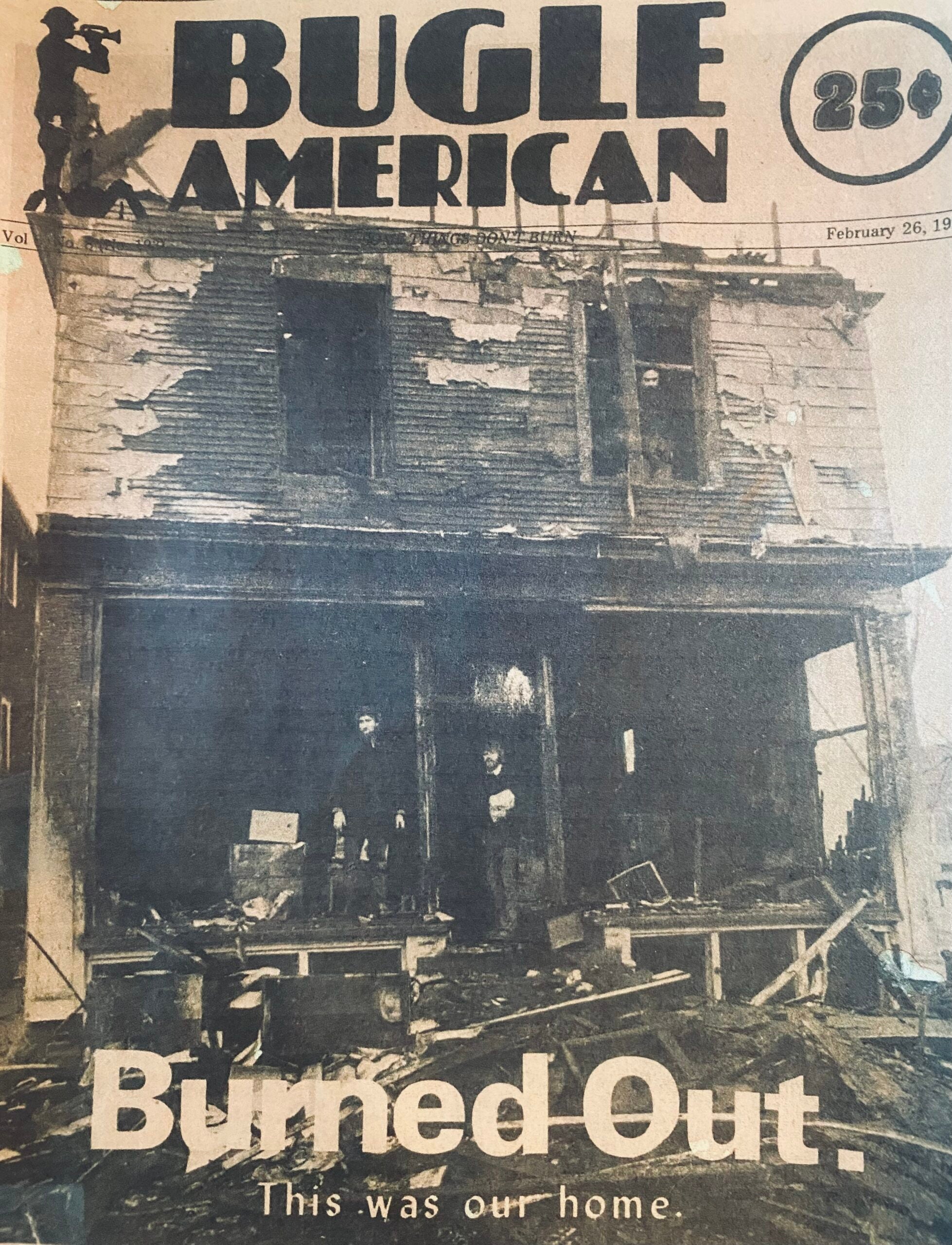
A stark photograph of the Bugle American’s burned-out building appeared on the paper’s Feb. 26, 1975, cover. Inside, Ed Goodman wrote a piece titled, “The Night Our Office Died.” “Arsonists tried to destroy the Bugle last week,” Goodman wrote. “They failed.” Photograph by Mark Goff, courtesy of Wisconsin Historical Society Press
“The people who read and supported the Bugle came out and brought them the back issues and equipment and typewriters, so that they could go ahead and still get that paper together and get it out,” Sibley said. “They continued to publish for another three and a half years.”
The crime of who threw the firebomb was minimally investigated by police and never solved. The Milwaukee police and fire departments never formally reported the fire to the State Department of Justice or the State Fire Marshall’s Office.
Years later, the Bugle got a call from a man claiming to be the firebomber. And Bugle news editor Peter Spielmann has continued to investigate decades later, and hopes that one day the truth will come to light.
“He’s collected quite a bit of evidence that there may have been involvement through Waupun State Prison Guards at the time. He had informants within the prison system and on the police force,” Sibley said. “But there were a lot of theories that maybe the police were behind it, or maybe neo-Nazis.”
The paper continued to publish until December 1978, as the counterculture started to lose steam and the paper lost ad revenue. The cover of its final issue was illustrated by Denis Kitchen, and featured a personified Bugle running from enemies — like “corruption,” “cops” and “big business” — and escaping down a manhole, telling the public, “To HELL with it. YOU fight ‘em.”
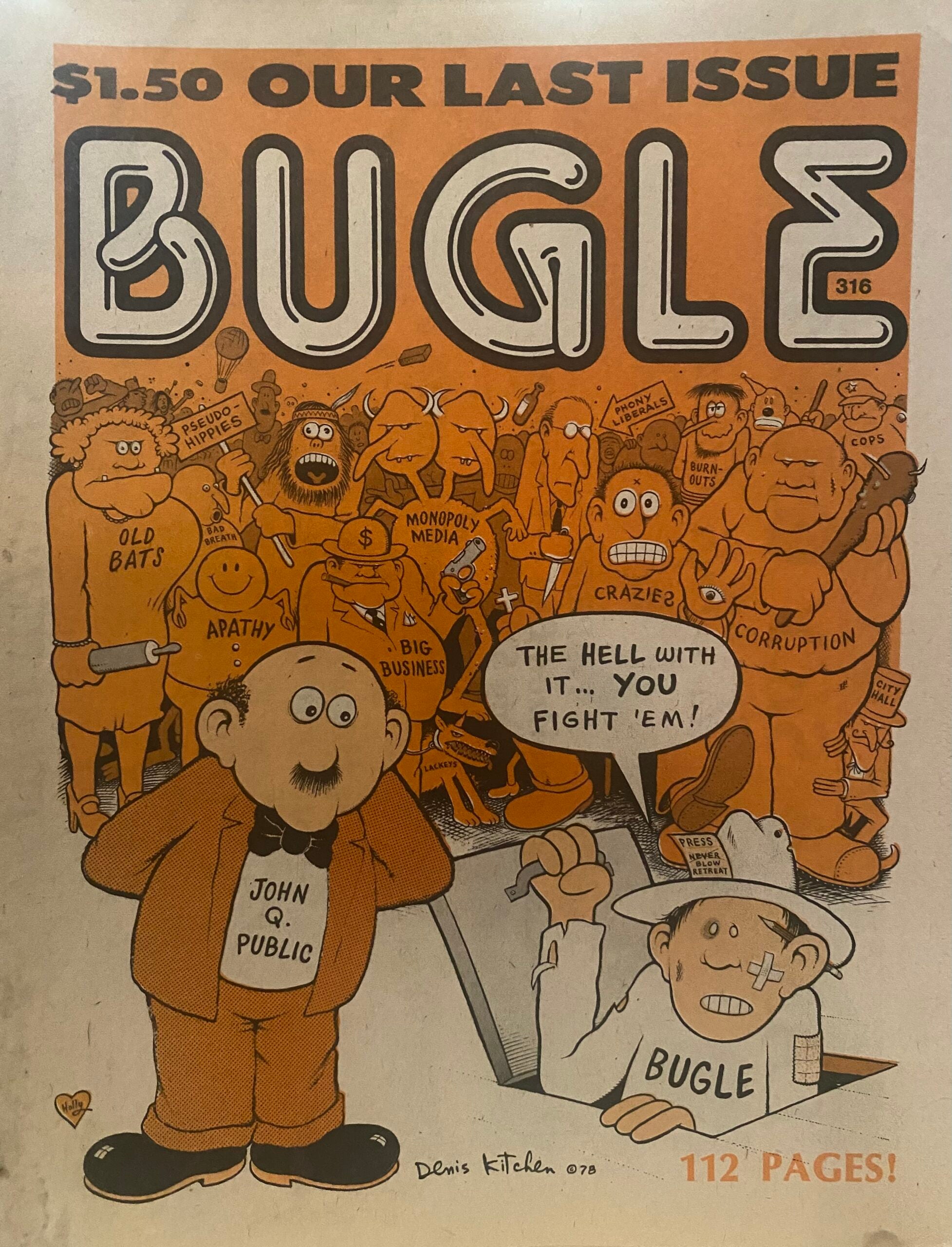
The Bugle American’s final issue, Dec. 10, 1978. Cover art by Denis Kitchen, courtesy of Wisconsin Historical Society Press
In his foreword for Sibley’s book, Kitchen reflected on the paper’s legacy.
“The Bugle’s long and steady survival … is testimony to the dedication of its always underpaid staff, its contributors, and its 20,000 or so readers who relied on the Bugle to champion marginalized voices and challenge mainstream narratives,” Kitchen wrote. “Seven years. Three hundred and sixteen weekly issues. In retrospect, a remarkable accomplishment.”
Editor’s note: This story was updated to reflect that the first issue of the Bugle American was published in September 1970.
This Wisconsin newspaper was firebombed. It still published the next week was originally published by Wisconsin Public Radio.
If you think stories like this are important, become a member of Urban Milwaukee and help support real, independent journalism. Plus you get some cool added benefits.