
Third Wisconsinite Dies of Measles as Cases Ramp Up
918 cases and 19 hospitalizations in state since August, and the first adult dies from measles.
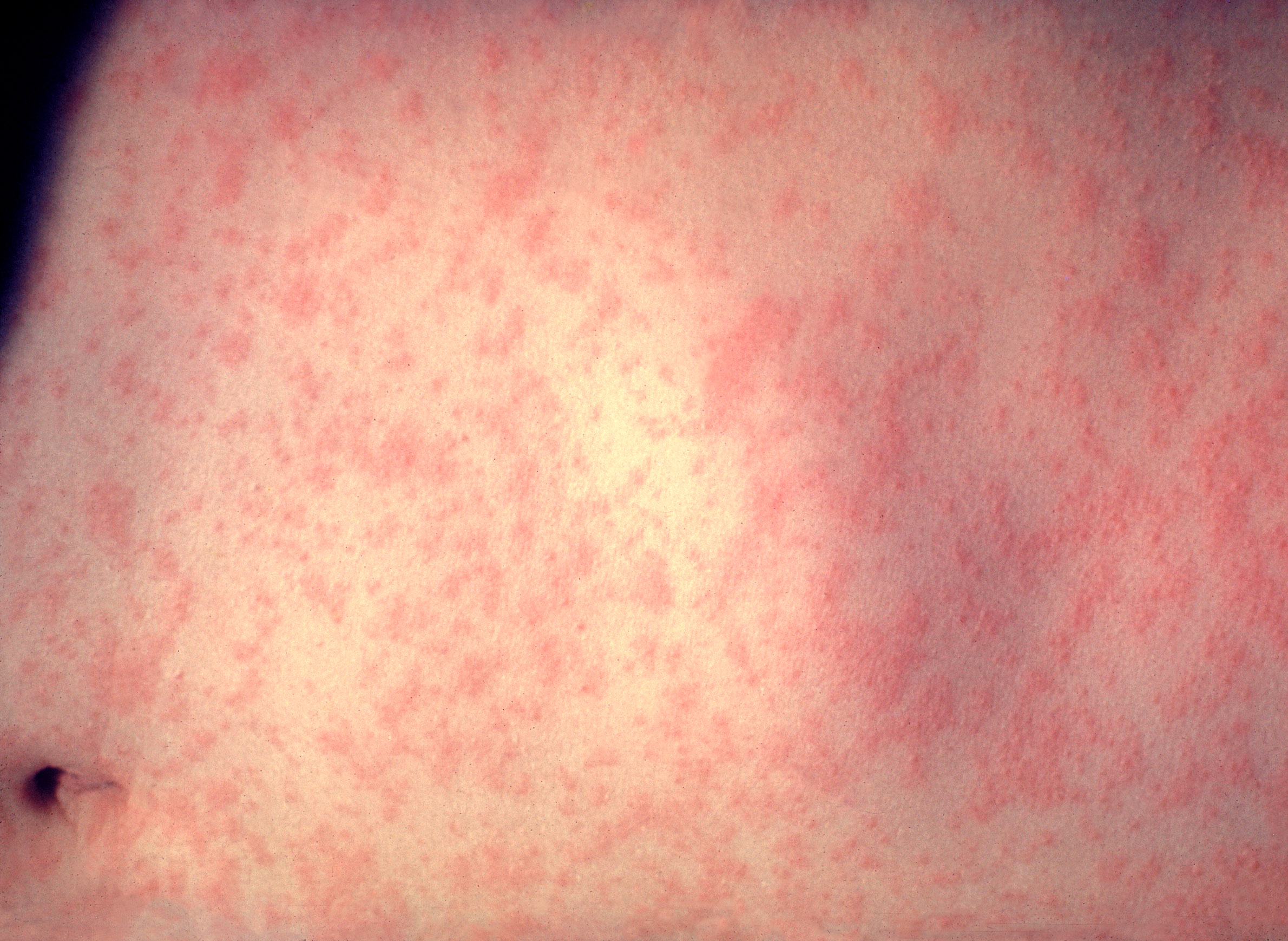
A skin rash is observed on a patient’s abdomen 3-days after the onset of a measles infection. The image was captured at New York Hospital-Cornell Medical Center in 1958. Photo by Heinz F. Eichenwald, MD /CDC Public Health Image Library.
A third Wisconsinite has died of measles as the highly contagious virus continues to spread unchecked.
The state Department of Health Services announced Tuesday an adult in Lafayette County had died. No further details were provided due to privacy concerns.
An infant and a child, both from Grant County, died of measles earlier this month, marking the first deaths from the disease since 1990.
Measles infections in Wisconsin have spiked in recent weeks. There have now been 918 cases and 19 hospitalizations since August. Nearly all cases have been in people who are unvaccinated.
Dr. Ryan Westergaard, chief epidemiologist of communicable diseases at DHS, said unvaccinated people are most at risk as people travel and gather for the Thanksgiving holiday this week.
“As we’ve seen with other communicable disease outbreaks, like COVID and flu, social gatherings, particularly indoors, are the way that outbreaks can become accelerated or expanded,” Westergaard said Tuesday on a call with reporters.
Two doses of the measles, mumps and rubella, or MMR, vaccine in childhood provides lifelong immunity in 97 percent of cases.
The two-dose recommendation started in 1989, and some infectious disease experts have questioned whether adults who received one dose in childhood or a less effective form of the shot given during the mid-1960s should get another shot.
But Westergaard said Tuesday one dose of the vaccine provides strong protection for about 93 percent of people.
“If someone who is in their 30s, 40s or older has gotten a single dose but doesn’t have the records that they received two doses, it is totally safe to get a second dose, and that would increase the probability that they are protected,” he said. “But it is not necessary for most people.”
The state has recommended that babies as young as six months who are at risk of exposure receive an early dose of MMR. The shot is generally given between 12 and 15 months to achieve the best immune response.
People who are older, have chronic conditions, are pregnant and children under age 5 are most at risk for severe complications from measles.
But Westergaard warned that the infection can be severe in anyone and cause pneumonia and swelling of the brain.
“It’s not predictable who’s going to get really, very severely ill,” he said.
DHS is also tracking instances of measles being passed from a pregnant mother to their baby, what’s called congenital measles.
Wisconsin Immunization Program Manager Stephanie Schauer told reporters that 14 people who are or have been pregnant have contracted measles, and there has been one confirmed case of congenital measles.
Measles can cause pregnancy loss, premature delivery, and low birth weight in infants, according to the American Academy of Pediatrics. Infants who survive an infection can experience serious neurologic and immune complications for months to years.
Schauer said the state has seen an increase in the number of infants receiving an early dose of MMR, which was previously only provided to babies who were traveling out of the country.
Wisconsin has reported some of the highest measles activity in the country in recent weeks.
Westergaard said Tuesday that the state has requested additional resources from the Centers for Disease Control and Prevention through a program called Epi-Aid, which the state previously used in August.
“We are going to be receiving additional staff to do case investigation, public communication and management of data,” he said. “We decided to do this now, several months into the outbreak, when it became clear that the outbreak was growing rather than shrinking.”
He said the state wanted to ensure counties seeing new cases emerge have the resources they need to respond.
Twenty-four of the state’s 72 counties have reported measles cases since August.
DHS reported a public exposure to the virus at the Unity Point Health-Meriter emergency department on November 15. It’s the second location in recent months where an unknown number of people have been exposed to the virus.
Third Wisconsinite dies of measles as cases ramp up was originally published by Wisconsin Public Radio.
If you think stories like this are important, become a member of Urban Milwaukee and help support real, independent journalism. Plus you get some cool added benefits.