
City Lines Up Funding To Keep Homes MKE Program Going
Pandemic-era effort has created housing for almost 250 people, tax revenue.
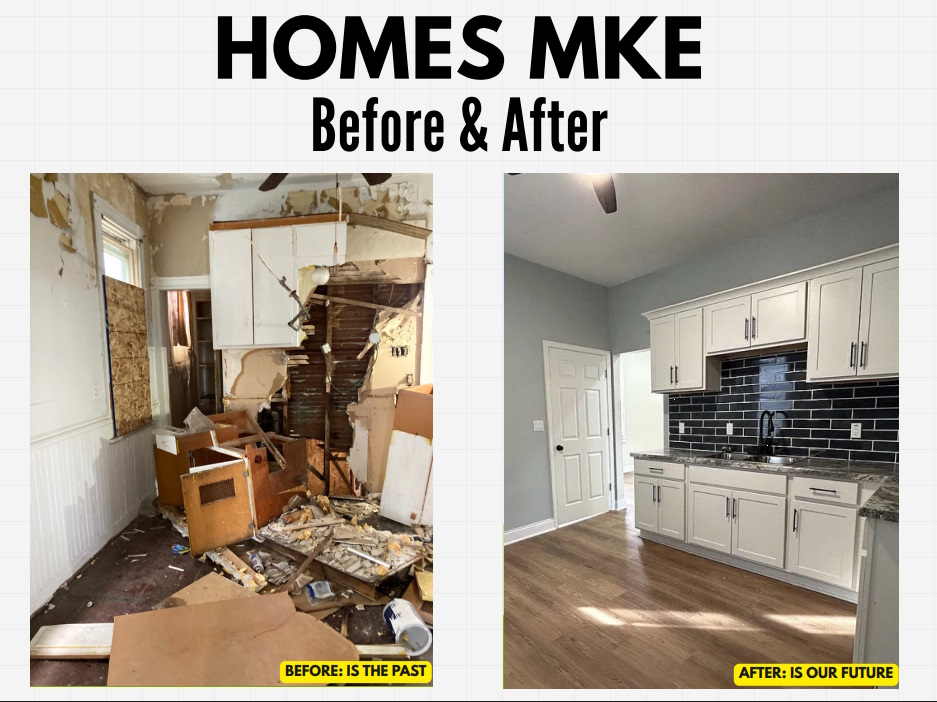
Before and after shot of a house that went through the Homes MKE program. Image from DCD slides.
A city initiative to renovate vacant, tax-foreclosed homes and sell them to owner-occupants will continue even after its federal funding runs out.
Homes MKE, one of the city’s most prominent programs funded by its $394.2 million American Rescue Plan Act allocation, will fall short of its original goal of renovating 150 homes. But the program has returned more than 100 long-vacant properties to productive use, and city officials are preparing to continue the effort with local funding in 2027.
The program launched in 2022 with $15 million, targeting a city-owned inventory of nearly 700 vacant homes. So far, 104 properties containing 125 housing units have been renovated, including several duplexes.
The city provides a reimbursement-based cash subsidy to developers to cover the financial gap between renovation costs and the final sale price.
The average sale price of the first 88 homes has been $165,585.
“There are a number that are on the market and wrapping up this month,” said Larry Kilmer, redevelopment and special projects director with the Department of City Development, to the Zoning, Neighborhoods & Development Committee.
The city’s subsidy has averaged $120,000 per property, Kilmer said, exceeding the original target of $100,000. He showed committee members photographs of properties that had holes in their ceilings or had been stripped of copper wiring before renovation.
“One of the reasons I pushed very hard for this back in 2021 was because I saw it as an alternative to demolition,” said Ald. Robert Bauman, the committee chair. He had initially proposed a $100 million program.
The Milwaukee Water Works partially covered the cost of replacing lead water service lines and the Milwaukee Metropolitan Sewerage District covered the cost of sewer line replacements.
“These are essentially brand new houses with old bones,” said Bauman.
Although Homes MKE does not impose income restrictions on buyers, most of the renovated properties are located in some of Milwaukee’s most economically challenged neighborhoods. Buyers have averaged 63% of the area median income, according to DCD.
Nearly three-quarters of buyers identified as Black, while 10% identified as Latino, 10% as white and 3% as Asian.
According to a presentation Tuesday, the city has already generated $298,230 in property tax revenue from the sold homes. The total will grow as more homes are sold. The total does not include property taxes paid to other entities.
After funding three administrative staff positions and reallocating $498,000 to other ARPA initiatives, a total of $12.66 million has gone directly to developers to renovate homes. Kilmer said a few hundred thousand more dollars would be spent later in November.
All ARPA expenditures must be complete by the end of 2026.
Kilmer said the city plans to continue Homes MKE in 2027 with $1.1 million in local funding, a fraction of the federal allocation that launched the program.
The money would come from three sources, all tied to tax incremental financing districts.
The largest share, $500,000, was previously earmarked to help homeowners make emergency repairs following the August 2025 floods. The city ultimately did not need the money after the Federal Emergency Management Agency (FEMA) provided assistance to affected homeowners.
Another $500,000 would come from higher-than-anticipated revenue generated by expiring tax incremental financing districts, while the remaining $100,000 would come from funds set aside for affordable housing following the 2021 closure of the Beerline district, also the original source of the flood funds.
“We do have to take a little bit of time still this year to figure out exactly how to administer [the program], how we want it to look,” said Kilmer. “I can’t imagine it looks too different.”
Kilmer said Homes MKE is itself a successor to several earlier city efforts to renovate tax-foreclosed homes, including the Milwaukee Employment/Renovation Initiative (MERI). The city has worked with emerging developers through several iterations of the program, but Homes MKE’s federal funding allowed it to operate on a substantially larger scale.
According to a 2025 report, the developers that ultimately participated in the program are Acts Community Development, Advance Investors, Ezekiel Community Development Corp., Financial Freedom, Maures Development Group, a partnership of One 5 Olive and the Milwaukee Community Land Trust, a partnership of Rico Love Foundation and Mayfield Properties, Servant Manor, T.A.S. Solutions, Walnut Way Conservation Corp., Strong Blocks, CME Development, the Martin Luther King Economic Development Corporation, and Walters Renovations.
Unless the property is sold to an owner-occupant, the house must be developer-owned for at least five years. Seventy-seven of the 88 sold houses have been sold directly to owner-occupants, with 11 homes renovated by Strong Blocks included in a rent-to-own program. A deed restriction requires a sold property to be owner-occupied for five years, and owners are required to complete eight hours of home-buyer counseling through either Acts Housing, Housing Resources, Inc. or the United Community Center.
To access the workforce subsidy included in the program, a developer’s workforce must include a minimum of 300 hours of work completed by unemployed or underemployed city residents. In addition, at least 50% of the work must be completed by employees residing in the following ZIP codes: 53204, 53205, 53206, 53208, 53210, 53212, 53215, 53218 or 53233. A living wage of at least $12.21 per hour must be paid.
The program’s future will depend in part on whether the city can continue to justify substantial subsidies for individual homes. But the alternative, Bauman suggested, is often leaving properties vacant and eventually demolishing them.
Legislation Link - Urban Milwaukee members see direct links to legislation mentioned in this article. Join today
If you think stories like this are important, become a member of Urban Milwaukee and help support real, independent journalism. Plus you get some cool added benefits.
More about the Homes MKE program
- City Lines Up Funding To Keep Homes MKE Program Going - Jeramey Jannene - Nov 19th, 2026
- Sherman Park, 10 Years Later – Promise, Progress And Gaps - Meredith Melland - Aug 15th, 2026
- Community Land Trust Celebrates New ‘Forever Affordable’ Homes - Jeramey Jannene - Jul 14th, 2025
- Homes MKE Putting First-Time Buyers Into Rehabbed Homes - Nick Rommel - Nov 21st, 2024
- Homes MKE program, investment in affordable housing shows promising results - Ald. Bob Bauman - Jan 10th, 2024
- Friday Photos: Ezekiel CDC Shows Off Foreclosed Home Rehabilitation - Jeramey Jannene - Oct 27th, 2023
- Eyes on Milwaukee: Work Starts on Redeveloping 150 Vacant Homes - Jeramey Jannene - Apr 19th, 2023
- Eyes on Milwaukee: First “Affordable Forever” House Available From Community Land Trust - Jeramey Jannene - Dec 8th, 2022
- Mayor Cavalier Johnson Signs Resolution to Advance Homes MKE Initiative - City of Milwaukee Department of City Development - Sep 28th, 2022
- Committee approves file advancing Homes MKE Program - Michael Murphy - Sep 13th, 2022
Read more about Homes MKE program here