
Evers Revives Commutations, But Wisconsin Prisons Hit Record High
Governor trims time for 14 people even as the state now holds about 23,900 adults behind bars.
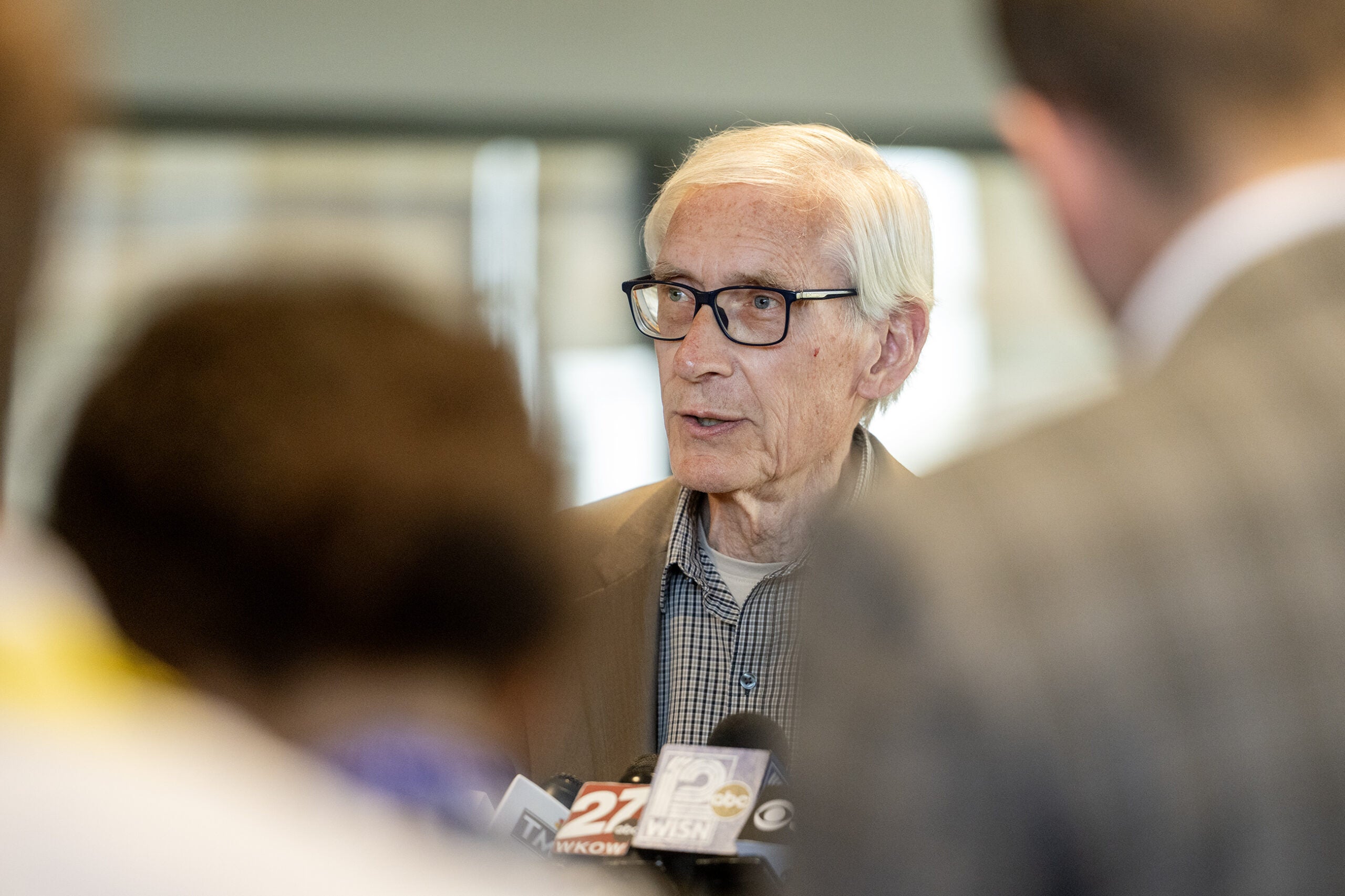
Gov. Tony Evers addresses reporters during a school visit Monday, May 11, 2026, in Barneveld, Wis. Angela Major/WPR
Wisconsin’s outgoing Democratic Gov. Tony Evers is shortening the criminal sentences for more than a dozen people, according to an announcement from his office on Friday afternoon.
The decision marks the first time that a Wisconsin governor has handed down commutations since 1995.
Under the Wisconsin Constitution, governors have the power to cut short someone’s time in prison or on probation, parole or extended supervision by handing out commutations. But, for decades, both Democratic and Republican governors in this state have allowed that power to sit untouched. Before Evers, the last Wisconsin governor to grant commutations was Republican Tommy Thompson.
On Friday, Evers announced commutations for 14 people, whose convictions run the gamut from burglary to armed robbery to first-degree intentional homicide. More than half a dozen of those people were convicted of crimes committed when they were teenagers.
All of those 14 people had their commutations recommended to the governor by a newly created Commutation Advisory Board. An additional 10 people also had hearings before that board, but Evers denied their commutation applications.
Under executive orders put out by Evers, the Commutation Advisory Board was directed to prioritize several factors, including an applicant’s personal growth, how a commutation would affect crime victims and how that person’s release would impact public safety.
Evers’ decision does not mean that those 14 people will immediately be released into the community. In some instances, people who recently got commutations still have to serve more years in prison, although Evers has agreed to shorten the length of confinement that’s mandated before those people can apply for parole or be eligible for extended supervision.
When he announced the creation of a Commutation Advisory Board earlier this year, Evers said certain crimes would not be eligible, including sexual assault and child abuse. The governor also said that, in order for a commutation to be granted, people had to have served at least half of their incarceration term, or at least 20 years of a life sentence.
Evers will leave office in January, and he could issue additional commutations before then.
Evers has been governor since 2019, but chose not to run for another four-year-term. His successor, Democrat David Crowley, has praised Evers for restarting the commutation process.
When he was first campaigning for governor, Evers said he wanted to decrease the state’s incarcerated population.
But, as of this year, Wisconsin’s prison population grew to its highest level ever. There are now roughly 23,900 adults locked up in state prisons.
Evers has blamed the Republican-controlled Legislature for fueling the state’s growing prison population by blocking many of his criminal justice reform proposals. That Legislature will shift to Democratic control in January.
Evers grants Wisconsin’s first commutations in decades was originally published by Wisconsin Public Radio.
Political Contributions Tracker
Displaying political contributions between people mentioned in this story. Learn more.