

Council Approves $1.35 Million to Study We Energies Takeover
Unanimous vote advances effort to create publicly owned electric utility.
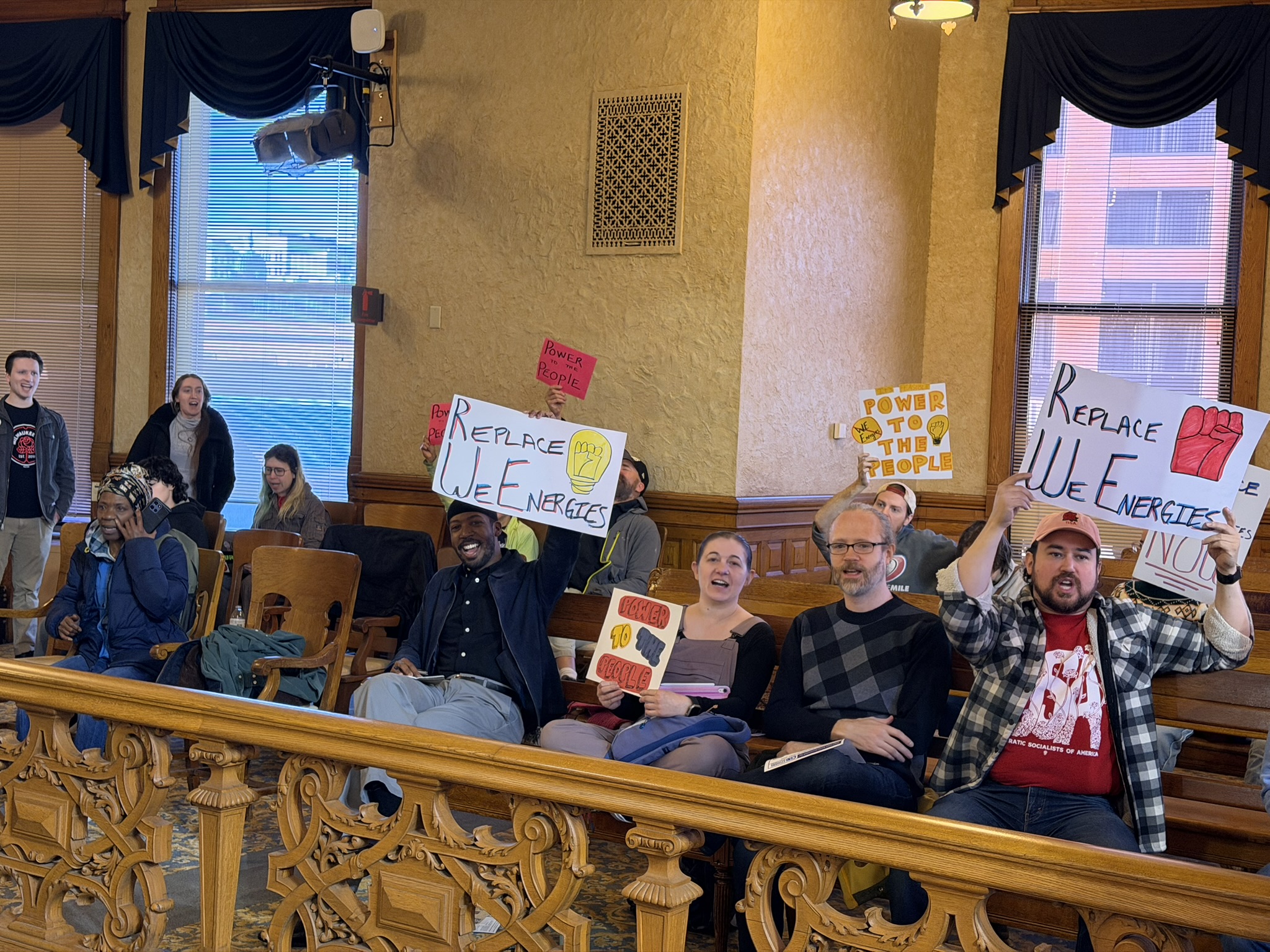
Power to the People campaign at Milwaukee City Hall. Photo by Jeramey Jannene.
The Milwaukee Common Council voted unanimously Friday to authorize up to $1.35 million in borrowing to study replacing We Energies with a city-owned electric utility, a major victory for a grassroots campaign seeking to transform how Milwaukee residents receive electricity.
The 15-0 vote came during the council’s debate over the city’s 2027 budget and followed an extended discussion about rising electricity costs, corporate profits and the feasibility of a public takeover.
The proposal, which remains subject to a potential veto by Mayor Cavalier Johnson, does not authorize the city to purchase or condemn any We Energies infrastructure. Instead, it would fund a feasibility study to determine whether a publicly owned electric utility would be financially and operationally viable.
“It’s the first step in owning our grid and replacing We Energies,” said Ald. Alex Brower, the proposal’s leading advocate.
Brower, who made municipal ownership of the electric utility the centerpiece of his successful 2025 campaign for alderman, acknowledged the substantial price tag.
“$1.35 million sounds like a lot of money,” he said, but argued that comparable studies in other cities have been more expensive. “Feasibility studies cost money, they don’t just come for free.”
The borrowing would be repaid over approximately five to six years, according to Brower.
The proposal, Amendment 92B, directs the city to solicit outside expertise by Feb. 1, 2027. At the suggestion of Ald. Milele A. Coggs, spending would be restricted until the city receives responses to its request for information or qualifications from potential consultants.
A task force would guide the study, with Brower envisioning representation from the Common Council, community organizations and organized labor.
“If this does pass today, there is still a lot of work in front of us,” said Brower.
The council’s unanimous endorsement represented a reversal from the Finance & Personnel Committee’s consideration of an earlier version of the proposal, which failed on a 2-2 vote. Alds. Scott Spiker and Peter Burgelis, who opposed the earlier amendment, supported the revised version Friday.
Spiker compared the $1.35 million authorization to the cost of a single fire truck. He said he supported the council’s desire to examine the issue, even though the study could ultimately demonstrate that a takeover is not feasible.
Ald. Robert Bauman, who chaired a three-hour public hearing on the proposal in June, also backed the measure.
“I want to commend Alderman Brower for his initiative on this subject,” said Bauman, who acknowledged that many questions remain unanswered.
“We want details,” he said. “At the end of the day it may come back that this is too expensive for the city to afford so it’s best that we adopt a different approach, but we need answers.”
The debate came less than a day after the state Public Service Commission approved another increase in We Energies rates. The commission reduced the utility’s requested increase, but the final rates have not yet been determined.
Alderwoman Marina Dimitrijevic said the continued increases and frequent complaints about power outages made the study worthwhile.
“It’s too expensive not to explore this,” she said.
Dimitrijevic cited a Citizens Utility Board analysis indicating that We Energies customers have faced cumulative rate increases of approximately 33% in recent years. She criticized the reaction to the Public Service Commission’s decision to reduce the latest proposed increase.
“We’re somehow now so downtrodden that we have to celebrate that it was less of an increase,” she said.
She said her priority was not only lowering utility bills, but providing electricity in an environmentally responsible way.
“My number one goal … is to supply not only more affordable energy to folks … but we have to do it in the cleanest way possible,” she said.
Brower argued that a public utility could eliminate the need to generate profits for private shareholders. He alleged that approximately one of every six dollars customers spend with We Energies goes toward company profits, though the figure is closer to the gross profit margin of parent company WEC Energy Group than the utility’s own profit margin.
He compared his vision to the city-owned Milwaukee Water Works, which generates revenue for city services rather than distributing profits to shareholders.
“We want to have one person, one vote, not whoever owns the shares gets as many votes as the number of shares they have,” Brower said. “That’s undemocratic.”
Other council members framed the vote as a means to pressure We Energies, regardless of whether the city ultimately proceeds with a takeover.
“At the very least, if we engage in this, let’s say it does fail … passing this feasibility study right now and voting yes is a shot across the bow at We Energies,” said Brower.
“If this amendment fails We Energies will know their power is cemented in this city and they can charge whatever they want,” he said.
Ald. JoCasta Zamarripa, who also called the vote “a shot across the bow,” said the city has struggled to hold We Energies accountable, including over the utility’s unpermitted closure of city streets.
Ald. Russell W. Stamper, II, reacting to the new rate increase, said, “Either they’re not worried about us or they’re daring us, either way I don’t like the disrespect.”
Ald. Larresa Taylor praised Brower’s persistence in advancing the proposal.
“Growth is discomfort, but stagnation is worse,” she said.
Coggs called the feasibility study a first step toward giving the city the option of a public takeover. Several council members signed on as cosponsors, and Ald. Mark Chambers, Jr. sought unanimous sponsorship of the measure but Spiker objected.
The vote was greeted by chants of “people over profit” from supporters in the council gallery.
A Long Road Ahead
The vote marks the most significant city financial commitment yet to the Power to the People campaign, which launched in December 2022.
The campaign seeks to replace the investor-owned electric utility with a public system that would be accountable to residents rather than shareholders.
Wisconsin law already provides a process for municipalities to purchase or condemn electric utility infrastructure, but the process could take years and involve substantial litigation.
At the June hearing, attorney Kat Grant of Madison-based Pines Bach explained that the city could acquire equipment serving Milwaukee customers, but an appraisal process involving the Public Service Commission and state courts would determine its value if the parties could not agree on a price.
The city would also need to determine how it would purchase electricity, maintain the distribution system and employ the workers necessary to operate it.
Representatives of IBEW Local 2150, which represents workers maintaining the existing system, previously warned that a takeover could create operational problems and jeopardize worker protections.
Supporters argue that the city could finance a purchase through revenue bonds backed by future utility payments, rather than general city tax revenues. Several Wisconsin municipalities, including Manitowoc, Cedarburg and Oconomowoc, already own electric utilities.
A referendum would ultimately be necessary before Milwaukee could proceed with a takeover.
Brower acknowledged Friday that the effort could face substantial political and legal resistance, including the possibility of changes to state law.
“I think we should expect nothing less than a change to state statute to prevent Milwaukee from doing this,” he said.
For now, however, the proposal represents an opportunity to answer questions that have lingered since the campaign began.
“I would encourage everyone to give this the oxygen, the examination that it needs,” said Brower. “We need to know more, people want to know more about what’s going on.”
Whether the city gets the opportunity to commission that study now rests in part with Johnson, who could veto the proposal. Brower encouraged his colleagues to be prepared to override the amendment.
A spokesperson for Johnson did not immediately respond to a request for comment.
We Energies Responds
In a statement issued shortly after the vote, We Energies responded to the council’s action.
“We share the Common Council’s concern about energy costs, and we work every day to keep bills as low as possible while providing customers with the reliable energy they depend on. But spending $1.35 million to study a city takeover is the wrong path for Milwaukee,” said a spokesperson in a statement. “Cities that have explored this have found it can cost billions of dollars, take years and put customers at risk. Ann Arbor spent about $500,000 studying the idea, and this week its voters rejected a proposal to create a city-run electric utility. On top of the multi-billion-dollar purchase price, a city-run utility could face more than $100 million a year in operating costs. Those costs, and the risk during storms and outages, would fall on Milwaukee customers alone.”
“We have served Milwaukee for more than 125 years. We invest in the local grid every year, partnered with the city on the largest solar project in Milwaukee history and have given more than $13 million to local nonprofits through our foundation – funded by shareholders, not customers,” said the spokesperson. “We’ll keep working with city leaders on what matters most: reliable, affordable energy for Milwaukee.”
If you think stories like this are important, become a member of Urban Milwaukee and help support real, independent journalism. Plus you get some cool added benefits.
More about the 2027 City of Milwaukee Budget
- Council Rewrites Mayor’s Budget, Setting Up Potential Veto Fight - Jeramey Jannene - Nov 6th, 2026
- Council Approves $1.35 Million to Study We Energies Takeover - Jeramey Jannene - Nov 6th, 2026
- $2 An Hour Or 2%? Council Rewrites City Worker Pay Plan - Jeramey Jannene - Nov 6th, 2026
- Finance Committee Wraps Budget Amendment Day After Nearly 12 Hours of Debate - Jeramey Jannene - Oct 30th, 2026
- Dimitrijevic’s Budget Amendment Restores Library Hours, City Worker Pay - Jeramey Jannene - Oct 28th, 2026
- Council Members Want To Bill MPS For City Attorney’s Time - Jeramey Jannene - Oct 13th, 2026
- Milwaukee’s Financial Strains Growing, Warns Policy Forum - Jeramey Jannene - Oct 9th, 2026
Read more about 2027 City of Milwaukee Budget here
More about the Power to the People campaign
- Council Approves $1.35 Million to Study We Energies Takeover - Jeramey Jannene - Nov 6th, 2026
- Finance Committee Wraps Budget Amendment Day After Nearly 12 Hours of Debate - Jeramey Jannene - Oct 30th, 2026
- ‘Power to the People’ Over We Energies? Issue Comes to City Hall - Jeramey Jannene - Jun 24th, 2026
- Proposed Takeover of We Energies Will Get City Hall Hearing - Jeramey Jannene - Jun 9th, 2026
- Milwaukee DSA and allies to deliver 10,000 public power petitions to City Hall - Milwaukee Democratic Socialists of America - Apr 30th, 2025
- Brower Waxes Anti-Capitalist In First Council Speech - Jeramey Jannene - Apr 22nd, 2025
- Brower Helps Get Milwaukee $1,000 From We Energies - Jeramey Jannene - Apr 9th, 2025
- Can Milwaukee Buy We Energies? - Jeramey Jannene - Mar 24th, 2025
- MTEA Announces support for the Power to the People Campaign to replace We Energies - Milwaukee Teachers’ Education Association - Nov 10th, 2023
- Advocates Push for City-Owned Public Utility - Evan Casey - May 16th, 2023
Read more about Power to the People campaign here
Political Contributions Tracker
Displaying political contributions between people mentioned in this story. Learn more.
- April 23, 2019 - JoCasta Zamarripa received $100 from Peter Burgelis
- February 20, 2016 - Cavalier Johnson received $250 from Robert Bauman
- February 13, 2016 - Milele A. Coggs received $10 from Larresa Taylor