
$21 Billion At Stake As Invasive Carp Barrier Sits In Limbo, Democrats Warn
Fishing and boating industries could be hit hard if carp breach the Chicago waterway and reach Lake Michigan, advocates say.
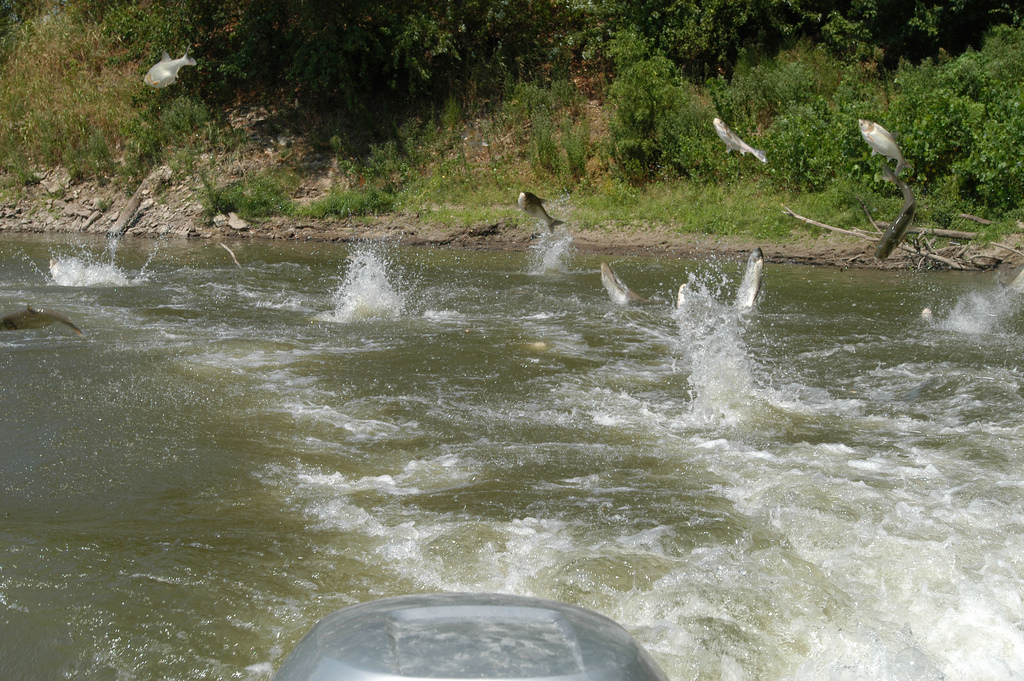
School of Jumping Silver Carp (A invasive of Asian Carp). Photo by Jason Jenkins. (CC BY 2.0)
U.S. Senate Democrats are urging the Trump administration to end delays on a key project to keep invasive carp out of the Great Lakes, warning the fish could gain a foothold and threaten the regional economy.
In July, the U.S. Army Corps of Engineers paused work for the second time on the $1.15 billion Brandon Road Interbasin Project that aims to block invasive carp from reaching the Great Lakes. Democratic lawmakers, including Wisconsin U.S. Sen. Tammy Baldwin said in a Sept. 22 letter that the stop work order this summer came without any clear explanation or warning to state partners.
The pause for administrative review came just weeks before sampling crews discovered hundreds of small silver carp about 80 miles from Lake Michigan in August, the farthest north juvenile fish have been detected since monitoring began in 2010.
“Our Great Lakes are a tremendous asset to our quality of life and our economy in Wisconsin,” Baldwin said in a statement. “The threat of invasive carp is becoming increasingly urgent as they move closer to Lake Michigan. Without action, we will be dealing with irreversible damage to our waters, native fish, and local economies. We have a solution to stop this threat, and there is no time for another pause or any more delays from the President.”
The White House referred questions to the Army Corps, which did not respond to a request for comment on the letter and project delays.
President Donald Trump has previously directed his administration to act with “maximum speed and efficiency” on the project. Joel Brammeier, president and CEO of the Alliance for the Great Lakes, said the most recent six-week delay is clearly the opposite of Trump’s directive. He said lawmakers have a right to know about progress on the project and the reasons behind delays.
“There have been individual adult carp found closer to Lake Michigan before, but the spawning activity really tells you that the front of the invasion is advancing, and it’s getting closer to establishing in the Great Lakes,” Brammeier said. “That’s why we were so concerned.”
Invasive carp threaten the roughly $5 billion Great Lakes fishing industry, as well as the $16 billion recreational boating industry. The invader can gobble up meals that native fish, including walleye and lake trout, rely on for food. Brammeier said the fish has also been known to break bones or knock people unconscious when they leap out of the water.
Invasive carp are notorious for leaping up to 10 feet in the air when disturbed by noise.
The project at the Brandon Road Lock and Dam includes installation of underwater defenses on the Des Plaines River near Joliet, Illinois. The goal is to keep invasive carp from getting into the Chicago Area Waterway System that connects the Illinois River to Lake Michigan. The barrier will use noisemakers, a bubble curtain, an electric barrier and a flushing lock to block the fish.
Congress had already provided $274 million for the project with another $28 million invested this year. Illinois and Michigan are also putting $50 million and $64 million respectively toward the project. Sara Walling, water and agriculture program director for Clean Wisconsin, said any delay is putting the Great Lakes fishery and ecosystem in jeopardy.
“My hope is that calls to action like this and questions from elected officials to the administration will further help them recognize that we are paying attention,” Walling said. “These projects that really are extremely important for a number of reasons — not just environmentally, but economically — really need to be prioritized and given the resources that are needed to get them completed.”
Brammeier and Walling said the Great Lakes have already faced challenges with the introduction of zebra and quagga mussels — which can damage power plants, water systems, boats and docks — as well as round gobies. It costs an estimated $500 million a year to manage zebra and quagga mussels alone.
Lawmakers are calling for a meeting to discuss the circumstances around the most recent pause in construction, and they’re urging the administration to be more transparent with non-federal sponsors of the project in advance of any changes.
Great Lakes lawmakers say delays on invasive carp barrier threaten ecosystems, economy was originally published by Wisconsin Public Radio.
If you think stories like this are important, become a member of Urban Milwaukee and help support real, independent journalism. Plus you get some cool added benefits.