Committee Endorse Removing Flock from Parks
Issue has bipartisan support, but Sheriff's Office objects.
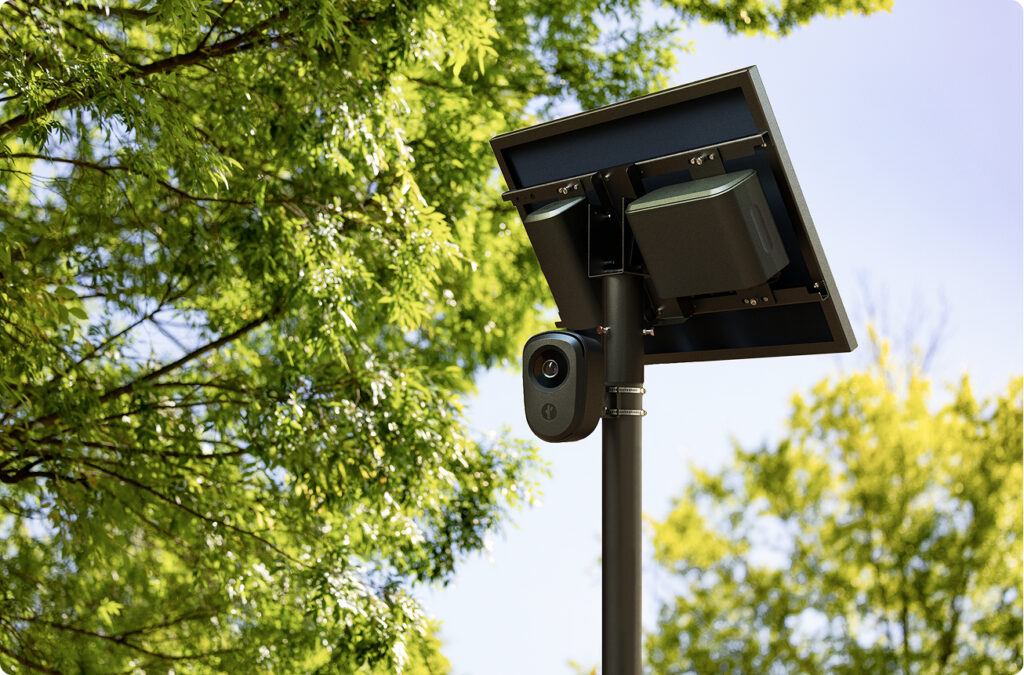
(Photo courtesy of Flock Safety)
Milwaukee County supervisors voted in favor of removing Flock cameras from Milwaukee County Parks on Tuesday.
The Committee on Parks and Culture voted unanimously Tuesday to pass a resolution led by Sup. Justin Bielinski, directing Parks to remove all Flock Safety camera systems, including automated license plate reading (ALPR) cameras and Condor pan, tilt, zoom cameras.
The resolution aims to keep ALPR and other surveillance technology out of Milwaukee County Parks until the county has policies or safeguards in place to ensure accountability and protect local residents’ civil rights. Bielinski said he would like to see a judicial warrant become the standard for searching an ALPR system.
The controversial surveillance cameras are capable of reading and storing license plate numbers in a searchable database. Law enforcement officers can also search for a vehicle by make, model or aftermarket modifications like a roof rack or bumper sticker, according to the Milwaukee County Sheriff’s Office.
The technology is “ripe for misuse,” Bielinski said, noting that a number of Wisconsin communities have investigated law enforcement officers for abusing the technology. Three Milwaukee Police Department officers have been investigated for improperly using Flock cameras, including one officer who investigated another officer for stalking his ex-girlfriend through the Flock system. U.S. Immigration and Customs Enforcement has also used the cameras for immigration operations.
“Big tech is a bad actor. This company is a bad actor,” Bielinski said.
There are currently 42 Flock cameras located in 11 county parks. The Milwaukee County Sheriff’s Office operates most of them, with 25 Flock ALPR cameras and six Flock Condor cameras, which do not have ALPR but can be controlled by MCSO personnel to track people or objects. There are also another six Flock cameras on county roads and equipment operated by municipal police departments.
“We have a lot of people that are afraid to go to the parks now because of these things,” said Sup. Juan Miguel Martinez.
MCSO Chief Deputy Brian Barkow advocated for maintaining the agency’s Flock cameras in parks, arguing they are a useful tool for investigating and deterring crime. He also said instances of Flock misuse by law enforcement are rare.
“If the board chooses to vote and remove this technology without a clear plan going forward, I can guarantee you that crime will increase,” Barkow said. “Where these cameras exist in those parks, they are extremely vulnerable and susceptible to crime because of what goes on in and around them, that’s not going to change, unfortunately, anytime soon.”
Barkow said MCSO is not actually able to track individuals with the number of Flock cameras it has, because ALPR cameras only take pictures of vehicles at a specific point in time. The technology can tell investigators if a suspect vehicle has not left the county. MCSO no longer shares any Flock data with other agencies, and it has reduced the amount of time it retains data from 30 days to seven days.
MCSO has used Flock ALPR cameras to investigate and solve 10 homicides, 12 non-fatal shootings, 22 sexual assaults, eight robberies, four burglaries, 32 thefts, 39 motor vehicle thefts and recover more than 80 stolen vehicles, Barkow said. He also said camera technology helped MCSO investigate the high-profile murders of Ee Lee, who was sexually assaulted and killed in Washington Park in 2o2o, and Sade Robinson.
“Without video technology, [the Robinson case] probably would have never made it to a courtroom,” Barkow said.
Sup. Sheldon Wasserman asked Barkow to clarify whether it was Flock ALPR technology, specifically, that proved critical in the Robinson case. Barkow said it was not ALPR specifically but video cameras in general. The criminal complaint revealed that cameras on Milwaukee County Transit System buses were key in tracking the perpetrator’s movement.
Wasserman put forward an amendment to Bielinski’s resolution that added language authorizing MCSO to replace Flock cameras with conventional video-surveillance cameras. The committee passed the resolution with Wasserman’s amendment attached.
Bielinski said he found public opinion was overwhelmingly in favor of removing the county’s Flock cameras, a sentiment shared by his colleagues, including conservative Sup. Steve Taylor. Taylor said removal had bipartisan support.
“Public confidence in Flock is extremely low, and that’s sort of an understatement,” said Sup. Anne O’Connor.
Representatives of the Milwaukee Turners, the ACLU of Wisconsin and DeFlock spoke in favor of removing the cameras from county parkland during the meeting. State Rep. Ryan Clancy (D-Milwaukee) also provided testimony, saying there is a bill in the state legislature to regulate Flock cameras.
Krissie Fung, who serves on the city of Milwaukee Fire and Police Commission, said the Flock interface is a website that law enforcement can access anywhere, including on personal devices. Publicly available data has shown Wisconsin law enforcement using Flock systems to provide data to federal immigration authorities engaged in civil, not criminal, enforcement, she said.
“This vendor has betrayed Milwaukee County’s trust, has a track record of making misleading statements to law enforcement and local governments, and even in a setting with robust civilian oversight, unlike this one, audits and guardrails are insufficient to address the community’s concerns,” Fung said.
Supervisors Priscilla E. Coggs-Jones and Felesia Martin both voted to approve the resolution, but also argued in favor of retaining some form of surveillance camera system in the parks. The county saw an uptick in homicides in county parks in recent years, according to MCSO data, and some of them occurred in Martin and Coggs-Jones’ districts.
“My area is an area that needs that aid and assistance for the sheriff’s department to do their jobs,” Coggs-Jones said.
MCSO has heard from some county residents that they are worried about crime in their local parks and want the MCSO to deploy cameras, Barkow said. Martin said she heard a similar sentiment at a public meeting on violent crime in McGovern Park.
“I had over 150 people show up to say, ‘We want a camera, not one camera. We want two cameras in this park’,” she said.
Milwaukee County Executive David Crowley has indicated he will not include funding for a contract with Flock in his 2027 budget. The current contract for 2026 is approximately $140,000, according to MCSO Inspector Patricia Carlson.
After the addition of Wasserman’s amendment, the committee unanimously passed the resolution. It goes next to the full county board for final approval.
Legislation Link - Urban Milwaukee members see direct links to legislation mentioned in this article. Join today
If you think stories like this are important, become a member of Urban Milwaukee and help support real, independent journalism. Plus you get some cool added benefits.
Political Contributions Tracker
Displaying political contributions between people mentioned in this story. Learn more.
- December 17, 2015 - David Crowley received $50 from Felesia Martin