
Should Voters Reduce Governor’s Veto Power?
It will create a more democratic system no matter which party controls the governor’s chair.
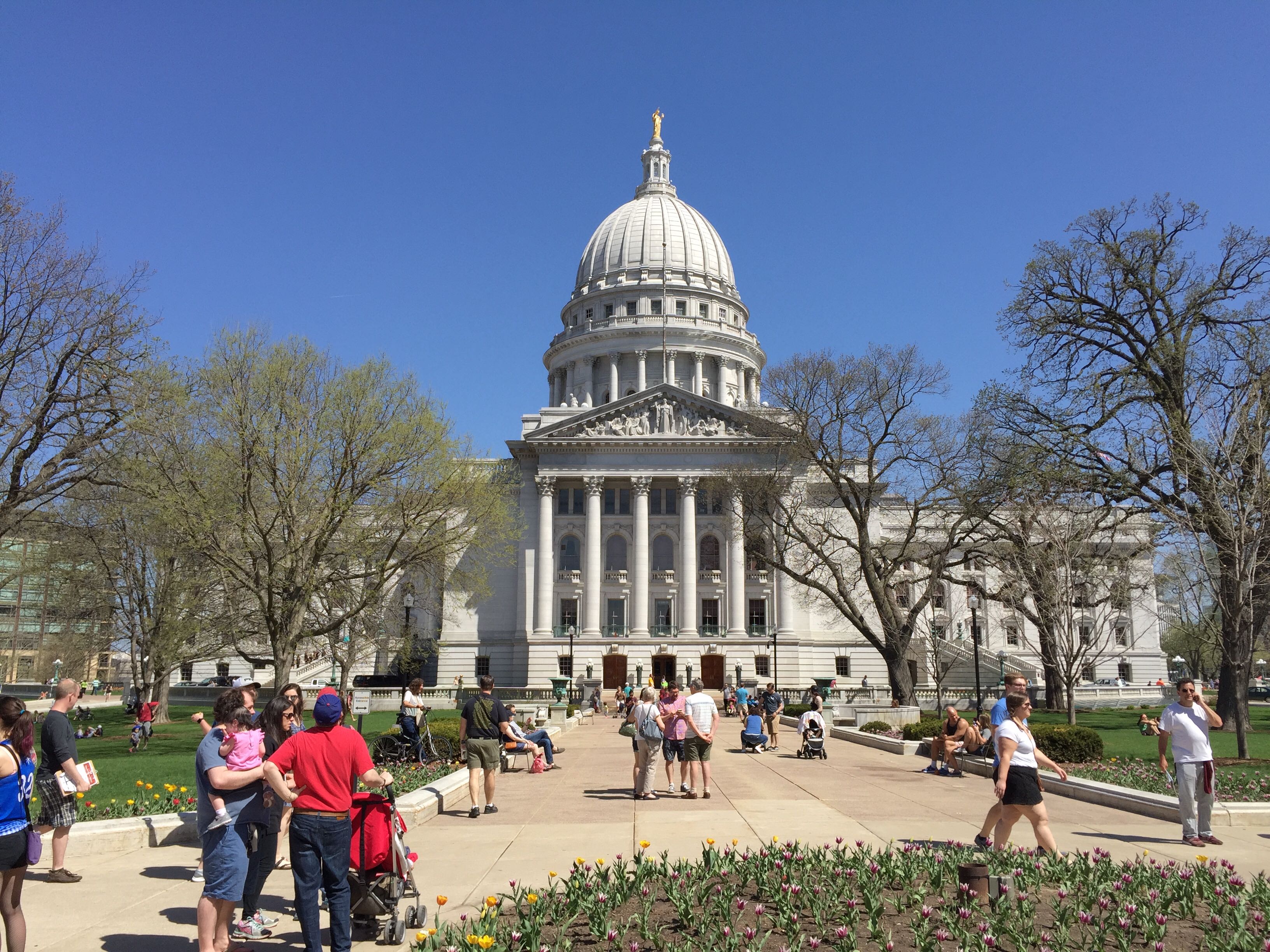
Wisconsin State Capitol. Photo by Dave Reid.
Voters in the Nov. 4 election will be asked to approve three constitutional amendments created and passed by Republicans in the state Legislature. Most Democrats oppose all three. As Milwaukee-based Democratic U.S. Rep. Gwen Moore put it last week, “I plan to vote no, no, no on the three referenda questions.”
The first of these might be seen as a reaction by Republicans to a partial veto by Democratic Gov. Tony Evers, which made cuts in the state budget bill’s language to pass an increase in school funding for 400 years. The language of the referendum amends the state constitution “to prohibit the governor, in exercising his or her partial veto authority, from creating or increasing or authorizing the creation or increase of any tax or fee.”
But it won’t prevent Evers from doing this because he won’t be serving as governor when the next state budget is passed. And it won’t just prevent Democratic governors from fiddling with the budget language to create or increase a tax or fee in a way that the Legislature never intended or approved. It will prevent any governor from any party from doing this, which will make the process of passing the budget more democratic and restrict the partial veto power in a way that state policymakers intended when they created it back in 1930.
The push to create a partial veto for the governor arose in the 1920s as omnibus budget bills packed with items that may have gotten little discussion were getting sent to the governor. In theory, any non-financial or policy items shouldn’t be included in the budget. Even today lawmakers in Madison can be heard decrying such additions, often done in secret, arguing that policy changes should be passed in separate bills after a full debate on their merits.
The push for the partial veto power was led by state Sen. Thomas Duncan, a Socialist from Milwaukee, who disseminated talking points through Wisconsin newspapers. Another proponent was state Sen. William Titus, a Progressive from Fond du Lac, who recruited Edwin Witte, who ran the Legislative Reference Bureau and would eventually author the federal Social Security Act, to draft the text of a constitutional amendment. “Appropriation bills may be approved in whole or in part by the governor, and the part approved shall become law,” the new amendment read.
At the time 30 other states had line-item vetoes similar to this provision. But not everyone agreed with the idea.
In the 1930 campaign for governor, Republican Progressive Philip La Follette said the proposal “smack[ed] of dictatorship.” But the amendment was approved by some 62% of voters in 1930, and after he was elected, La Follette became the first governor to use a partial veto.
But his vetoes targeted whole budget items, and governors over the next four decades followed a similar approach. The partial veto was a corrective to omnibus budget bills that had gotten out of hand.
But that changed under Democrat Patrick Lucey, who began a modern trend of creative vetoes. In 1973, Lucey crossed out a single digit to cut a $25 million bond to $5 million and deleted the word “not” to completely reverse a provision’s legislative intent.
In 1983 Democratic Gov. Tony Earl used the pick-a-letter or “Vanna White” veto to slice a 121-word paragraph down to 22 words.
In 1991, Republican Gov. Tommy Thompson issued 457 partial vetoes in a single budget cycle, setting a record and generating a famous headline in a Green Bay newspaper that meant to say “Thompson’s pen is a sword,” but skipped a space to declare that “Thompson’s penis a sword.” It was a howler of an error, but seemed somehow fitting given the absurdity of so many vetoes.
Yet its use got even more ludicrous. In 2005 Democratic Gov. Jim Doyle created what was soon dubbed the “Frankenstein veto” by stitching together 20 words from a 752-word passage, thereby shifting far more money to school funding.
In short, a good government proposal to combat legislative excess had turned into a joke, with governors competing for the most outrageously undemocratic policymaking. Yet legal challenges resulted in the courts repeatedly ruling in favor of increasingly creative vetoes. So, it was left to Wisconsin citizens, who wisely voted in favor of constitutional amendments banning the Vanna White veto in 1990 and the Frankenstein veto in 2008.
Even so, Wisconsin still has what is considered the most powerful partial veto power in the nation. And it still allows a governor to overturn the work of the majority of the Legislature with creative vetoes, if less outrageous than the Frankenstein or Vanna White vetoes.
Many Democrats cheered Evers’ use of the veto to create 400 years of school funding. But imagine if Democrats take over both houses of the Legislature while Republican Tom Tiffany wins the race for governor. Just as Evers did, he will be looking for ways to be a one-man legislator who can rewrite the budget in ways the Legislature did not approve.
You could argue that the Republican amendment only bars a partial veto that creates or increases a tax or fee, not the opposite: a veto that eliminates or decreases a tax or fee. But both kinds of vetoes are undemocratic and should be struck down, even if it takes successive amendments to do so. In the words of Philip La Follette, such a veto smacks of dictatorship and should be unconstitutional.
An invitation to readers: On Sunday there will be a reading of Wings of a Dove, a new play by Bruce Murphy adapting the Henry James novel, at Pink Umbrella Theater. For details check this press release.
If you think stories like this are important, become a member of Urban Milwaukee and help support real, independent journalism. Plus you get some cool added benefits.


Murphy's Law
-
Tom Tiffany Is Running Against Milwaukee
 Oct 20th, 2026 by Bruce Murphy
-
Tom Tiffany Loves Trump
 Oct 15th, 2026 by Bruce Murphy
-
Top Republican Has Turned on Donald Trump
 Oct 12th, 2026 by Bruce Murphy