

Supervisors Hit the Brakes on Oak Leaf Speed Limit
Are electric bikes too fast for county trails? Board members delay action, call for more study.
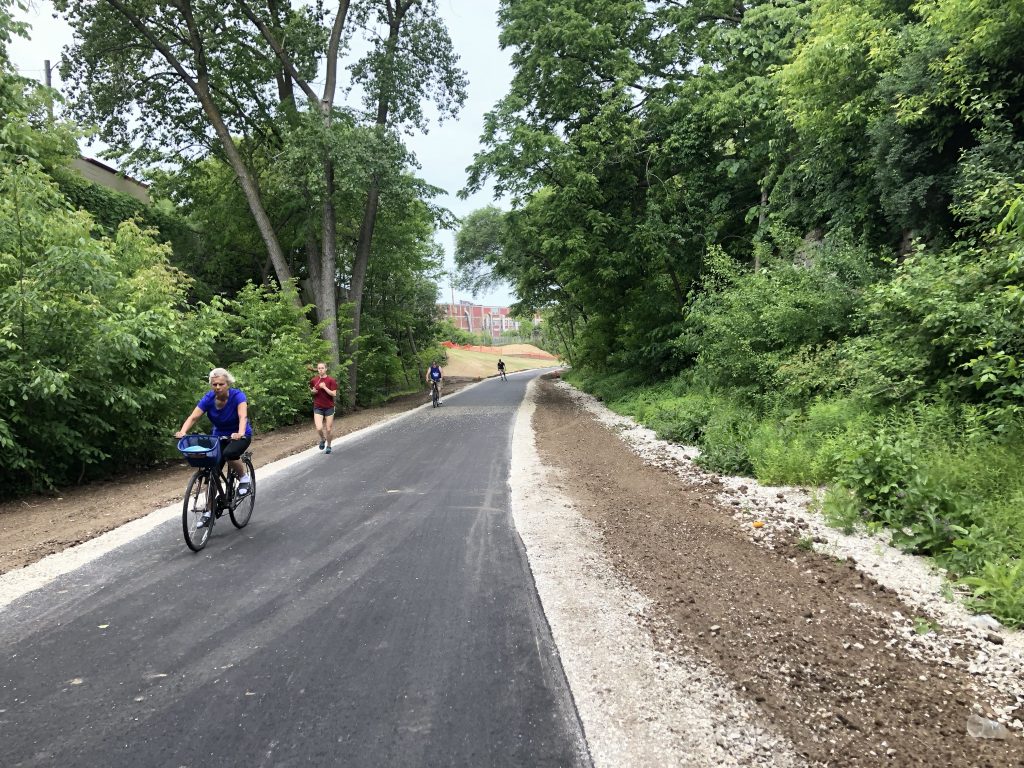
Bikers and runners on the Oak Leaf Trail. Photo by Jeramey Jannene.
Speed-limit signs will not be going up on the Oak Leaf Trail anytime soon.
The Milwaukee County Board of Supervisors pumped the brakes Thursday on consideration of a 15 mph speed limit for the Oak Leaf Trail network during its monthly meeting. Even if approved, Milwaukee County Parks did not plan to dedicate resources to monitoring trail users and ticketing cyclists traveling faster than 16 mph.
The speed-limit proposal was an attempt by Milwaukee County Parks to address safety concerns caused by the growing number of powerful electric bikes being used on the trail system. The plan was to post signs near high-traffic pinch points along the Oak Leaf network to remind users to slow down and to avoid singling out, or banning, a single class of trail user.
The idea didn’t “come out of thin air,” Deputy Director James Tarantino told the county board’s Committee on Parks and Culture on Sept. 29. Parks was asked by supervisors and members of the public to address safety concerns on the Oak Leaf Trail caused by the speed differential between regular and electric bikes.
Parks largely views e-bikes as a positive development, as they have expanded access to healthy recreation for people with mobility issues. But e-bikes are blurring the lines as to what vehicles are acceptable on the county trail system.
State law has created three classes of e-bikes, rated for the assistance an electric motor can provide to a rider. The fastest e-bike, a Class 3, provides assistance to the rider up to 28 mph. Above that, bikes become out-of-class electric vehicles (OCEVs). The out-of-class vehicles, typically unlicensed e-motos, are a leading source of concern. They also are not legally allowed on the Oak Leaf Trail, where motor vehicles are already banned.
Parks’ plan largely rests on putting speed-limit signs along the Oak Leaf network to encourage users to consider regulating speed as a matter of trail etiquette.
“Our approach to enforcement is going to lean on education first and foremost,” Tarantino said. “But we’re not proposing any additional fines or punitive measures like that.”
The Milwaukee County Sheriff’s Office (MCSO) would not deploy any resources to enforce trail speeds if a speed limit were passed, said Inspector Doug Holton, who commands the MCSO’s patrol division.
The proposal received a mixed response from supervisors and the public. While some supervisors were supportive of regulating e-bikes and e-motos through the parks proposal, others thought the speed limit didn’t go far enough. Sup. Jack Eckblad questioned why Parks needed the speed limit to educate residents on the role of speed in trail safety and etiquette and voted against the proposal at committee.
One cyclist who provided comment to the parks committee, Nate Ostrey, opposed the blanket speed limit for all trail users, noting that cyclists on traditional bicycles can often easily reach speeds of 15 mph. He also expressed concern that a speed limit could affect insurance claims for cyclists injured along the Oak Leaf Trail.
Jake Newborn, Wisconsin Bike Fed deputy director, said conversations around e-bikes and their acceptable use are occurring across the state. Newborn said the Bike Fed agrees that high-powered e-bikes and motos should not be on the trail system, but suggested Parks substitute a standard of “reasonable and prudent” speed for the precise speed limit of 15 mph.
Under state law, a “reasonable and prudent” standard means cars should not drive faster than is safe for current road conditions. This legal concept could be applied to cycling speeds along the Oak Leaf Trail, Newborn said.
When the speed limit went before the full county board on Thursday, Oct. 1, Sup. Anne O’Connor moved to send the proposal back to the board’s Parks Committee.
“There’s no doubt that we need to legislate some improvements for safety on the Oak Leaf Trail, especially with the introduction of a lot of new unregulated vehicles,” O’Connor said. “But when we discussed the actual ordinance as proposed, I think it became clear in committee that we need to do a little more listening to community members.”
As supervisors reconsider the proposal, it’s likely they will look into how the county could hold parents responsible for children riding high-powered e-bikes on the Oak Leaf network. Parks has found that these unlicensed e-motos are typically driven by minors. Supervisors have said the same.
Supervisors Kathleen Vincent and Steve Taylor suggested the board should consider ways to hold parents accountable for children who are dangerously riding e-bikes.
“Parents, for whatever reason, are allowing youth to ride some of these vehicles, and I think that is one of the biggest concerns,” Vincent said.
Legislation Link - Urban Milwaukee members see direct links to legislation mentioned in this article. Join today
If you think stories like this are important, become a member of Urban Milwaukee and help support real, independent journalism. Plus you get some cool added benefits.


MKE County
-
Mayor, Congresswoman Moore Stump for Crowley As Early Voting Begins
 Oct 21st, 2026 by Graham Kilmer
-
Republicans Attack Crowley Over Wife’s Nonprofit Work
 Oct 19th, 2026 by Graham Kilmer
-
Zoo’s New Parking System Is a Success
 Oct 17th, 2026 by Graham Kilmer
Transportation
-
Wisconsin Wins $218 Million Grant To Extend Hiawatha To Madison
 Oct 16th, 2026 by Jeramey Jannene
-
MCTS Reports Rising Fare Collection
 Oct 15th, 2026 by Graham Kilmer
-
$80 Million Air Cargo Center Takes Off At Mitchell Airport
 Oct 15th, 2026 by Graham Kilmer




















There were a lot of issues with this proposal.
1. There was no enforcement arm of this proposal. As such, it would not have addressed concerns that have arisen from E-motos and Class 3 E-bikes on the trail who are already breaking the rules.
2. If we are going to have speed limits, specific segments should have specific speed limits. Maybe 15 mph makes sense on certain segments, but there are also segments where that is too low and too high.
3. Most bikes do not have speedometers and many cyclists, including myself can easily get ride above 15 mph with just a regular bike. To really enforce compliance, you’d have to mandate speedometer usage, which seems ridiculous.
It will be hard to get the average E-bike rider, a 14 year old dressed like they are going to the X games for masked vigilantes, to obey any traffic laws. I’ve seen these clowns going through stop lights into active traffic .I’ve run on the oak leaf and been buzzed by them going at least 30 mph. They think they look cool. They look like morons. How can you get morons to obey any laws? I doubt they could read a clock face. What makes people assume they will comprehend road rules?
And as long as there won’t be any enforcement or consequences for the people violating the rules, there is no sense in making any new rules.
And so walkers who brave the trail will continue to put their lives at risk as bikes whip past at close range, often with zero notice.
I formerly walked the Warnimont trail almost daily. Bikes posed a frequent hazard unless the bicyclist warned the pedestrians of their approach. The bike speed was irrelevant. Educated cyclists were a joy to watch whiz by me.
Thank you, gwarzyn. I’ve found that most folks step right when they hear a bell from behind. Some stop and turn or “rush” to the side, but most, quite literally, take it in stride.
I hate the E-moto riders with the fire of a thousand burning suns. Unfortunately it’s a problem with no obvious solution. There’s no chance of enforcement. I’d support a “15 mph when pedestrians are present” rule only if it could help someone injured by a bad rider receive compensation, but I’m guessing even that’d be impossible to prove after-the-fact.