Underly Calls For School Funding Overhaul, Conservatives Say Money Not The Issue
State of Education speech sparks clash over whether Wisconsin schools need more cash or more reform.
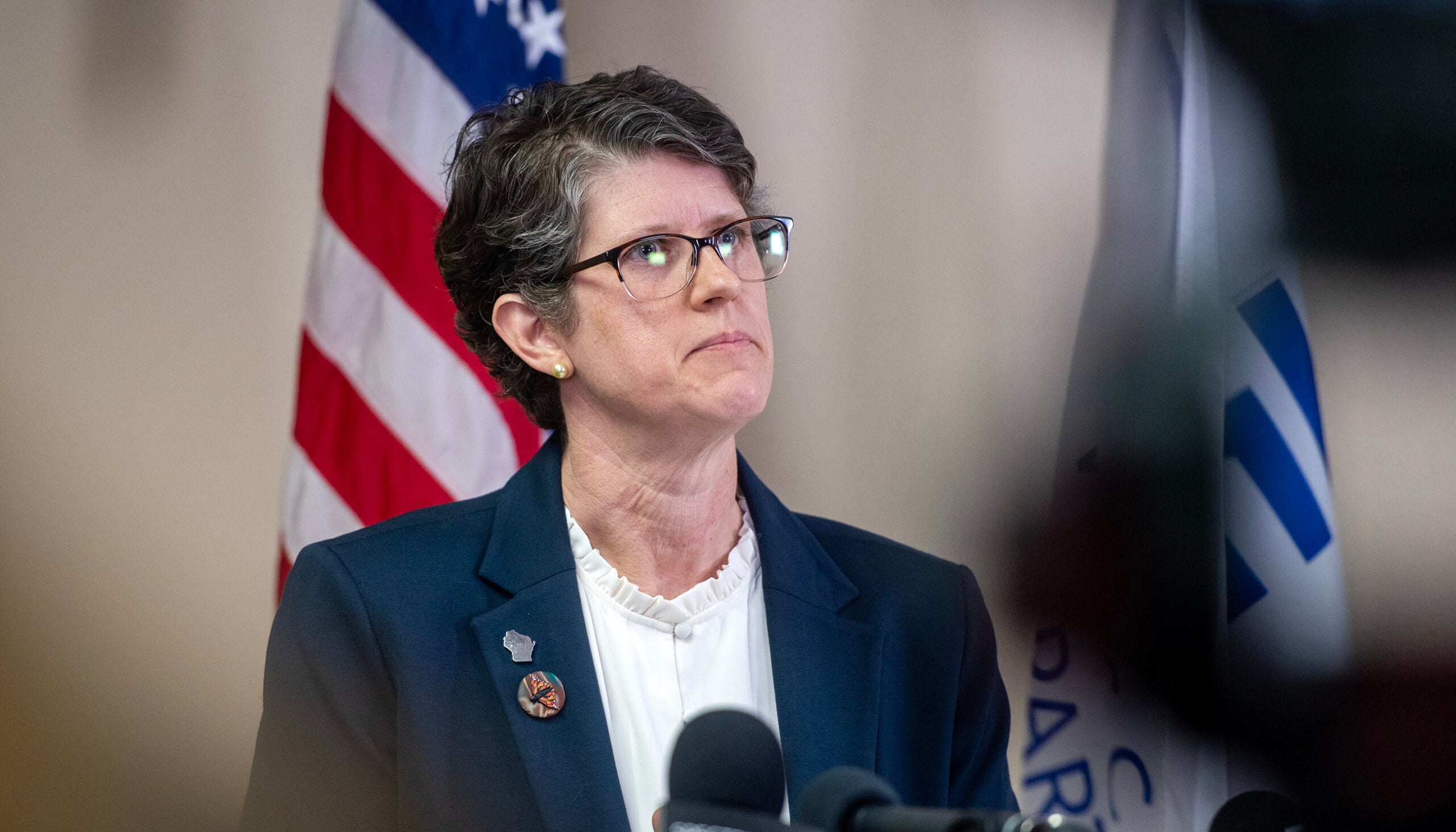
Wisconsin Superintendent Jill Underly speaks during a press conference Tuesday, Nov. 4, 2025, at the Tommy G. Thompson Center in Madison, Wis. Angela Major/WPR
In her sixth State of Education Address Thursday, Superintendent Jill Underly warned there will be consequences to “years of underfunding” for public schools.
Underly called on the state Legislature — not for the first time — to change the way Wisconsin schools are funded and called on Wisconsinites to choose leaders who will “protect public education and invest in the next generation.”
Underly’s comments come as control of the governor’s office, state Senate and Assembly hang in the balance in this year’s midterms.
“Our schools are not the problem,” Underly said. “Our teachers are not the problem. Our students are not the problem. The problem is that we have asked them to carry the weight of decades of political decisions — and then blamed them when the burden became too heavy.”
In Wisconsin, public schools are primarily funded through property taxes and state money in the form of general school aid.
Underly said for nearly two decades, elected officials have failed to provide predictable, sustainable state funding that keeps pace with inflation.
“At the same time, they have expanded policies that redirect public dollars intounaccountable private systems at historic numbers,” she said. “They claimed in 2009 that disconnecting school aids from inflation would be temporary. And33 years later, the revenue caps remain, and 17 years later, school aides remain disconnected from inflation. Schools simply cannot absorb decades of below-inflation funding without consequence.”
She said the school funding formula places value on the wrong things: enrollment, district spending and property value rather than student need.
“It fails to ask the most essential question: How much does it actually cost to educate the students who live in a district so that they have an equal opportunity to succeed?” Underly said.
In February, Gov. Tony Evers and the Legislature were close to a deal to use some of the state’s $2.5 billion surplus, at the time, to provide both tax relief and money for schools.
Wisconsin’s K–12 public schools have gone without cost of living adjustments for the last 17 years. At the same time, a promised increase in funding for students with disabilities was less than expected this school year.
That lower payment resulted in millions of dollars less for public schools. For example, in Milwaukee Public Schools, if special education reimbursement would have been 42 percent, as promised, instead of 35 percent, the district would have gotten another $36 million this year.
“Unfortunately, for far too long, too many lawmakers have not treated our schools — or the people who depend on them — with the urgency they deserve,” Underly said. “These are the people who have been entrusted with the stewardship of these public institutions — responsible for protecting them, just as past generations did for them.
“We need people in positions of decision-making power who are pro-public school, pro-child, and pro-Wisconsin — full stop.”
But conservative groups including the Institute for Reforming Government and the Wisconsin Institute for Law & Liberty say spending more money is not a solution.
Ahead of Underly’s speech, WILL released a dashboard looking at spending by public school districts.
According to WILL’s report, statewide, average per-pupil revenue is $19,000. This comes as Wisconsin ranks 33rd of 38 states in math recovery and 30th of 35 in reading recovery since 2022 — despite spending increases, said Will Flanders, WILL’s director of policy research.
While the state’s reading and math recovery numbers lag others around the country, Wisconsin’s overall student achievement in math and reading remains strong. The state ranks second among states for overall math scores in the National Assessment of Educational Progress, and 13th in reading, according to U.S. News & World Report.
The analysis by U.S. News & World Report ranks Wisconsin as having the fifth best education system in the nation. A Consumer Affairs ranking shows Wisconsin at 22nd in the nation for its funding of public education, but second in academic achievement.
“Dr. Underly’s speech focused on the same tired excuses that more funding is the fix for the problems in our schools. But reality is we spend more adjusted for inflation on schools than we did 25 years ago, and other states around the nation are achieving better results for less,” Flanders said.
He said, “Wisconsin’s schools need reforms that improve accountability, effectiveness, and results, not just a larger check.”
Superintendent Underly calls on Legislature to change funding formula for public schools was originally published by Wisconsin Public Radio.
If you think stories like this are important, become a member of Urban Milwaukee and help support real, independent journalism. Plus you get some cool added benefits.