

See The Drastic MCTS Redesign Concepts
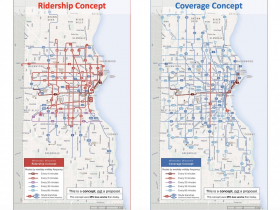
Maps highlight tradeoff between geographic coverage or ridership.
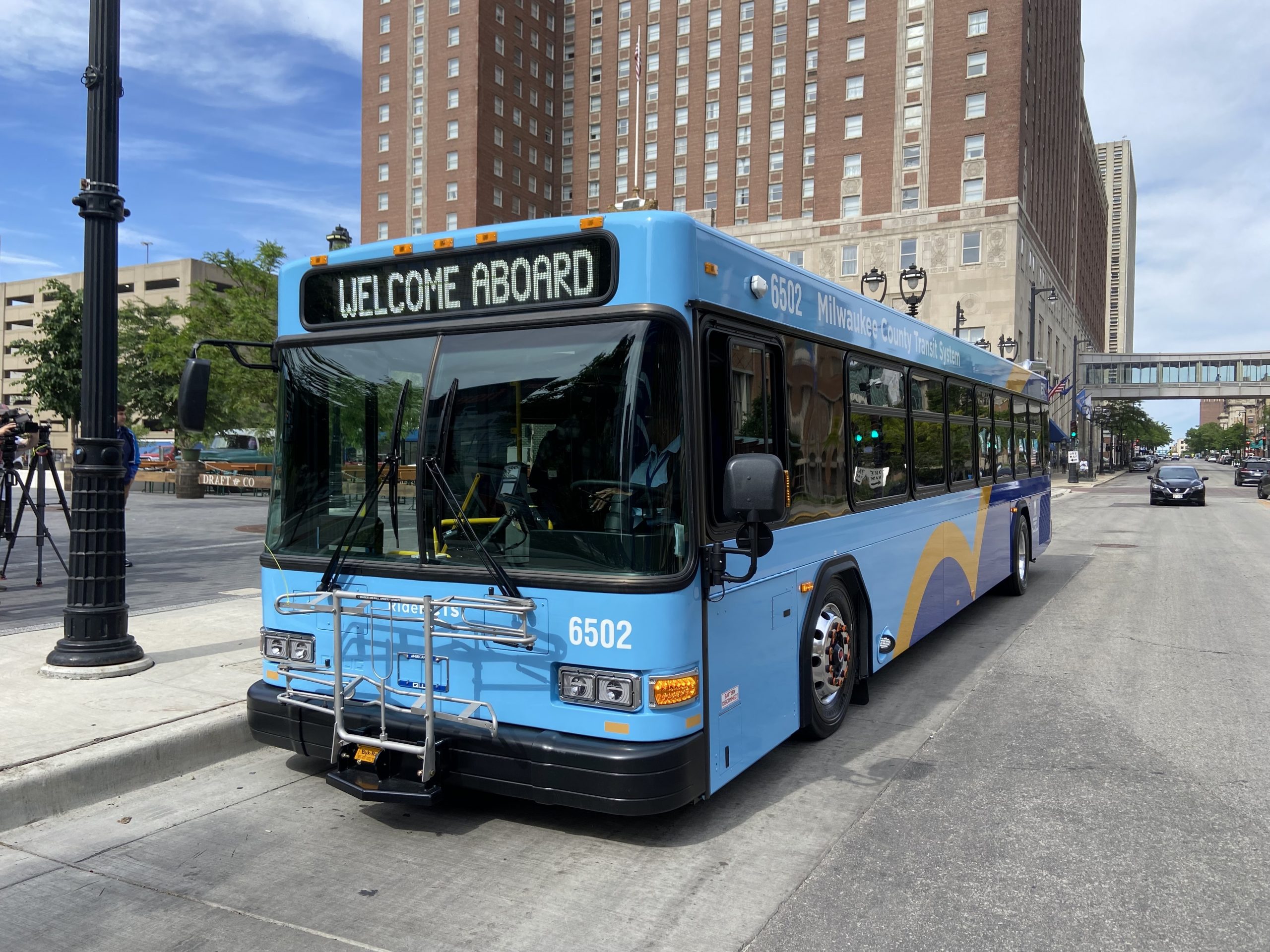
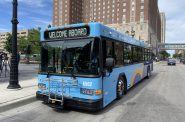
MCTS bus on W. Wisconsin Avenue. Photo taken Thursday, June 4, 2026 by Graham Kilmer.
Milwaukee County supervisors had their first look Wednesday at conceptual ideas for a newly designed Milwaukee County Transit System (MCTS).
Members of the Committee on Transportation and Transit saw two maps, each demonstrating a potential future bus network favoring either geographic coverage or high ridership. The maps, still conceptual in nature, are part of a project called MCTS Forward, an effort by MCTS to redesign the bus network for long-term financial sustainability and, maybe, growth.
The redesign initiative is being led by MCTS President and CEO Steve Fuentes, who came into his role in late 2025. MCTS contracted with Jarrett Walker + Associates (JWA), a transit planning consultancy with experience redesigning transit systems across the world.
MCTS has a structural budget deficit largely caused by frozen mass transit funding from the state. State support is the system’s largest source of operating funds, and annual inflation has eroded how much service the system can run on a finite funding base. In 2026, MCTS implemented its first major budget cuts since before the COVID-19 pandemic, cutting service by approximately $9.3 million. The gap in 2027 is projected at $15.7 million.
The system does not want to cut bus service or choose between geographic coverage and bus ridership, Fuentes told supervisors Wednesday. The system is being forced to plan for a future where it has significantly fewer resources to provide transit in Milwaukee, and it cannot maintain a system that maximizes both without significantly more funding.
“We’re not just sitting back and watching things happen to us. We’re trying to be proactive,” Fuentes said.
Baked into the MCTS Forward project is the reality of MCTS’ finite resources. To design a sustainable system, MCTS and JWA are developing concepts assuming a 25% cut to transit service. The point of such a massive reduction is to bring operations to a level that can be sustained for at least the next three years without additional funding.
No decisions have been made yet about which direction MCTS should take. Nor have any decisions been made about what routes would be cut or changed. What supervisors saw Wednesday is a general representation of the geographic coverage or frequency MCTS can provide given the financial reality. MCTS and JWA are looking for input from the public and, ultimately, direction from policymakers about what direction MCTS should take in a final design.
The concept maps were presented by Ricky Angueira, a principal associate with JWA, who said JWA is agnostic about which concept the county chooses, but believes it needs to choose one. JWA is trying to provide clear conceptual plans for MCTS and policymakers to pursue.
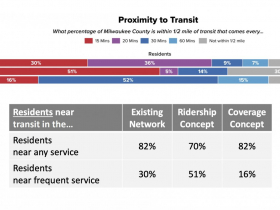
The ridership concept creates a centralized grid of high-frequency bus routes, greatly increasing the number of routes with buses arriving at stops every 15 minutes. The increased frequency makes transfers easier, which makes the system more useful for riders. Approximately 51% of all county residents would live within half a mile of a bus route, but 30% of residents would be farther than half a mile from a bus route. The ridership map presented Wednesday would reduce bus routes from 44 to 21.
“The way the ridership concept was developed was really just following the formula for what makes transit useful, which is, ultimately, geometry,” Angueira said. “It’s really just putting it where the most dense places are, the most walkable for people, traveling in straight lines and closing gaps.”
The coverage concept would maintain significantly more routes than the ridership concept and maintain service in nearly every area of the county where it is today. But service along most bus routes would be cut to one bus every 30 to 60 minutes. Only 18% of county residents would find themselves more than a half mile from a bus route, but 51% of the county’s population would live within a half mile of a high-frequency route with a bus coming every 15 minutes or less. The coverage map would reduce bus routes from 44 to 43.
The coverage concept makes the bus less useful for county residents, with longer waits at the bus stop or between transfers. Modeling by JWA also shows the longer wait times make the bus less useful for getting to work.
“That’s what it means to reduce frequencies throughout the county. It means that the network overall is going to be 37 percent less useful,” Angueira said. “But there’s still service for everybody, and if that’s the goal, that’s okay.”
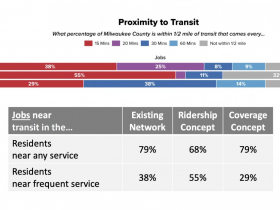
JWA mapped out how many jobs residents can get to within 45 minutes based on each design. Assuming a 25% cut to MCTS service, the ridership concept would translate to a 2% reduction in access to existing jobs. The coverage concept would reduce access to existing jobs by 37%.
The firm is presenting policymakers with two general options for the future of the bus network in Milwaukee: a network that spreads routes across the county, favoring geographic coverage at the expense of bus frequency, or a system that favors bus frequency along high-ridership routes focused on areas where the most people and jobs are, but at the expense of geographic coverage.
Concept Maps and Data
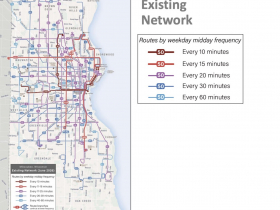
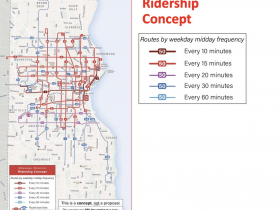
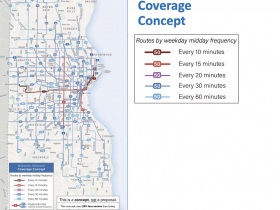
Supervisors, Union React
After hearing the presentation Wednesday, supervisors expressed concerns about the tradeoffs represented by each concept and urged MCTS and JWA to focus on robust outreach to the community.
Sup. Justin Bielinski pointed out that the ridership map would leave as many as six or seven supervisors’ districts with little or no transit service. He also asked which concept would be easier for MCTS to scale up in the future if MCTS had more funding. Both can be scaled up, Angueira said.
Looming behind supervisors’ considerations of the future is the midterm election cycle. Democrats are trying to win control of the state Legislature and the governor’s office for the first time in nearly two decades. There is anticipation on the board that a new political makeup in state government would give Milwaukee County better prospects for securing new transit funding.
Sup. Priscilla E. Coggs-Jones urged MCTS and JWA to reach out to residents in places that people already regularly use transit to reach, “the barber shops, the gas stations, the hair supply stores.” The supervisor also worried what longer wait times would mean for bus riders in communities where crime is a persistent concern for local residents.
Sup. Juan Miguel Martinez echoed Coggs-Jones, expressing concern that a new, reduced system would be rolled out without the knowledge of people who would be most affected, namely the county residents who rely on the system to get around.
Representatives of the Amalgamated Transit Union Local 998 (ATU) expressed frustration with the idea of redesigning the transit system around budget cuts.
ATU President Bruce Freeman said MCTS seems to be “in a lose, lose situation,” having to choose between geographic coverage or ridership. Vice President Michael Brown said the cuts to bus service would exacerbate existing social challenges in the city, like crime and unemployment; that any redesign or cuts would greatly impact the county’s Black community.
Sup. Steven Shea, chair of the committee, said, “For the record, I believe all of us don’t want cuts. There isn’t anybody here who wants any cuts. The problem has always comes down to money, and the state has not been doing its duty of giving us our own fair share of our own tax money.”
Members of the public can share their thoughts via the MCTS Forward survey.
If you think stories like this are important, become a member of Urban Milwaukee and help support real, independent journalism. Plus you get some cool added benefits.


MKE County
-
Board Moves to Quash Lakefront Parking Fees
 Oct 24th, 2026 by Graham Kilmer
-
Supervisors Save Education Aid, Food Assistance From Budget Cuts
 Oct 23rd, 2026 by Graham Kilmer
-
Mayor, Congresswoman Moore Stump for Crowley As Early Voting Begins
 Oct 21st, 2026 by Graham Kilmer
Transportation
-
Toll Roads Becomes an Issue in Wisconsin’s Race for Governor
 Oct 26th, 2026 by Rich Kremer
-
Wisconsin Wins $218 Million Grant To Extend Hiawatha To Madison
 Oct 16th, 2026 by Jeramey Jannene
-
MCTS Reports Rising Fare Collection
 Oct 15th, 2026 by Graham Kilmer



















It would suck to lose the current coverage (the 14 for me) but I’d personally be willing to walk a little further for a more frequent and reliable service than have a less frequent and less reliable service closer to my home. And who knows? Perhaps starting with a high-frequency network will help build ridership enough to grow into the regions where the lines could be cut.
Either way, we need that damn state funding to be updated.
These are “concepts” not proposals but looks to be bad news for bay view.
They need to decrease the stops per mile and make the system run more efficiently. Milwaukee has one of the highest stops per mile in the world. Less stops means shorter duration rides, more people taking the bus, less busses and drivers needed, and less spending needed. Yes, people would have to walk an extra couple hundred feet sometimes.
Anything that makes the system less attractive to ride will just result in the same problem and discussion a couple years down the road. We need more riders, not less.
While a redesign of the system is important for the future of the bus system, even more important is that Milwaukee receive an equitable share of funding from the State, commensurate with what we citizens send there in our tax dollars. As long as we have a State Legislature that is adversarial towards Milwaukee, for whatever reasons, it will remain an injustice for our city.
We are all paying for the former entitled culture that until recently ran MCTS and had a policy that actually encouraged fare evasion. It still continues. I will pay the price because I have always been dependent on public transit.
Operators should be taught to say, “No fare. No ride. Sorry,” like the Waukesha Metro operators say.
Disappointed with both concepts. My choices are being narrowed, with one route I take regularly being eliminated. Thank you, entitled culture and County Board of Supervisors for allowing it to get to this point. There have been issues for years but the County Board did not take it seriously. Most of them find public transit beneath them and their constituents. My Supervisor never responded to me. I don’t live in Hale Corners and those folks are all she cares about.
It will never be implemented, but the Purple Line should have deep cuts because there are so many fare evaders along that route. Let them find out the hard way what it’s like. Force them to make a choice between paying a reasonable fare or walking.