
Wisconsin Supreme Court Weighs Next Step On Congressional Map Suits
Justices will decide if lower-court panels were right to toss two gerrymandering challenges.
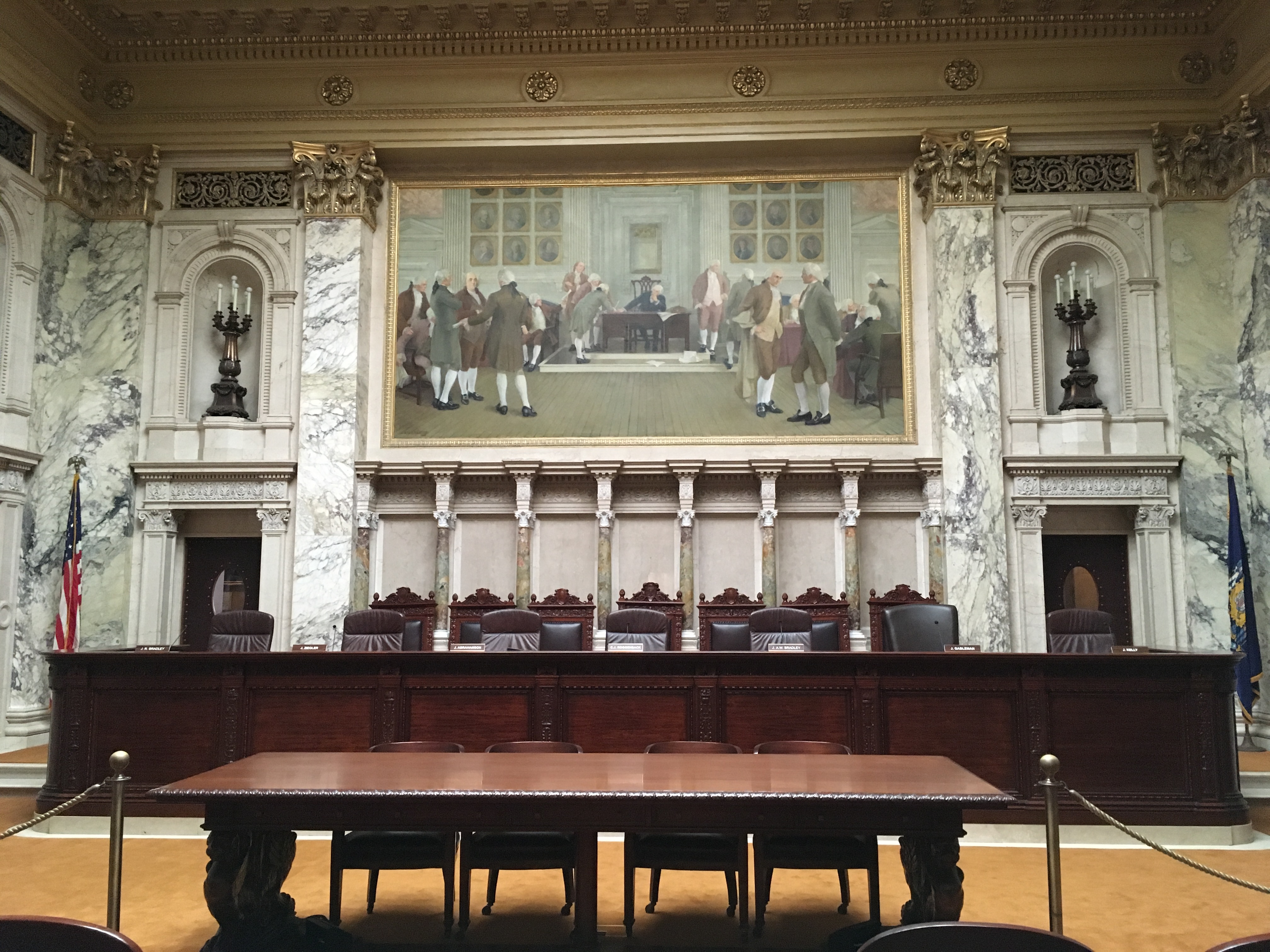
Wisconsin Supreme Court. Photo by Mariiana Tzotcheva.
Wisconsin Supreme Court justices will hear arguments this week in two lawsuits claiming the state’s eight U.S. House districts are gerrymandered and must be redrawn.
Both cases were dismissed by special judicial panels at the circuit court level. The liberal firms that brought the cases say those judges got it wrong.
Democrats have been trying to overturn Wisconsin’s current congressional districts through the courts ever since they were first drawn by Republican legislators in 2011. After the 2020 census, the Wisconsin Supreme Court’s former conservative majority ordered a redraw with the caveat that new maps contain the “least changes” possible to those drawn a decade earlier.
The two latest lawsuits challenging the House districts will be heard by justices during oral arguments. But the only thing the court is expected to rule on is whether the three-judge panels were right to dismiss both cases.
Plaintiffs say there’s more than one way to gerrymander a map
The lawsuits filed last year by two liberal firms, Elias Law Group and Law Forward, argue the current 6-2 Republican majority in the state’s U.S. House delegation is the result of different flavors of gerrymandering.
The Elias suit takes the more traditional path, arguing the GOP dominance is due to partisan gerrymandering. The group claims Republican lawmakers drew the congressional map in 2011 to maximize their party’s chances of keeping a majority of the delegation.
Elias also argues the “least change” directive from the court’s former conservative majority to redraw the maps a decade later was invalid. Elias argues that because the Supreme Court’s current liberal majority overruled the “least changes” approach in a 2023 decision overturning state legislative districts, the congressional map must also be redrawn.
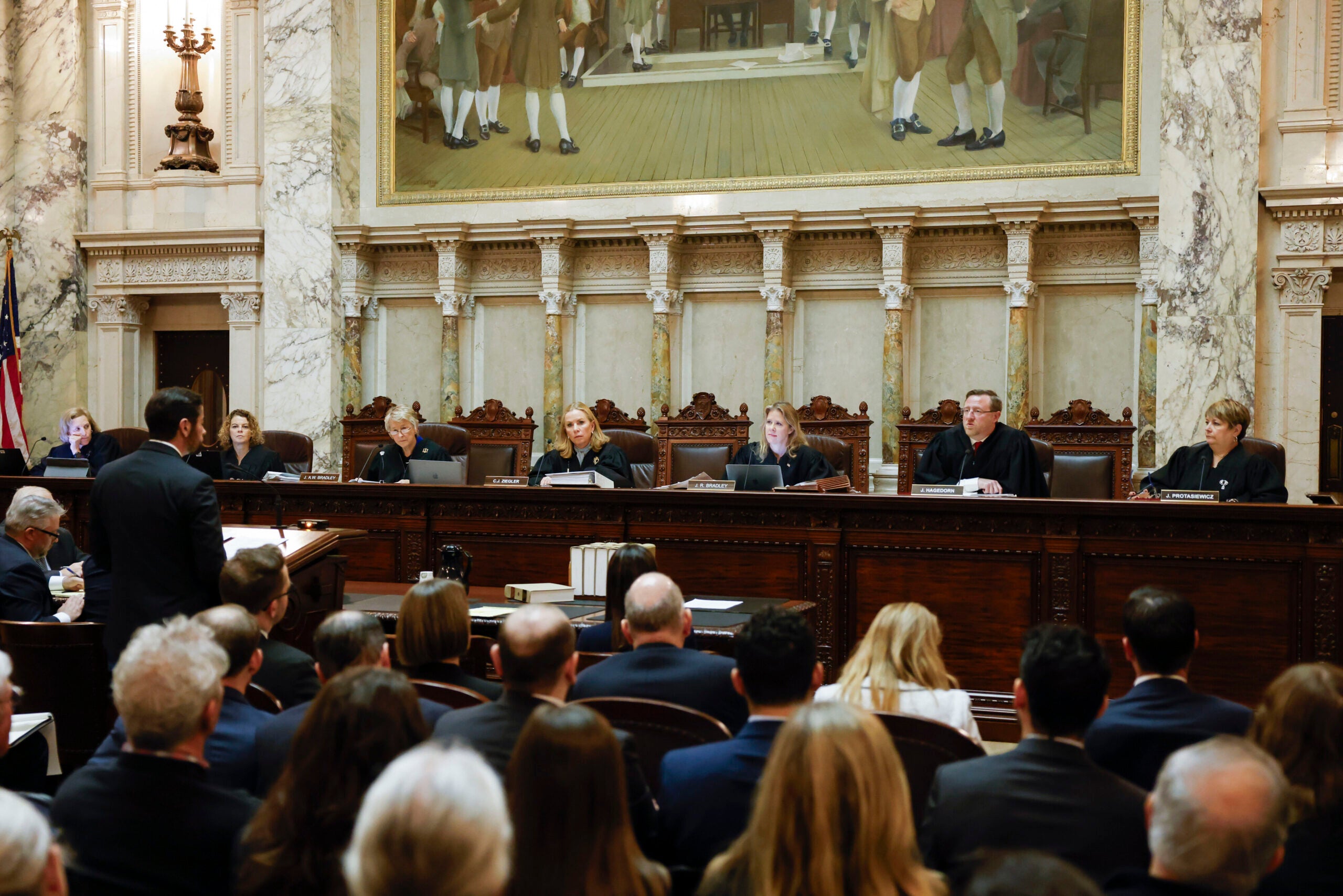
The Wisconsin Supreme Court listens to arguments from Wisconsin Assistant Attorney General Anthony D. Russomanno, who is representing Gov. Tony Evers, in a redistricting hearing at the Wisconsin state Capitol Building in Madison, Wis., on Tuesday, Nov. 21, 2023. Ruthie Hauge/The Capital Times via AP
Law Forward, which is representing a group called Wisconsin Business Leaders for Democracy, is using a new approach. They claim the current House map represents an anti-competitive gerrymander designed to protect incumbents above all else. Law Forward argues that also violates principles in the state constitution.
The lawsuits are opposed by Wisconsin’s six Republican U.S. House members, the GOP-controlled Wisconsin Legislature and others. Attorneys representing them filed briefs arguing both cases should be dismissed because circuit court judges cannot overrule the Wisconsin Supreme Court.
With regard to the partisan gerrymandering claim from Elias, Republicans argue the U.S. Supreme Court has already rejected that legal argument.
Republicans also argue Law Forward’s anti-competitive gerrymandering claim should be rejected because they say it’s a partisan gerrymandering claim by a different name.
Wisconsin’s Supreme Court isn’t ruling on the maps just yet
Elias and Law Forward are pushing their lawsuits through a legal framework created in 2011 when Republicans held the levers of state government. It’s never been tested before now.
The system allows parties to ask the Supreme Court to appoint three-member panels of county circuit court judges to hear map challenges and lets any appeal leapfrog all the way to the state’s highest bench.
In March and April, the two panels formed to hear the claims from Elias and Law Forward ruled that they can’t overturn previous Supreme Court decisions on congressional maps and dismissed the suits. Wednesday’s arguments focus on whether those panels were right.
In a press conference last week, Law Forward attorney Doug Poland said judges wrongly conflated anti-competitive gerrymandering with partisan gerrymandering. He said Law Forward wants the Supreme Court to reverse the panel’s ruling and send the case back, while recognizing their anti-competitive gerrymandering claim is valid under state law.
“Whatever our personal politics, we should be able to agree on this much: Elections for congressional and state legislative districts are supposed to be decided by voters in those districts, not by the legislators who seek to represent them, drawing the district boundaries to ensure that they prevail in elections.”
Attorney Jack Deschler of the Election Law Clinic at Harvard Law School, which is assisting Law Forward with the case, said Wisconsin’s justices can “set an example” for other courts around the country by allowing the anti-competitive gerrymandering claim to be heard.
“We think this is generally a healthy thing for democracy to have competitive elections, and so we’re certainly hopeful that it’ll become an example,” said Deschler.
Attorney Abha Khanna, who is a partner with Elias Law Group, told WPR the Supreme Court’s choice is simple because justices already rejected the least changes approach in 2023. Khanna said her firm is merely asking the court to apply that same finding to Wisconsin’s House map.
“That precedent mandates that any map that was drawn pursuant to a now constitutionally defunct principle of least change is not what the Wisconsin Constitution allows for Wisconsin voters, and since that congressional map continues to be in place, this is not some relic of the past,” said Khanna. “This is a map that Wisconsin voters will vote under in 2026 and 2028 and 2030, and as long as that map remains in effect, the injury is incurred anew with every election, and this court should go back and fix it.”
Khanna said Republicans haven’t rebutted that argument, and the Supreme Court could overturn the maps if it wanted. Elias’ current case is nearly identical to one filed directly with the Supreme Court last year, which was rejected by justices without explanation. Khanna said the court “didn’t like that procedural posture,” which is why Elias went the judicial panel route this time.
As for Republicans’ argument about the U.S. Supreme Court getting involved if the Wisconsin justices rule in Elias’ favor, Khanna said it shows “they know that there’s really nothing stopping this court from ruling on the merits” of its least changes claim.
While Law Forward is asking justices to recognize its anti-competitive gerrymander claim and send the case back to the three-judge panel, Elias wants justices to order the panel that dismissed its case to rule in its favor and start the process of redrawing the congressional map before the 2028 election.
Editor’s note: This story was updated to reflect that attorney Jack Deschler is assisting with Law Forward’s case.
Wisconsin Supreme Court to hear congressional map arguments was originally published by Wisconsin Public Radio.
If you think stories like this are important, become a member of Urban Milwaukee and help support real, independent journalism. Plus you get some cool added benefits.