
Report Says Job Growth in Wisconsin Has ‘Ground To a Halt’
New report from Madison think thank says state has lost jobs since January 2025.
jaymarable (CC-BY)
Although median wages hit a record high in Wisconsin, job growth has hit a snag and the state’s Black unemployment rate is rising.
Those are some of the main findings included in “The State of Working Wisconsin 2026,” a new report on the state’s job market. The annual report is released by the High Road Strategy Center, a left-leaning “think-and-do tank” at the University of Wisconsin-Madison.
The report finds that after hitting a record high number of jobs — 3,051,000 — in November 2024, by July the state had 3,042,900 jobs.
“Job growth has ground to a halt, and though wages hit a new high in 2025, high inflation is undermining workers’ wages in 2026,” said Laura Dresser, author of the report and the associate director of the High Road Strategy Center. “The (report) still shows some very bright spots, but the clouds are gathering on the economic horizon.”
In an interview with WPR, Dresser said the report’s findings show a “mixed picture.”
“There’s some really great news still in this economy,” she said. “We’ve had a strong recovery from the pandemic lockdowns, it’s been sustained and we show again that we got a new high in median wages in 2025.”
Last year’s report found that the economy was softening, and Dresser said the new data shows some of those trends have continued.
Report sees higher unemployment ahead
The state’s unemployment rate is at 3.3 percent. That is low, but it’s “drifting upward” compared to the state’s 2.6 unemployment rate in 2023, according to the report’s findings.
“With the state losing jobs, it is likely that the rate will continue to rise,” the report said.
And the state has been losing jobs since 2025.
“Wisconsin’s economy has grown slowly relative to the national economy for years, and now job growth has ground to a halt,” the report said.
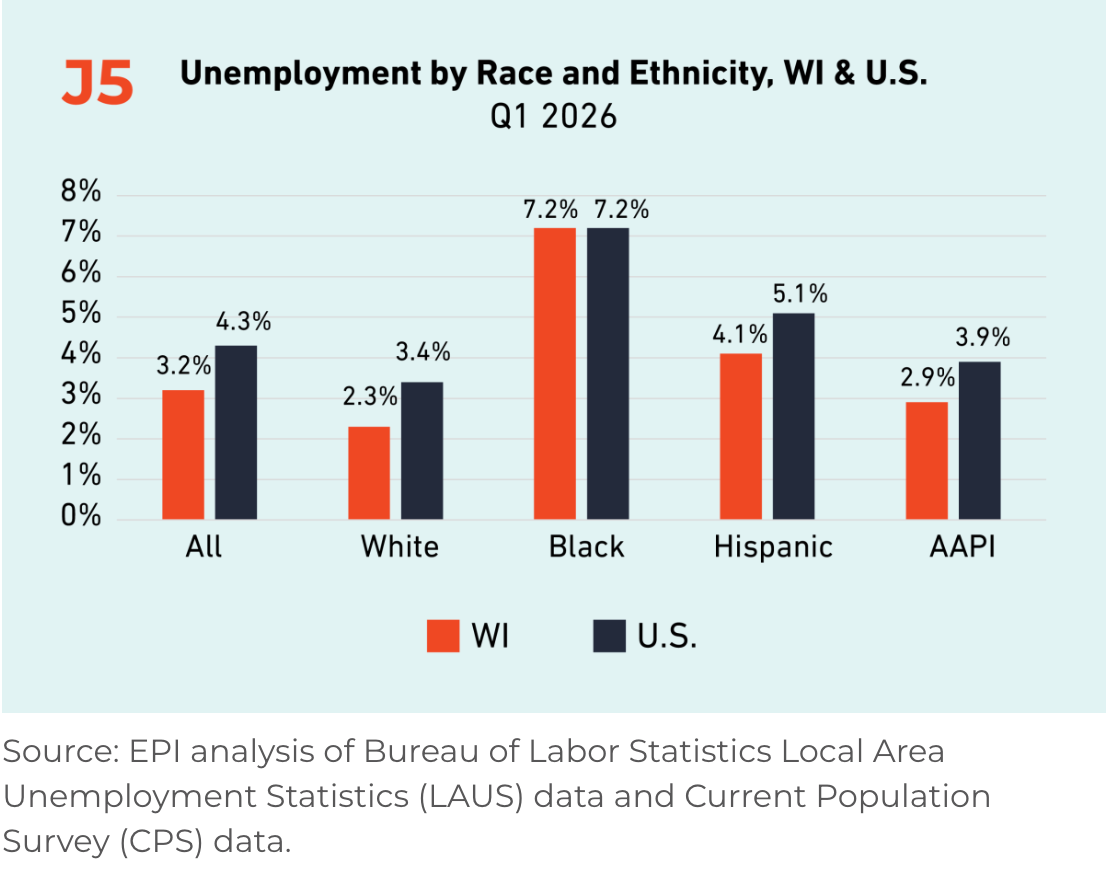
It also found that the economy in Wisconsin, “is riddled with inequalities by geography, race, education and gender.”
The report says the unemployment rate for Black residents of the state is, “growing much more rapidly than unemployment for other groups.”
The Black unemployment rate in Wisconsin was at 7.2 percent during the first quarter of 2026, which matches the national rate, according to data included in the report. But the state’s unemployment rate for white residents was at 2.3 percent.
“In 2023, when the unemployment rate was at its low and the labor market was strong, the gap between Black and white unemployment shrank,” the report said. “But as the overall rate has drifted up, the Black rate has grown much more swiftly.”
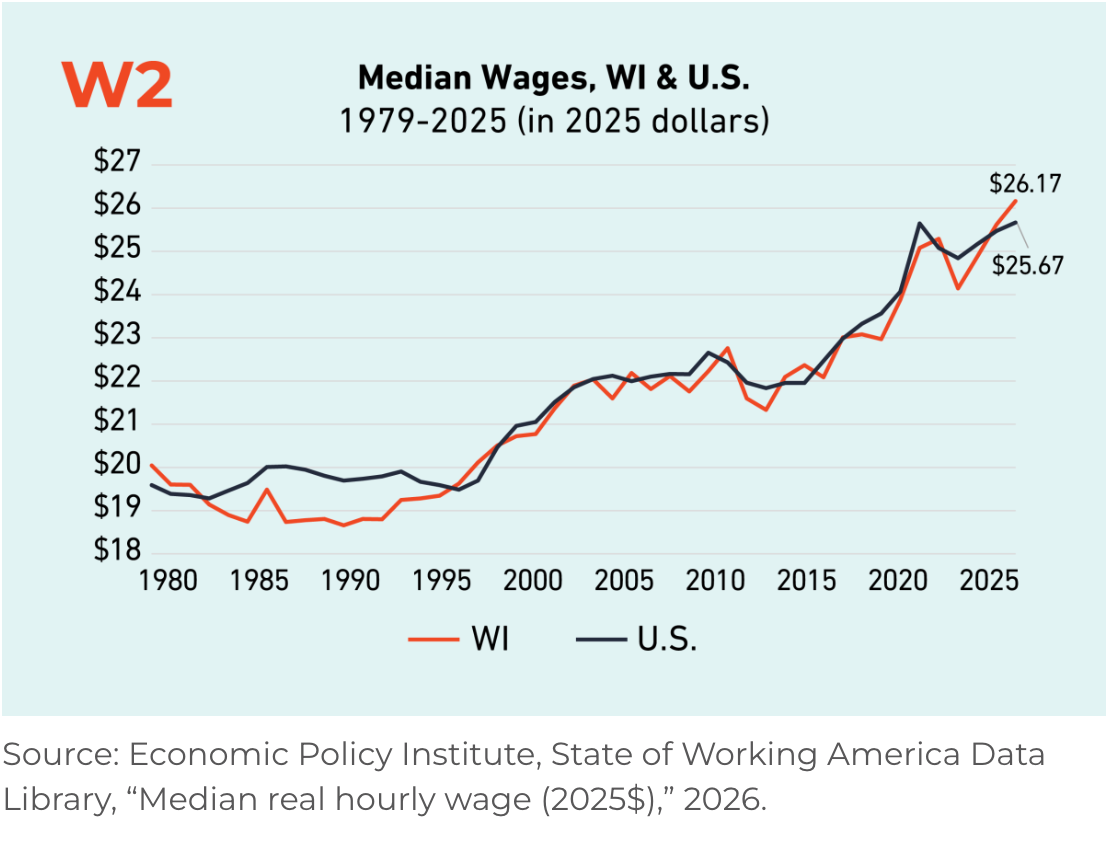
The median wage was at a record high of $26.17 per hour last year in Wisconsin. Data for this year is not yet available, “but the signs there are troubling,” the report said.
“Inflation has risen and wage gains have been weaker,” according to the report. “As it did in 2022, inflation could wipe out the wage gains of 2026.”
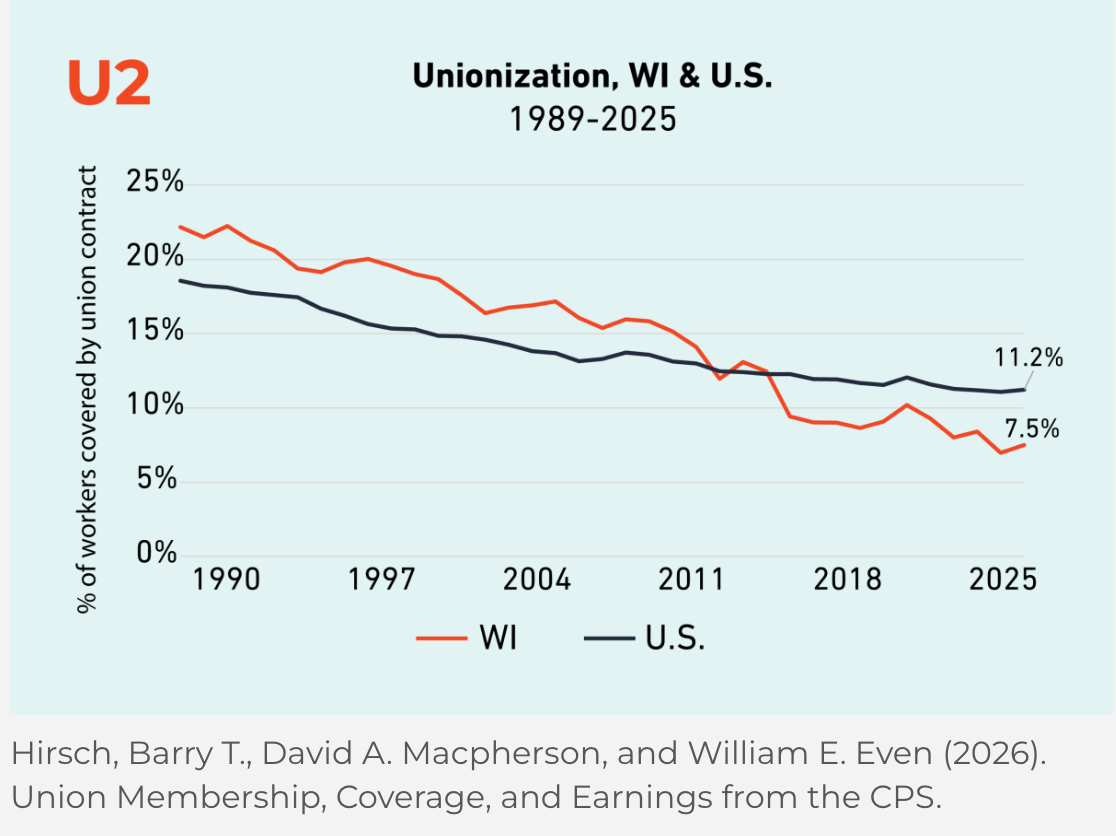
The state’s unionization rate is also down.
“From 2011 to 2025, Wisconsin’s unionization rate fell by nearly half, from 14 percent to 7.5 percent,” the report said.
“State trends in unionization reflect both state policy and industrial structure,” the report added.
Pam Fendt, the president of the Milwaukee Area Labor Council, pointed to the impacts of Act 10 on union membership in Wisconsin. But she also believes interest in unions is on the rise and she said she feels “hopeful for the future.”
“We do see a lot of interest in organizing,” Fendt said.
A new Gallup Poll found that the approval rate for unions is at 71 percent.
Meanwhile, Wisconsin’s minimum wage is still $7.25, despite efforts by some to raise it.
“An increase in the state minimum wage to $20 by 2030 would raise wages for more than 730,000 Wisconsin workers,” the report said.
“All the neighboring states except for Iowa are on a dramatically different path for minimum wages, and this state has (for) too long just not attended to the minimum wage and raising it for the state’s lower paid workers,” Dresser said.
Fendt also said they support raising the minimum wage.
“Getting it to $20 an hour by 2030 is something that we support because, honestly, the minimum wage has been stagnant for way too long,” Fendt said.
Report: Job growth in Wisconsin has ‘ground to a halt’ was originally published by Wisconsin Public Radio.
If you think stories like this are important, become a member of Urban Milwaukee and help support real, independent journalism. Plus you get some cool added benefits.