

Milwaukee Residents, Groups Object to We Energies Rate Hikes
Proposed rates would increase by $22 per month in two years.
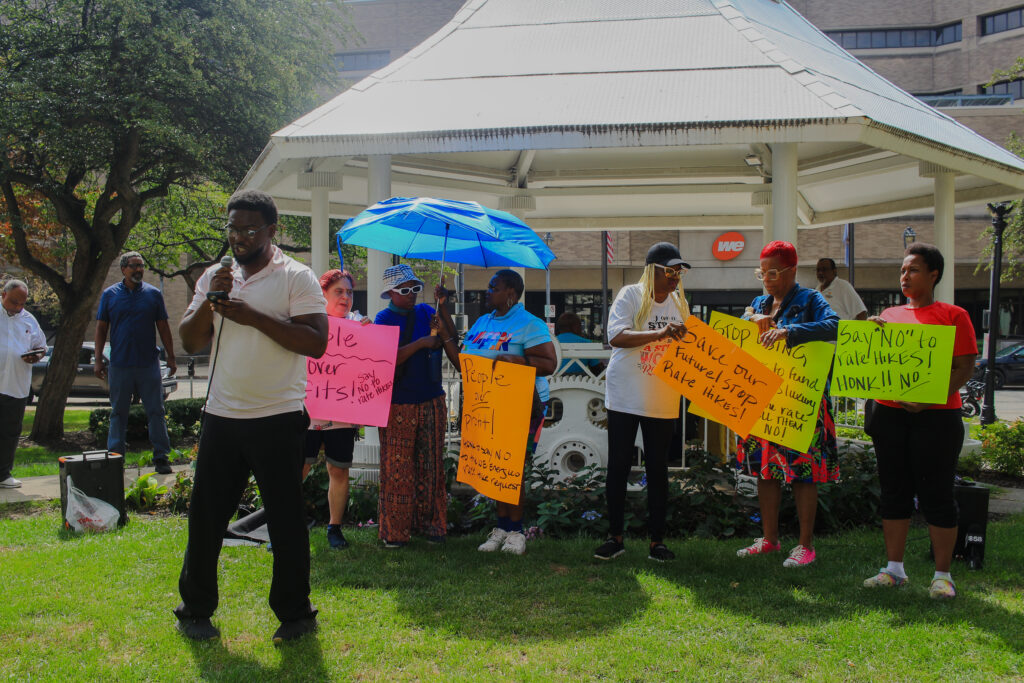
Yusuf Adama of Walnut Way speaks against We Energies’ proposed rate increase at a rally in Milwaukee Sept. 1, 2026. (Henry Redman | Wisconsin Examiner)
Dozens of southeastern Wisconsin residents, community organizers, local leaders and environmental activists voiced their opposition to a proposal from the electric utility We Energies to raise rates during a series of meetings in Milwaukee Tuesday.
At a rally outside the We Energies offices Tuesday morning and at a public hearing on the rate increase held by the Wisconsin Public Service Commission on the Marquette University campus in the afternoon, opponents of the planned increase by as much as $22 per month by 2028 complained that the company was raising money that would go to building data center infrastructure and executive salaries on the backs of Milwaukee residents struggling to get by. Opponents also demanded that Wisconsin change direction as the state continues to fall behind its neighbors in renewable energy development.
The proposed rate increase comes as public attention has focused on the structure of Wisconsin’s energy system and the sources of its power due to widespread opposition to the construction of hyperscale data centers — particularly in the communities of Port Washington and Mount Pleasant. The issue has become a major topic in the ongoing race for governor as both Democrat David Crowley, the Milwaukee County executive, and Republican Tom Tiffany, a member of the U.S. House of Representatives, argue for their vision for the future of data centers and energy in the state.
Crowley has said he wants to require that data center developers pay the cost of their own energy use while pushing them to construct renewable sources of energy such as utility-scale solar and wind. Tiffany, whose campaign ads attack “data center David,” has argued that data centers, wind and solar farms are all taking too much of the state’s farmland.
Voters across Wisconsin have expressed frustration recently with the lack of oversight or regulation of polluting industry. A group of activists in western Wisconsin recently successfully challenged the state Department of Natural Resources’ decision to grant a controversial Pierce County factory farm a permit to expand on the grounds that there weren’t enough protections for local groundwater.
We Energies’ request to raise rates would increase monthly bills by $13.35 per month in 2027 and another $8.69 per month in 2028, adding up to about $22 more per month after two years, for a household that uses 660 kilowatt-hours per month.
At the rally in Zeidler Union Square, directly in front of the We Energies headquarters, attendees complained that the PSC hearing was being held on the first day of school, when many of the working families who will be most affected by the rate increase are too busy to attend; that the utility has increased rates several times in recent years as the company’s profits have continued to go up; that, on a hot and muggy late summer day in Wisconsin, poor residents in the city would have to choose between cooling their homes and other necessities and that the state’s utility companies have continued to extend the lives of coal and natural gas power plants.
“I didn’t come here to complain. Y’all know we do not complain. That’s not what we do. We have a reason to be angry, though,” Antonio Butts, executive director of the local non-profit Walnut Way Conservation Corps, said. “They’re asking for $480 million — $480 million on top of hundreds of millions that they’ve asked for in previous years. We have a right to be angry. We literally have a right to be angry. But being angry has never reduced our energy bill. Not one time.”
Most of the speakers complained that the utility has continued to reap massive profits and returns to shareholders — and paid its CEO $12 million in 2025 — while many Milwaukee families are struggling to make ends meet.
“We have a runaway monopoly that are supposed to be stewards of a necessity, a necessity that we all need,” Rev. Steve Tipton, pastor of El Bethel Church of God in Christ on the city’s northwest side, said. “We need to be warm in the winter, and you know how Milwaukee is. Y’all know how Milwaukee is. And we need to be comfortable in the summer. You see how we are sweating right now. So imagine how homes and families and people that are working, people that are working with two and three jobs that are trying to take care of their children and still keep their household together, and still have to deal with a bill where they got to make a choice whether it’s going to be groceries, their medication, or the necessity of energy.”
Throughout the rally, speakers explicitly tied the fight against the rate increase to the broader fight against climate change and pushing Wisconsin’s energy system to use more renewable energy.
“Climate change is no longer some distant environmental problem, it is an issue of public health, infrastructure affordability, and ultimately human safety,” Yusuf Adama, a Beloit common council member and environmental justice advocate with Walnut Way, said. “And we continue to see another reason why we need to move from our dependence on volatile fossil fuels like methane gas when our energy systems depend on fuels whose prices can fluctuate because of markets and events far outside the control of other Wisconsinites.”
State Sen. Chris Larson (D-Milwaukee) was at the rally and hearing Tuesday, arguing that government officials should listen to the demands of the activists in Milwaukee on Tuesday and Wisconsinites who are fighting against data centers across the state. With Democrats confident they’ll win control of state government in November, he said he wanted to push for protections against data center-caused increases in energy and water use, cap utility rate increases at 2%, bar utility companies from lobbying and forcing more renewable energy development.
Larson made that argument as Tiffany’s campaign for governor argues explicitly against renewable energy and for the increasing Wisconsin’s use of fossil fuels.
“Tom Tiffany is lying through his teeth, or maybe he’s too dumb to realize,” that he’s been deceived by fossil fuel “propaganda,” Larson told the Examiner. “The cheapest form of energy is solar.”
Adama, of the Beloit common council and Walnut Way, told the Examiner that while Tuesday’s hearing was about the rate increase, it’s important to keep the focus on the “cohesive set of circumstances” that form the state’s energy policies and push for broader policies to fight climate change.
Milwaukee residents object to proposed We Energy rate increase was originally published by Wisconsin Examiner.
Political Contributions Tracker
Displaying political contributions between people mentioned in this story. Learn more.


















Enuf is enuf; this is a fight worth having! Hopefully the PSC will say NO to this rate increase!
Before imposing more rate hikes, WE Energies should consider closing its area at the WI State Fair and discontinuing the yearly cookie book. Just MO. Are these public service gestures worth its ever-increasing rate hikes?