

AI Deepfakes Hit Wisconsin’s Most Competitive Congressional Race
An AI-crafted “anointed” candidate video fuels a broader debate over deception and free speech in campaigns.
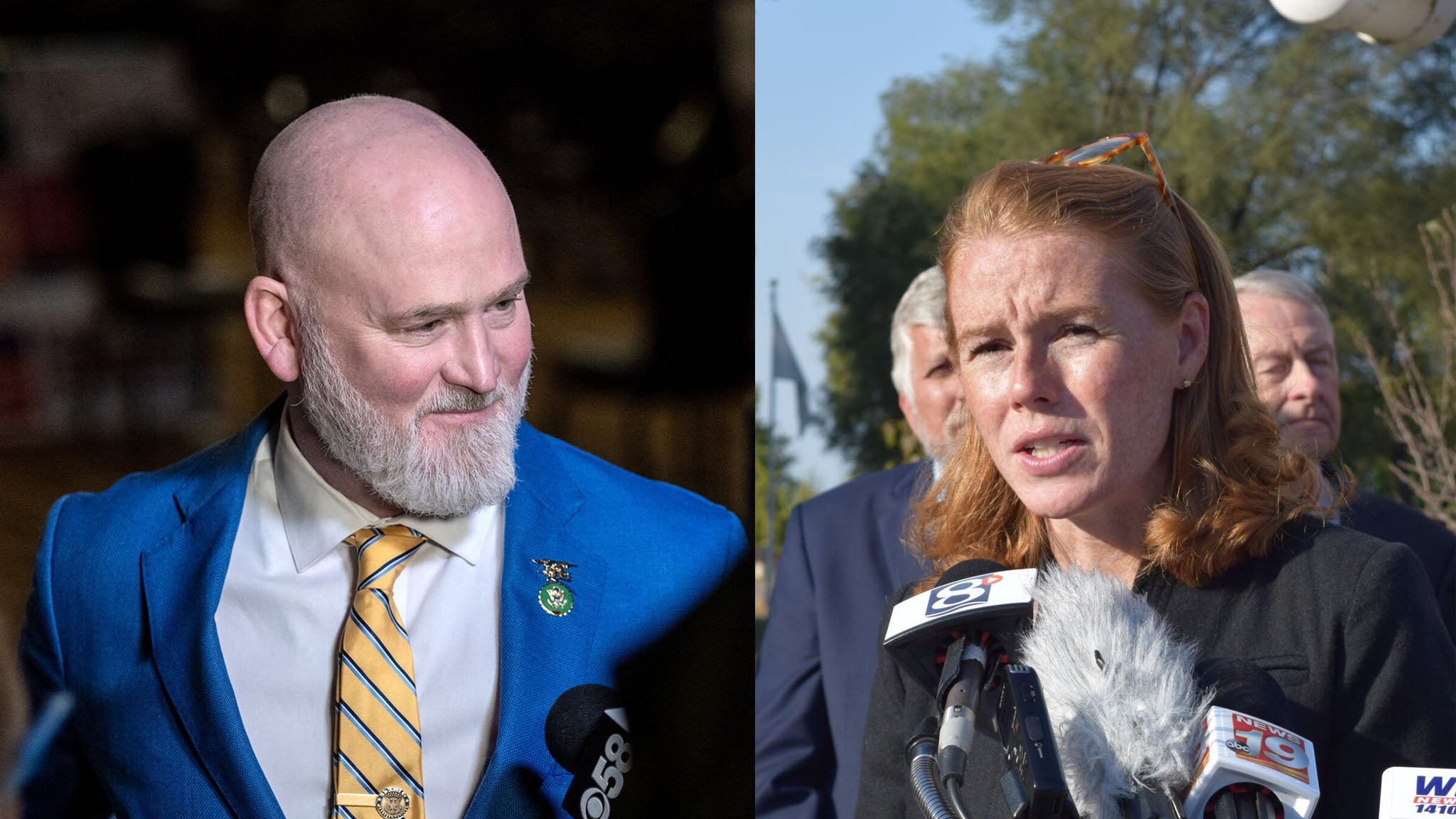
U.S. Rep. Derrick Van Orden and Rebecca Cooke. Angela Major/WPR and Hope Kirwan/WPR
As artificial intelligence makes it easy to generate realistic-looking depictions of just about anyone, these tools are creeping into campaigns, too.
In Wisconsin, a recent example can be found on the campaign social media of U.S. Rep. Derrick Van Orden, R-Prairie du Chien, who is running a competitive reelection bid.
In the weeks since the Democratic primary affirmed that his opponent will be Rebecca Cooke, Van Orden has criticized her for receiving support from national Democratic groups. He has described her as being “anointed” by an elite establishment based in Washington, D.C.
And with the help of Grok, the AI companion built into X, formerly Twitter, he recently created and published a video of a red-headed and freckled young woman — strongly resembling Cooke — ordering “peasants” to vote for her.
“I am the Anointed One. You will comply and you will vote for me,” the synthetic figure says. “That is an order from your D.C. masters.”
While Wisconsin has a law in place, passed with bipartisan support and signed in 2024, that requires campaign advertisements to disclose if they use AI-generated content, there’s no such restriction on social media content.
That would be hard to regulate with the wide protections given to political speech, said Peter Loge, who directs the School of Media and Public Affairs at the George Washington University, and its Project on Ethics and Political Communication.
But Loge says that, while AI-generated “deep fakes” is new, the art of lying about a political opponent may be as old as democracy itself.
“AI makes it easier to create fake videos and fake audio, and it makes it easier to spread those than ever before,” he said.
But “the issue isn’t whether or not they’re AI-generated or deep fakes,” he added. “It’s that the Republican incumbent is making stuff up about his Democratic challenger, and regardless of the technology, you shouldn’t make stuff up about your challenger.”
The race for Van Orden’s seat is the most competitive Congressional race in Wisconsin, and in the crosshairs of national Democrats looking to flip Republicans’ narrow majority in the U.S. House.
In a statement, the Van Orden campaign pointed out that the video has a disclaimer about being AI-generated directly below it. The video is intended as satire, said campaign spokesperson Grace Kim.
“Democrats seem to be awfully upset that the Congressman is satirizing things that are grounded in reality,” Kim said. “Rebecca Cooke has spent three campaign cycles lying to voters about who she is, so it’s pretty rich to see her suddenly outraged over this obviously AI-generated joke about her own record.”
In a statement, Cooke said she’d advocate for stricter regulations on using AI-generated content in elections, such as the Protect Elections from Deceptive AI bill, which would ban the distributions of videos just like the Van Orden clip.
“This sort of slop is what frustrates people on both sides of the aisle. It’s nasty mudslinging and character defamation,” Cooke said. “Deception like this should be illegal. But unfortunately, Congress hasn’t passed any laws to help that stand up in court. We need leaders in Congress to put guardrails on this technology to protect our communities.”
Legal vs. appropriate
Loge argued that those kinds of regulations are harder to enact than it may seem. How can lawmakers decide how much AI is too much? Instead, he said, voters should demand a higher and more informative level of civil discourse, regardless of legality.
“Whether that thing’s legal doesn’t mean it’s always appropriate, right?” he said. “You could dress up in a bunny suit and stand across the street from an elementary school yelling slander about Santa Claus. That’s probably legal, but you really shouldn’t do it.”
Voters should be hearing about the candidates’ records, he said, and where they stand on the issues of the day: immigration, tariffs, education, farm policy.
The risk of using deep fakes to score points, he added, is that it trains voters not to trust anything they see.
“We’ve always been skeptical. We should be skeptical. But if nobody believes politics, politics goes away,” he said. “If we believe that everything could be a lie, we then believe that things that are true could be lies.”
A national debate
States across the country are grappling with how to keep deep fakes from deceiving or confusing voters in the face of this growing technology. Twenty-eight states, including Wisconsin, have disclosure laws about AI-generated content, and three have some kind of ban on political deep fakes, according to the National Conference of State Legislatures.
And some states, including Wisconsin, have separate laws — long predating the advent of common AI tools — that bar impersonating public officials.
But candidates nationwide are using these tools anyway. In Tennessee, which has a disclosure law, two Republicans in a recent congressional primary used AI to attack one another. One candidate portrayed the other cavorting with drag queens and Nancy Pelosi. The other portrayed his opponent driving a campaign bus into a swamp. According to local reporting, the use of AI was not disclosed in the ads.
In Kentucky, which also has a disclosure law, national PACs created ads in a Republican congressional primary, each accusing the other of being too liberal. One of the Republicans was depicted holding hands with left-wing U.S. Reps. Alexandria Ocasio-Cortez and Ilhan Omar. The other was depicted as running away from a rally for President Donald Trump. According to local reporting, the use of AI was not disclosed in the ads.
But in Oregon, a similar situation is seen as a test case for their disclosure laws. There, the Secretary of State is investigating a former Republican candidate for Congress, whose failed campaign included AI videos posted to social media.
Video in competitive congressional race spotlights challenge of regulating AI-generated political content was originally published by Wisconsin Public Radio.
If you think stories like this are important, become a member of Urban Milwaukee and help support real, independent journalism. Plus you get some cool added benefits.





















Congressman Van Orden has experience with “making stuff up” : see Body cams capture incident Congressman calls ‘political violence’ – WISN https://www.wisn.com/article/wisconsin-body-camera-congressman-van-orden-political-violence/61779690
DVO is nothing more than a reTrumplican stooge, and his campaign people, as described here, are fully invested in the same low-level BS his party has chosen to utilize in order to remain in power.
Local TV stations have some discretion over whether or not to accept and air commercials like this, but it depends on who is paying for the commercial time. If it is the candidate, stations have almost nothing they can do. If it is a third-party PAC stations can say no.
The fact that the rules for all political advertising are controlled by the very people for whom they benefit has always been a laughable conflict of interest. Now, with the financial support of the likes of DOGE-master Musk and his AI spawn Grok, it becomes a terrible conflict of interest.
All the more reason why voters should not allow thirty-second TV commercials to sway or convince them about who to vote for. They need to do their own homework about the candidates involved in any campaign, and make their decisions accordingly.
The TV spots are only airing to convince the small percentage of people that seemingly can’t decide on a candidate. These people probably have problems with choosing what socks to wear everyday, as well.
Why can’t VanOrden can not run on his record or his support for Trump