
What’s Happening With Community Collaborative Commission
Citizen group oversees how Milwaukee Police comply with 2020 stop and frisk settlement.
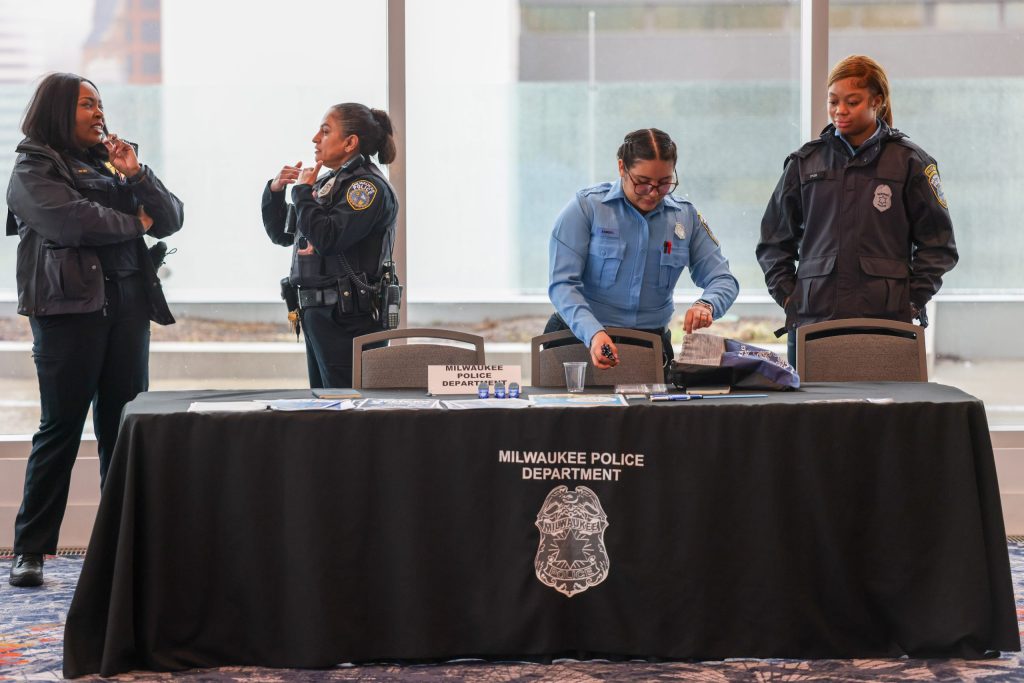
Milwaukee police officers participate in the All In, All Youth, All Summer resource and employment fair in April. A new plan that organizers hope will improve community/police relations was discussed Thursday. (Photo by Jonathan Aguilar / Milwaukee Neighborhood News Service / CatchLight Local)
The Community Collaborative Commission met virtually on July 9 to push forward efforts to finalize a community policing plan.
In recent years, the commission has worked on police policy reform, community-oriented policing and oversight of other reforms. Its members include community activists and leaders of local nonprofits.
Here’s what we learned.
Community policing plan still a work in progress
Commission members agreed the plan should be built with broad community representation in mind, including those that have historically been left out of policing conversations.
“We need to make sure that we have all those communities at the forefront when we’re discussing a working document,” said Nate Hamilton, chair of the Community Collaborative Commission. “If we’re missing any community or any stakeholders … we want you guys to bring those up.”
Among the populations Hamilton mentioned were the Muslim, LGBTQ and disabled communities.
There is collaboration with another oversight body
The Milwaukee Fire and Police Commission is a collaborator of the Community Collaborative Commission.
Generally, the Fire and Police Commission provides civilian oversight of the Milwaukee Police Department and can make nonbinding policy recommendations to the Milwaukee Common Council.
The Fire and Police Commission has provided subject matter expertise on problem-oriented policing, and, as the oversight body, would have ability to affect implementation of a community policing plan, said Krissie Fung, a member of the Fire and Police Commission.
Problem-oriented policing is “a strategy that focuses on identifying and addressing the root causes of crime – as opposed to traditional policing, which is more focused on enforcement of and short term response to specific incidents,” Fung said in an email to NNS.
She added that it’s a scientific method that uses the Scanning, Analysis, Response, Assessment, or SARA, model, which actively incorporates the community into appropriate responses.
Members want to engage the public about the progress being made
Hamilton expressed an interest in informing the public about progress the commission is making as well as about the ultimate policy itself.
Members discussed starting an outreach committee, though a final decision on it wasn’t made.
During the June Community Collaborative Commission meeting members discussed holding a public update later this summer focused on the status of the community-oriented policing plan. They also said they wanted to reach residents through outreach at neighborhood events and advertising.
Background
Originally established as the Milwaukee Collaborative Committee in 2018, the group was formed to address a leaked report by the U.S. Department of Justice that criticized the Milwaukee Police Department’s engagement with the community and the civil unrest that followed the fatal shooting of Sylville Smith by a Milwaukee police officer in the Sherman Park neighborhood in 2016.
Established in 2020, the Community Collaborative Commission was tasked with helping police meet the requirements of the landmark stop-and-frisk settlement. That settlement originated from a lawsuit filed against the city by Charles Collins and eight other Milwaukee residents who were pulled over by police.
Collins, a military veteran and longtime Milwaukee resident in his late 60s, was pulled over by police officers while driving home with his wife after visiting their son in 2014. Like the other plaintiffs, he broke no laws and was never charged.
Challenges for commission
Despite positive momentum toward the development of a community policing plan, there have been a number of challenges over the years for the Community Collaborative Commission.
Frustrated over what he said was a lack of support from the city, Stephen Jansen, then co-chair of the group, resigned from the commission in 2023.
“Fundamental and significant changes in policing have not occurred. The promises made to oppressed communities by elected officials at the local, state and federal level have not been fulfilled,” Jansen wrote in a resignation letter.
Another challenge for the group is a lack of engagement among members. During its February meeting, the commission discussed ongoing concerns over member attendance. Enough commissioners attended the past two meetings to make quorum, which hasn’t always been the case.
For more information
The Community Collaborative Commission’s next meeting has not been scheduled.
Information about upcoming meetings, agendas and minutes is available on the city’s public records website.
Jonathan Aguilar is a visual journalist at Milwaukee Neighborhood News Service who is supported through a partnership between CatchLight Local and Report for America.
This article first appeared on Milwaukee Neighborhood News Service and is republished here under a Creative Commons Attribution-NoDerivatives 4.0 International License.