

Complicated Financing Plan Will Pay For Paving, Playground and More Near Century City
'Monumental' progress says redevelopment authority commissioner.
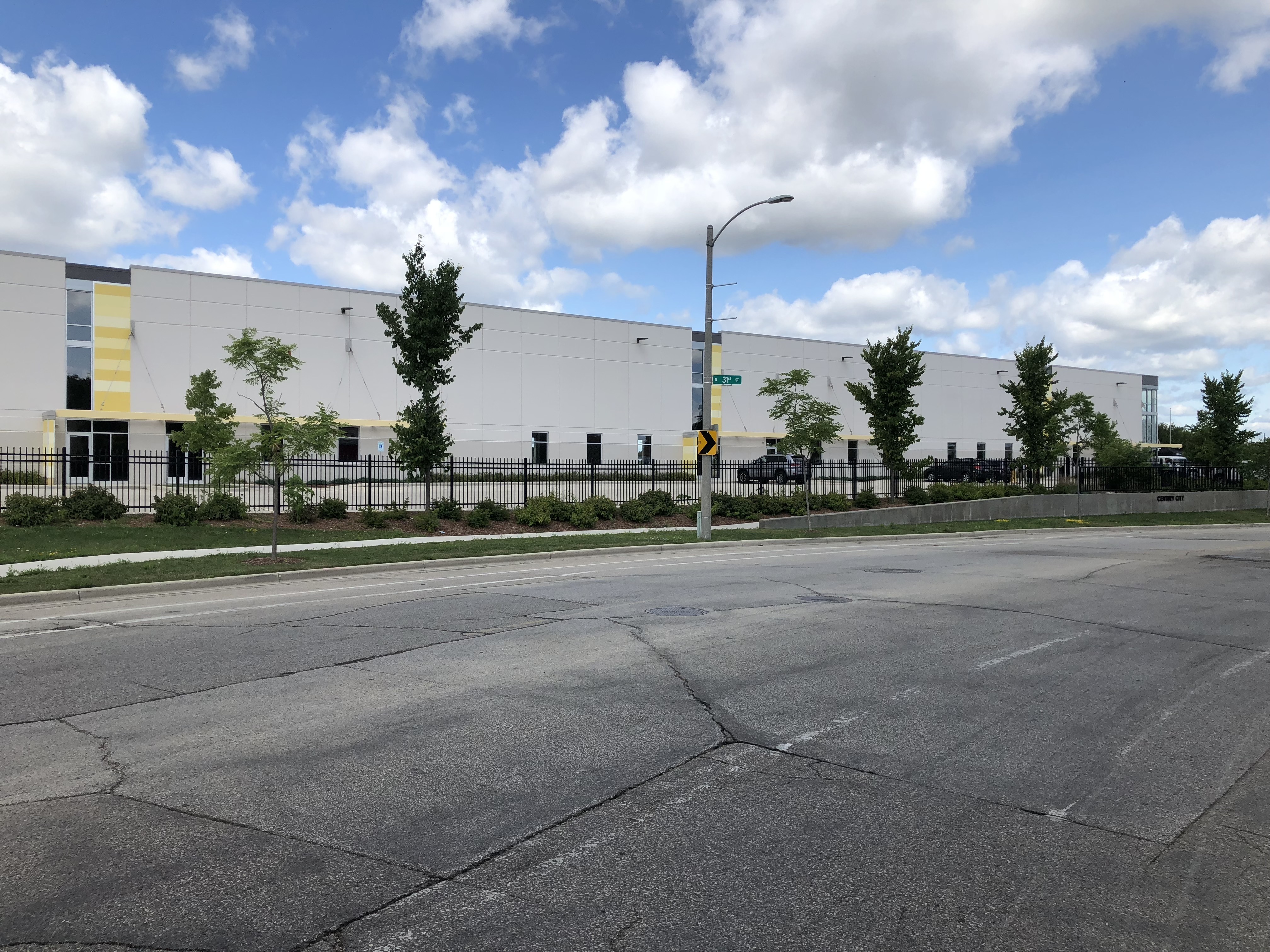
W. Hopkins St. near Century City. Photo by Jeramey Jannene.
A trio of tax incremental financing (TIF) districts surrounding the Century City business park would fund approximately $7 million in street repairs, traffic-safety projects, environmental cleanup, housing improvements, street-lighting upgrades, and a new playground.
The proposed amendments cover three districts on Milwaukee’s North Side: the Century City district, the Bishop’s Creek district and a smaller district associated with a former DRS Technologies facility.
“Combined, the three amendments today are about $7 million of investment into the neighborhood,” said Dan Casanova, Department of City Development senior economic development specialist, to the board of the Redevelopment Authority of the City of Milwaukee (RACM) Thursday afternoon.
The largest amendment would add about $4 million in spending to the Century City district (No. 74). The district, centered near N. 35th Street and W. Capitol Drive, was created in 2009 to support the redevelopment of the former Tower Automotive complex and includes several hundred surrounding homes.
The proposal marks a significant change in fortunes for a district that spent years unable to generate enough property tax revenue to cover the city’s costs of acquiring, cleaning and preparing the former industrial site. Successful TIF districts elsewhere in Milwaukee have donated approximately $21 million to help pay off the Century City district’s debt.
“It took a long time to get here, but this TID is doing what it was designed to,” said RACM Commissioner Montavius Jones. He called the turnaround “monumental.”
The district had an $89.2 million base value when it was created in 2009. That figure was reset to $63.3 million in 2014 after property values fell during and after the Great Recession. The district is now valued at about $109.9 million.
“There is positive value in the district, which is actually ahead of what was projected in 2009,” Casanova said. “It just took us a really long time to get there.”
The district’s struggles were caused not only by the slow pace of development at Century City but also by declining residential property values within its boundaries. About 900 properties are included in the district.
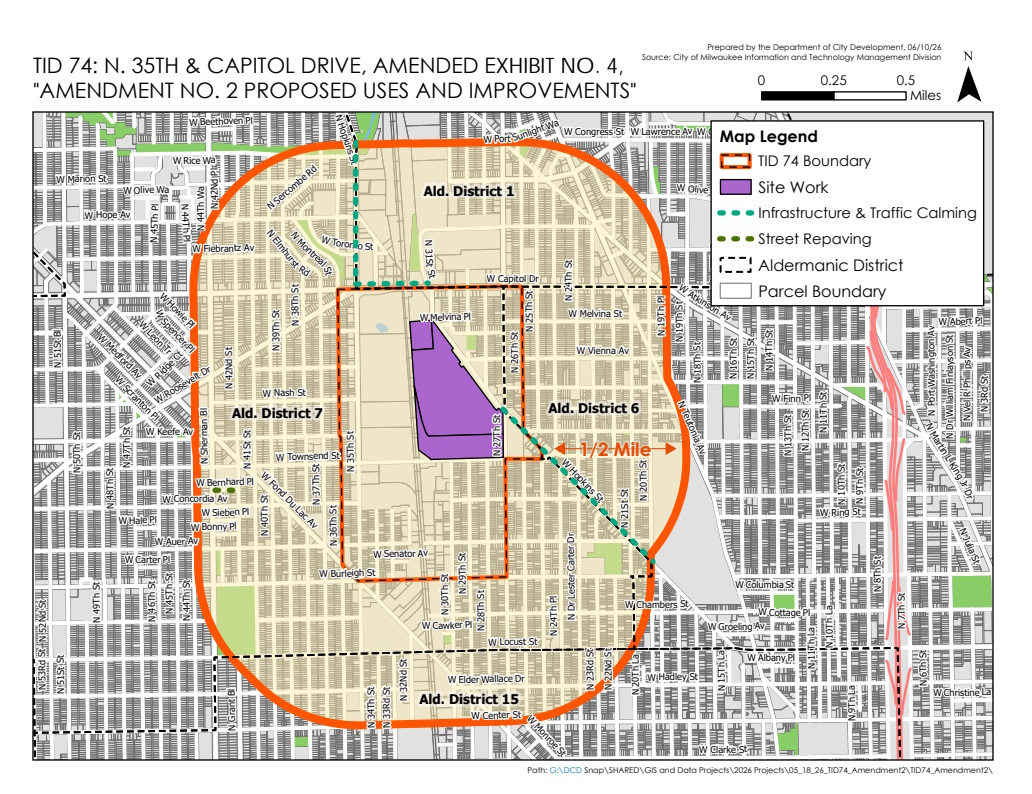
TIF District 74 plan. Image from DCD.
The amendment would provide $1 million for environmental remediation and site preparation at Century City, where city officials continue to pursue new industrial development.
Dave Misky, city director of real estate, said an effort to construct a second building modeled on Century City 1 has encountered complications from PFAS contamination. But he said the majority of the about 40-acre development site is prepared and ready for construction.
The plan also includes $1.1 million for safety improvements and repaving on N. 35th Street, $820,000 for improvements to W. Capitol Drive between N. 31st and N. 35th streets and $500,000 for safety improvements on N. Hopkins Street between N. 20th and N. 27th streets.
N. 35th Street, Capitol Drive and Hopkins Street are all included on the city’s High Injury Network, which identifies streets where severe and fatal crashes are concentrated.
City Engineer Kevin Muhs said the Capitol Drive work would focus on the south side of the street and improve conditions for pedestrians and bicyclists. The project would connect several other nearby investments and include work beneath the railroad viaduct.
Another $220,000 would be used to repave W. Bernhard Place, next to Townsend Street School.
The amendment includes $150,000 for grants to homeowners, administered through the Neighborhood Improvement Development Corporation. Casanova said the amount is based on what the district can support, not the level of demand, which is substantially greater.
The plan also reserves $150,000 as a contingency and $100,000 for administration. The district is expected to pay off its obligations by 2034.
Bishop’s Creek Improvements
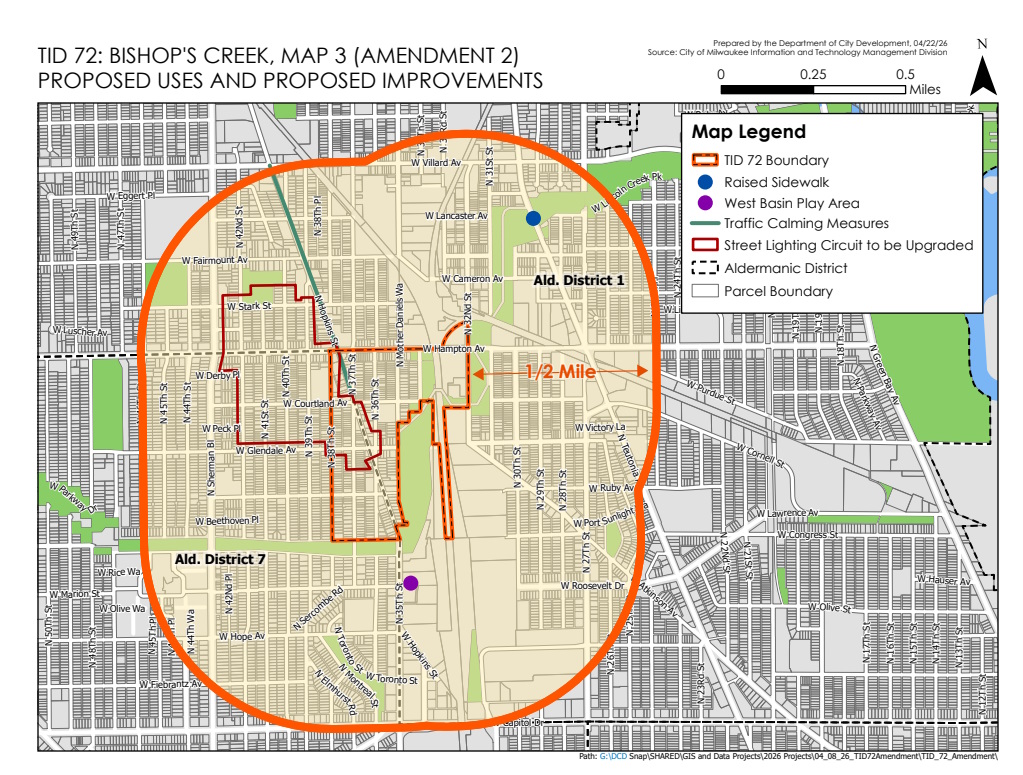
TIF District 72 plan. Image from DCD.
A second amendment would draw about $2 million from the Bishop’s Creek district, No. 72, for street lighting, traffic calming and a new playground at the Milwaukee Metropolitan Sewerage District’s planned West Basin project.
The district was created in 2008 to support the redevelopment of the former Kaiser tannery property. It included a provision for forgivable home-improvement loans and supported an affordable housing development led by Holy Redeemer Institutional Church.
Like Century City, Bishop’s Creek was hit hard by the Great Recession.
The district’s base value was reset in 2014, reducing it by about $8 million and giving the district more flexibility to recover financially.
The amendment would provide $935,000 to replace street lighting, an issue area Alderwoman Andrea Pratt said generates frequent complaints from residents experiencing repeated outages.
Another $315,000 would fund traffic-calming improvements on N. Hopkins Street north of the work proposed through the neighboring TIF District. Raised crosswalks would also be installed near N. Teutonia Avenue and W. Lincoln Creek Parkway.
The largest single recreational investment would be $750,000 for a new playground at West Basin. The site is intended to hold 30 million gallons of stormwater, reducing area flooding and Deep Tunnel overflows. Misky said the playground component stems from neighborhood outreach led by the Northwest Side Community Development Corporation.
Pratt said the West Basin area, even before the project has been completed, has “really become a hub in the area.”
The Department of Public Works‘s MKE Plays program would maintain the playground.
“I’m happy we are able to deliver that for them,” said Pratt.
Wisconsin law allows TIF revenue to be spent on eligible public infrastructure within a half-mile of a district’s boundaries. The Bishop’s Creek district is expected to pay off its obligations in 2032, its 22nd year.
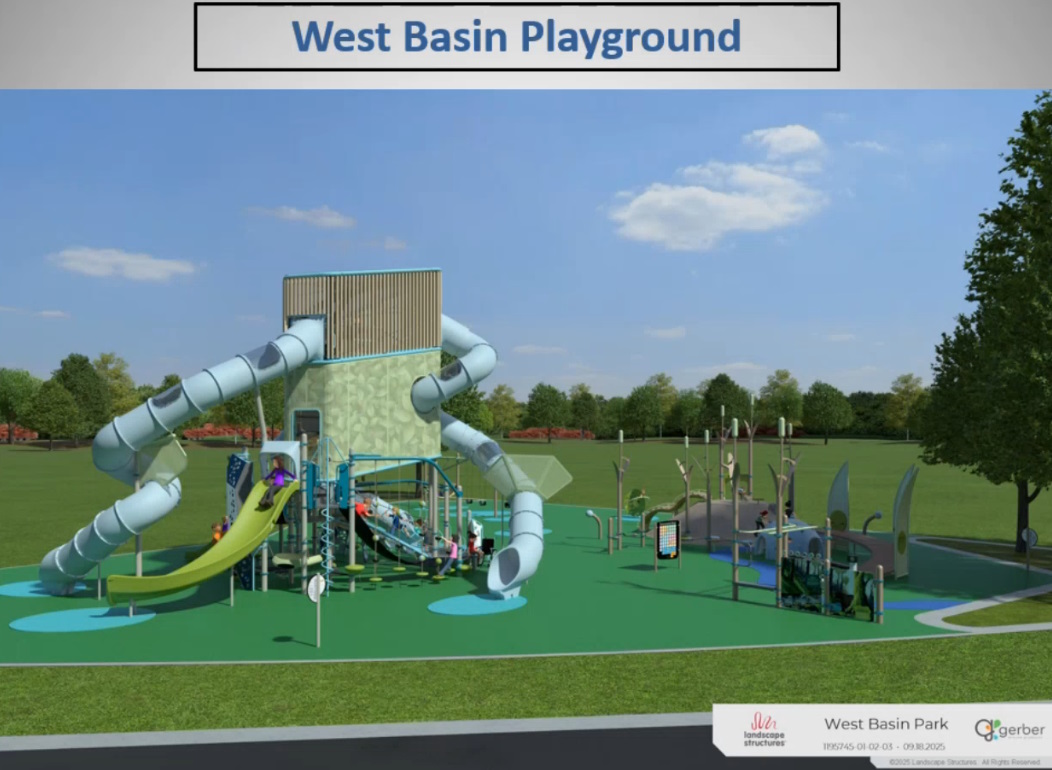
Proposed West Basin playground. Image from the City of Milwaukee.
Street Repairs Near Former DRS Facility
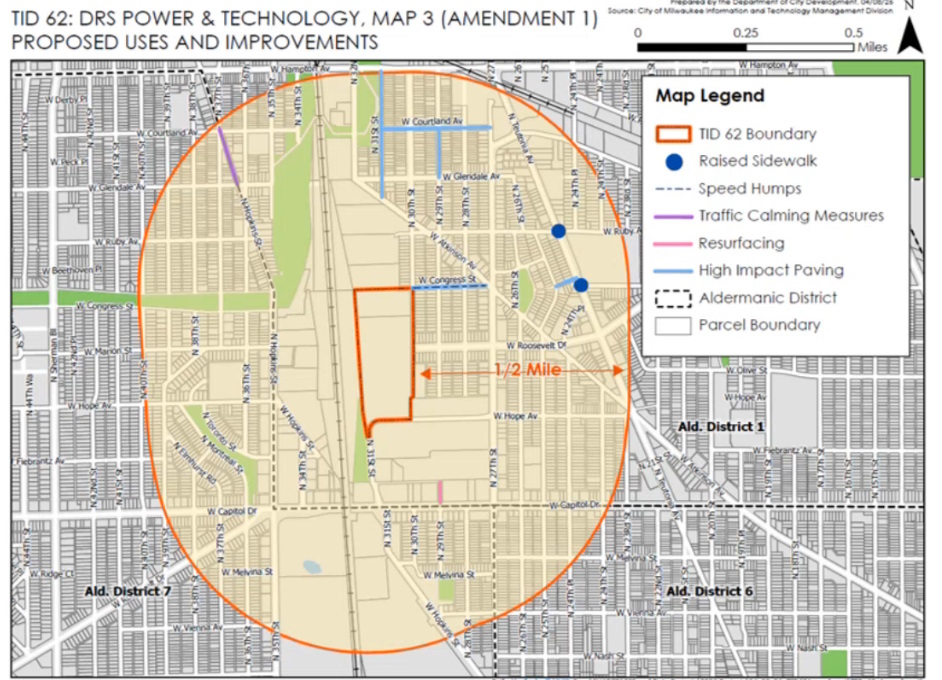
TIF District 62 plan. Image from DCD.
The smallest amendment would use $1 million from district No. 62 for street resurfacing and traffic-safety work.
The district was originally created in connection with a DRS Technologies facility at 4265 N. 30th Street and an employment commitment involving 450 workers over 10 years.
But, after the job commitment expired, the company left the facility for Menomonee Falls
“They’ve moved out,” Misky said, adding that the building is being used for other purposes.
Despite the departure, the district has generated enough revenue to fund neighborhood improvements without additional borrowing. It currently has about $6.8 million in assessed value above a base value of about $2.8 million, creating a $4 million tax increment and about $80,000 in annual incremental property tax revenue.
The district is expected to pay off its existing obligations next year.
The amendment would provide $120,000 to resurface N. 29th Street near W. Capitol Drive.
Another $570,000 would pay for the high-impact paving on W. Courtland Avenue, N. 31st Street and two segments of W. Congress Street. An additional $40,000 would fund speed humps on Congress Street between N. 27th and N. 30th streets.
The proposal includes $370,000 for additional traffic calming on N. Hopkins Street, another High Injury Network corridor, and $120,000 for raised crosswalks near Lloyd Barbee Montessori School.
Pratt said the investments are particularly important in an area that has experienced years of declining investment.
“We have seen a lot of divestment from this area,” she said. “So it’s a huge deal that something is happening here for neighbors.”
“These are some of the worst streets in my district,” said the alderwoman.
Pratt said the projects would also offer residents a visible example of how their property tax payments can be reinvested in their neighborhoods.
“I am happy to let people know that we care about every neighborhood in the city,” she said.
The board unanimously approved all three amendments, but the Common Council must still approve the spending plan.

Existing members must be signed in to see the interactive map. Sign in.
If you think stories like this are important, become a member of Urban Milwaukee and help support real, independent journalism. Plus you get some cool added benefits.




















It just seems a darn shame that Rockwell picked New Berlin and the other manufacturer HQs in town (Milwaukee, Rexnord, Enerpac, JCI/Clarios, etc) don’t have major mfg facilities here any more. Those are the jobs needs (to come back) to this area.
I agree with the first comment. Rockwell would have been amazing. This location struggles with highway access. It’s a huge pain driving big trucks down any of the truck routes here to 43 or 94.