

Congress Reconsiders 1960s Law That’s Helped Green Bay Packers for Decades
Rep. Scott Fitzgerald pushes to reconsider antitrust exemption for sports broadcasting.
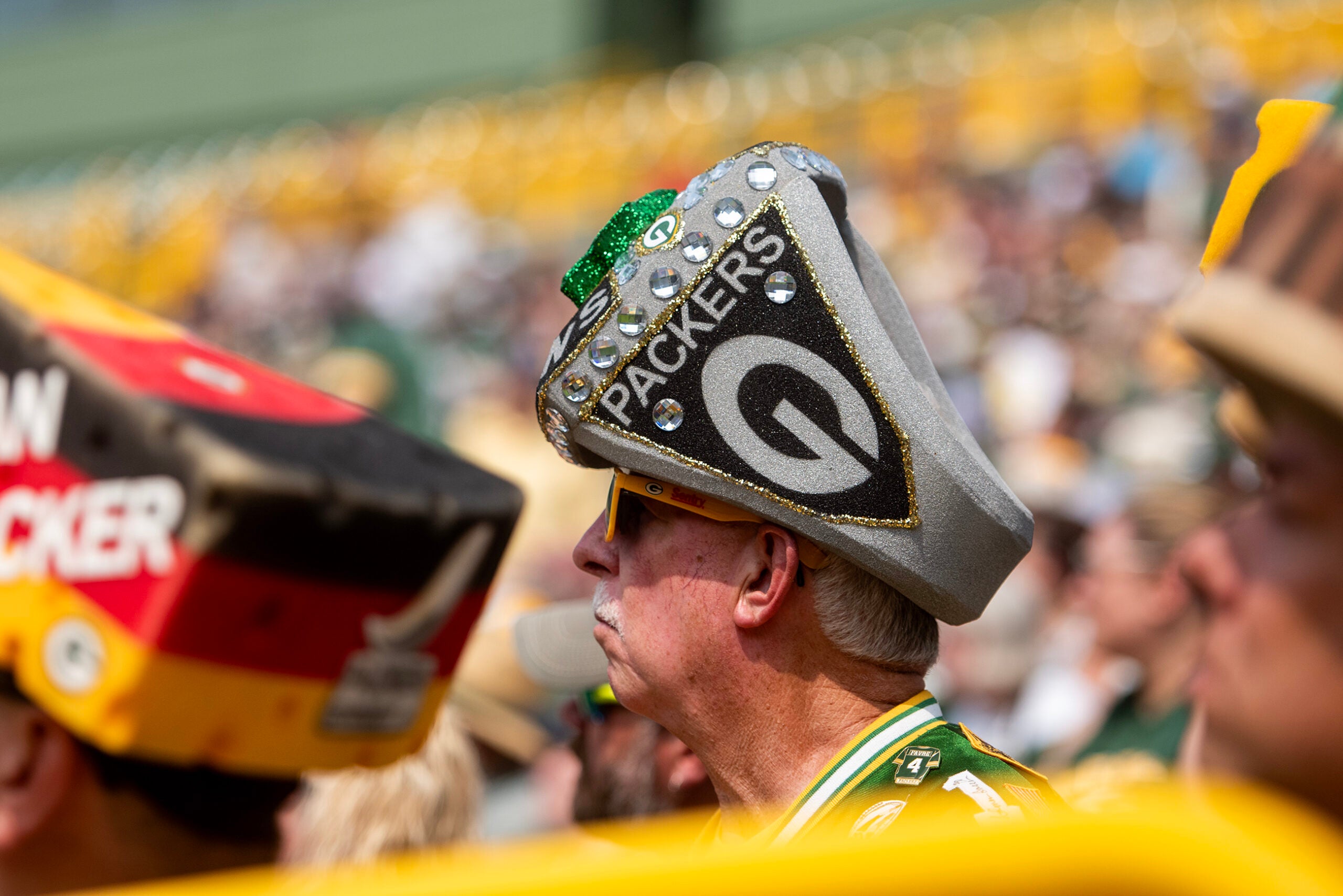
Fans and shareholders attend the Green Bay Packers Annual Meeting of Shareholders on Friday, July 25, 2025, at Lambeau Field in Green Bay, Wis. Angela Major/WPR
As Congress investigates a federal law from the 1960s, Wisconsin Republicans find themselves on different sides of the issue — and the Green Bay Packers are on edge.
The House Judiciary Committee last week took testimony about the Sports Broadcasting Act of 1961, questioning whether it still applies in a world of streaming media.
Passed when home televisions were just beginning to be a fixture in most American households, the law offered professional sports leagues a carveout from antitrust laws when it came to broadcasting rights. Instead of making every team negotiate with the big four broadcasters, the law allowed the league to make those deals and divvy up the profits.
That gave an advantage to teams that operate in smaller media markets, said Matthew Mitten, executive director of the National Sports Law Institute at Marquette University Law School.
“This has definitely benefited the Packers, because they’re in the league’s smallest market,” Mitten said. “Their … share is much higher than if the Packers were individually selling their broadcast rights, trademark licensing rights, et cetera.”
Now Congress is questioning whether the 65-year-old antitrust exemption for sports leagues still applies, if they’re not broadly distributing their content for free on TV. Today, broadcast rights to certain games or events may be distributed exclusively to paywalled services such as Amazon Prime or Peacock.
U.S. Rep. Scott Fitzgerald, R-Juneau, chairs the House Judiciary Committee’s antitrust subcommittee, which instigated an investigation into leagues’ pricing models. At a hearing last week, Fitzgerald argued that these broadcasting deals are worth far more than in 1961, and that fans may be on the losing side of the current structure.
“Years later … it is fair for this body to ask whether the professional sports leagues have kept up their end of the bargain. In my opinion, they have not, and sports fans are paying the price because of it,” Fitzgerald said. “While the leagues are undoubtedly more popular than they were in 1961, because they do not follow America’s antitrust laws for television agreements, they can charge consumers inflated prices that would otherwise be illegal.”
The NFL is by far the most watched league in the country, drawing 10 to 20 times more viewers than the MLB or NBA. According to a report by the House Judiciary Committee, some football fans pay as much as $600 per season to keep up.
Representatives for the Packers have said that the current revenue-sharing model keeps their team alive. In a letter to Fitzgerald, Packers public affairs director Aaron Popkey said “any disruption to the current (Sports Broadcasting Act) model … would pose an existential threat to the Green Bay Packers and their existence in Green Bay as we know it.”
And some members of Congress sent U.S. Rep. Jim Jordan, who chairs the judiciary committee, a letter arguing that the law has been a success in offering local markets free access to home games. The law, they wrote, “means that fans in Green Bay, Buffalo and Kansas City can watch their teams compete on an equal playing field with those in Chicago, New York and Los Angeles.”
Among the signatories of that letter were U.S. Reps. Tony Wied, R-Green Bay, and Derrick Van Orden, R-Prairie du Chien.
Although there is a salary cap that means no one team can simply pay all their players more than any other team, having relatively equal revenue streams allows teams to recruit strong players, coaches and staff, Mitten said.
“It’s expensive to field the winning team,” he said.
In a television appearance over the weekend, Fitzgerald argued that those concerns are overblown.
“When it comes to the NFL, shared revenue is not an issue, and as a matter of fact, I don’t care how the NFL divides up the pie amongst the teams in the NFL,” he said on WISN-TV’s “UpFront.” “It’s not something that’s even affected by the SBA.”
And there may be a more banal reason Packers fans don’t need to worry for now, said Mitten: Congressional dysfunction.
“These days it’s very difficult to enact any federal legislation, you know, particularly sports legislation,” he said.
Congress is investigating a 1960s law that’s helped the Green Bay Packers for decades was originally published by Wisconsin Public Radio.
If you think stories like this are important, become a member of Urban Milwaukee and help support real, independent journalism. Plus you get some cool added benefits.


















Listen to Fitzy! He probably needs help choosing his socks every day, but he’s apparently become an expert on the financial machinations of the Sports Broadcasting Act and how they are applied within the NFL. Maybe he can throw his hat in the ring if the Packers need to replace their president and CEO Ed Policy.
Wisconsin taxpayers have been subsidizing the Packers organization for 65 years.
Fitzgerald is more concerned about his campaign donations than Wisconsin Citizens.
Meanwhile, We continue being shortchanged “Shared” Revenue.
Reinstate Anti-Trust law.
Milwaukee Metro area has been hemorrhaging money since it was coerced by the state to pay for the new stadium for the Milwaukee Brewers (for so-called “shared revenue”).
See Urban Milwaukee’s, Bruce Murphy’s article April 13, 2022:
40-Year Tax Subsidy For Miller Park: $1,561,150,000.
BUCKS Arena also cost us. Murphy references it.