Assembly Speaker Vos Vows to Try Again on Failed Tax Cut Deal
Marquette poll found 80% in state survey said Legislature should have passed the bill.
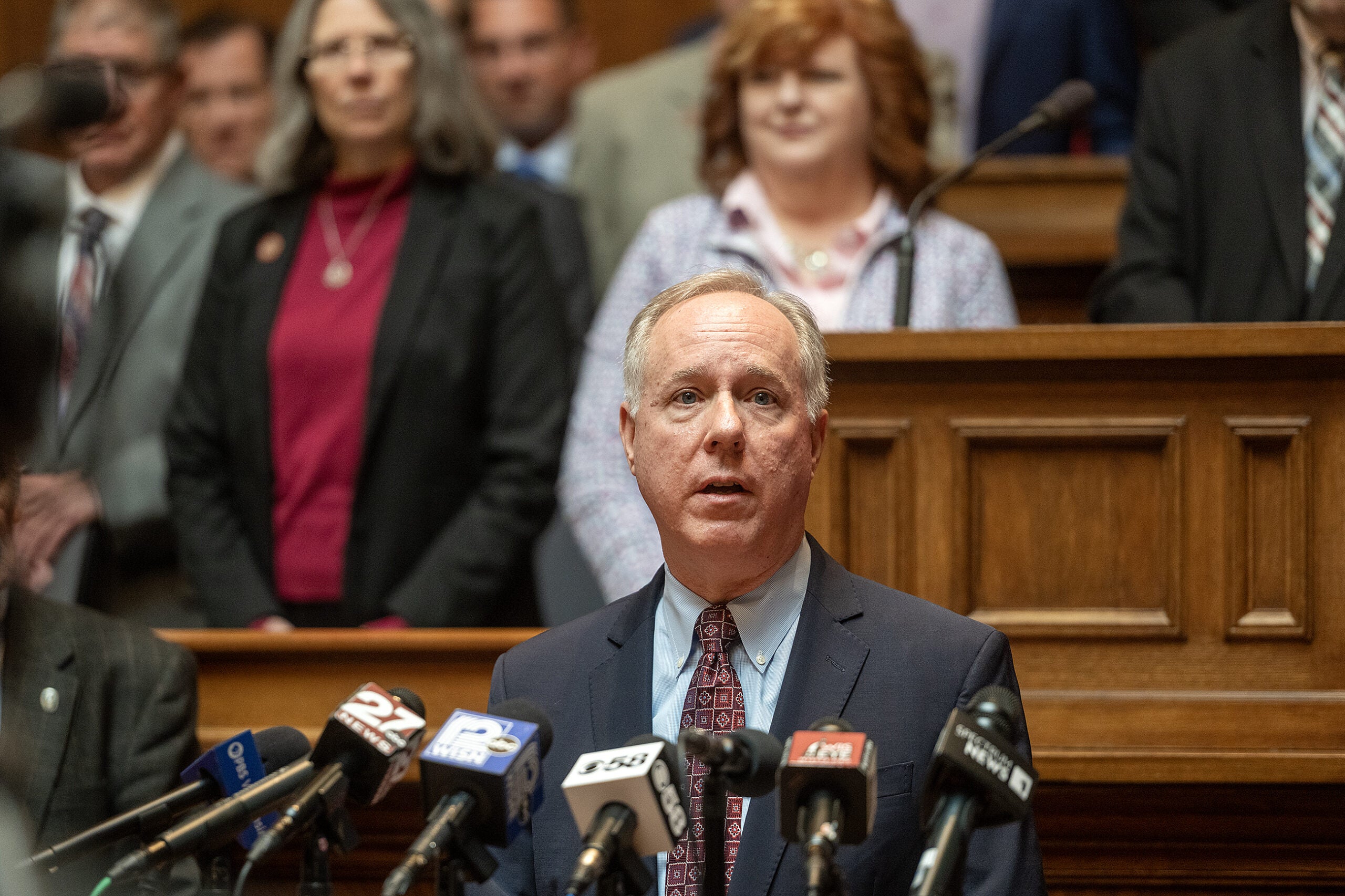
Republican Assembly Speaker Robin Vos stands with fellow Republicans for a press conference to discuss a proposed property tax agreement Wednesday, May 13, 2026, at the Wisconsin State Capitol in Madison, Wis. Angela Major/WPR
A vote in the state Senate last month tanked a deal to use Wisconsin’s budget surplus for tax refunds, special education funding and more. Now, the top Republican in the state Assembly wants to bring some kind of deal back to the table.
The initial proposal was negotiated by Democratic Gov. Tony Evers and Republican legislative leaders. The roughly $1.8 billion spending plan would have secured $600 million for K-12 school funding aimed at lowering property taxes and covering more special education costs. It also included more than $850 million in direct payments to income tax filers and eliminated state income tax on overtime and tipped income.
The bipartisan plan ultimately met bipartisan opposition, as all Senate Democrats and three Senate Republicans rejected the plan. But a Marquette Law School Poll found that 80 percent of Wisconsin adults said that the Wisconsin legislature should have passed it.
Assembly Speaker Robin Vos said that consensus merits returning to negotiations.
“Wisconsinites are so divided, like much of the country,” Vos told WPR’s “Wisconsin Today.” “So anytime that you get 80 percent of the people agreeing on something, we should at least give it our full-throated effort to try to find a consensus that everybody can live with.”
Assembly Speaker Robin Vos spoke with “Wisconsin Today” about what he thinks the next deal should look like, and the possibility of getting it over the finish line.
This interview has been edited for length and clarity.
Rob Ferrett: Earlier this week, you told Up Front that you want to work with Governor Evers on a revised plan. What are you hoping to accomplish?
Robin Vos: We have concerns about school funding. We know property taxes are too high, and we certainly need to do more to help people deal with the ravages of inflation. So when a Democratic governor and a Republican legislature negotiate in good faith, it should be something that everybody just signs off on, saying, “Wow, I can’t believe that two sides who normally don’t get along very well are showing leadership.”
I was disappointed that our Senate Democrat colleagues didn’t even offer an amendment. They didn’t say, “Here’s a way to make the deal better, here’s what we can do to try to showcase that we’re willing to lead as well.” So, I want to give them another chance. They had said they were concerned about the deficit. … We know that the deficit that would be projected is way lower than the one that we voted for last year, and we’ve had two increases in revenue: one, $1.5 billion in January because of the growing economy, and the second, another $300 million increase, just from where our baseline was.
So even by investing the surplus in the no tax on tips and overtime, more funding for special education and property tax relief, we still have a sizable surplus going forward, and that’s where we should all be proud that we can come back together and figure it out.
RF: Is the governor open to going back to the table on this?
RV: Yeah, it sounds like the governor is willing to work with us again. I talked to the legislative leadership in the Assembly, and I’ve reached out to those colleagues in the state Senate to say, “Let’s come back to the table.” We are all paid to do our job through the end of the year. There is no reason that we don’t come back and try to deal with this surplus in June.
RF: Last week, I talked to State Sen. Chris Kapenga, one of the Republicans who voted against the plan. He sees this as perpetual funding based on a one-time surplus. You said the deficit numbers weren’t as bad as critics made out. What would you say to Sen. Kapenga and his two colleagues who voted against this?
RV: Well, it’s really disappointing, because I thought Sen. Kapinga was smarter than what he’s sounding like in these interviews. We know that we do a two year budget cycle where we do projections of revenue and projections of expenditures. The expenditures have basically been in line, and the revenues have been ahead of our projections. So, why would we want to keep that money in Madison when we have the opportunity to give back extra money that we do not need back to the taxpayers?
The reason we want it to be permanent is because if somebody earns overtime or tips, or they want property tax relief, we don’t want it to be one time. That property tax bill or their income tax bill is forever. … I thought Sen. Kapenga was a Republican, and that’s the basics of what we do as Republicans, which is to try to make government more efficient, drive efficiencies into the system, so at the same time we can give the money back to the taxpayers. That’s why I ran for office. I think for most Republicans, that’s why we’re there.
RF: Would you be open to changing the deal to make it more focused on the one-time stuff, to get those votes in the Senate?
RV: I’m always open to listening to good ideas, so if they have a way to do it, of course we’re willing to listen. But again, if we’re going to have ongoing spending, which is really what is required — take special ed as an example, where we would take it to the highest level in Wisconsin history — if we’re going to do that, we’re not going to do it one time and then cut it back later.
So if we’re going to have spending built in, which it should be to help school districts with the increasing cost of special ed, I don’t want to say that the tax cuts are one time, so that we have permanent spending on schools, but not permanent relief for families.
RF: Sen. Kapenga and other lawmakers also questioned the process here, that the governor and the leadership in both chambers met up, came up with this deal, came to the rank and file and said “Here’s the deal, take it or leave it.” They wanted more input and more back and forth on this. What do you say to those concerns?
RV: Sen. Kapenga spends a lot of time out of state, so perhaps he wasn’t at some of the caucuses that they had, but I know Sen. Devin LeMahieu came to us and said he had been working with his caucus, I had worked with our caucus in the Assembly. That’s why I think everybody but one member voted for it, because they knew it was in the deal. They knew it was a good deal for taxpayers, and it was important to make some of these strategic investments. I believe they had the exact same conversations in the state Senate.
The three members who voted no said they had to have a sizable rebate in order to support the deal. That’s why we actually put that $300 and $600 rebate for individuals and couples into the bill to be able to say we listened to what they wanted.
RF: You’re not running for re-election. Do you feel like this plan is a fiscally responsible way to wrap up your career as Speaker?
RV: Oh, absolutely. I am proud of the fact that when we inherited the majority, we had massive deficits, no money in the rainy day fund — literally a fiscal crisis in the state. We’ve solved that, and now every session that we’ve been in charge, we’ve been able to reduce the tax burden, because these surpluses keep piling up because of prudent fiscal responsible leadership. … Most of the people who voted for this deal — in the Assembly it was both Democrats and Republicans — most of them are running for re-election. They wouldn’t have done it if they thought it was a stupid idea.
In the state Senate, the only people who really voted “no” were two people not running for reelection — who’ve been a “no” on pretty much everything in their entire career — and the Senate Democrats who cynically want to spend it on growing the government next time. I think this is a perfect opportunity for us to strike a middle of the road deal: money for schools and money for taxpayers, all out of the surplus, so we can show that Wisconsin actually works and that we can find a way to get to yes.
Assembly Speaker Vos vows to try again on failed budget surplus deal was originally published by Wisconsin Public Radio.
If you think stories like this are important, become a member of Urban Milwaukee and help support real, independent journalism. Plus you get some cool added benefits.