

Failed Evers-GOP Deal Would Have Created State Budget Deficit
An analysis by the Legislature's nonpartisan budget office found it would have created a $2.9 billion deficit.

Gov. Tony Evers learns about the Sources of Strength program during a school visit Monday, May 11, 2026, in Barneveld, Wis. Angela Major/WPR
A failed deal on tax relief and school funding would have left Wisconsin in the red by billions of dollars, according to a memo released Wednesday by the Legislature’s nonpartisan budget office.
The proposal died dramatically in the Senate last week, after a coalition of Democrats and a few Republicans voted against it, voicing concerns it would cost too much.
The deal brokered by Democratic Gov. Tony Evers and Republican leaders came with an estimated price tag of $1.8 billion. That money would have been spent on direct checks sent to most income taxpayers, general school aid, increased special education reimbursement and ending the state income tax on overtime and tipped wages.
According to an analysis prepared by the Legislative Fiscal Bureau, that proposal, combined with preexisting expenditures from the state budget and legislation passed over the last year-and-a-half, would have caused the state to spend an additional $3.5 billion over four years.
The analysis found — assuming no other changes in revenue or spending — that would leave the state with a $2.95 billion deficit.
“I think the simplest way to put it is, it would have put the next budget into a tougher position, a genuinely tougher position,” said Jason Stein, president of the Wisconsin Policy Forum. “Would it be manageable? I mean, in the end, everything can be managed. But could it be easily managed? Not necessarily.”
During debate over the failed deal, critics of the bill from both sides of the aisle pointed to the possibility of unknown costs coming down the pipeline. Democrats in particular pointed to the war in Iran, which is contributing to soaring gas prices and rising costs.
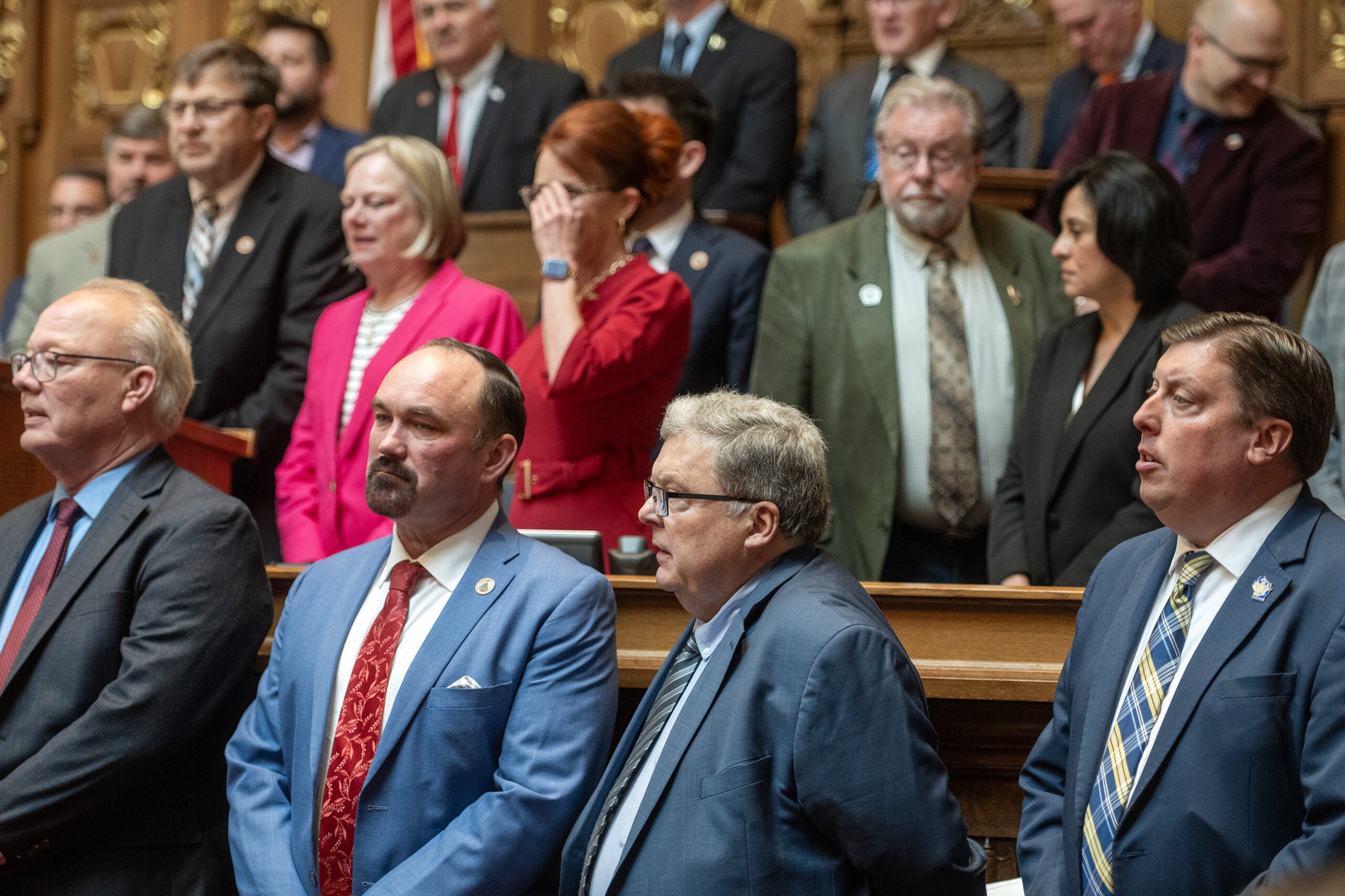
Republican members of the Wisconsin State Assembly stand together before a special session Wednesday, May 13, 2026, at the Wisconsin State Capitol in Madison, Wis. Angela Major/WPR
In a statement to WisPolitics, Senate Minority Leader Dianne Hesselbein, D-Middleton, whose caucus sunk the deal, said the Fiscal Bureau’s analysis justifies her members’ concerns.
Meanwhile, Sen. Howard Marklein, R-Spring Green, who co-chairs the Legislature’s budget writing committee and supported the deal, said the analysis doesn’t account for historical norms in increased tax revenue, which he said would have offset the cost.
Separate analysis shows ongoing budget challenge
The Legislative Fiscal Bureau also prepared a separate memo for lawmakers that sums up the status of the budget as it stands right now — without the tax and school funding deal.
Only accounting for the cost of every bill passed in the last legislative session — which began on Jan. 1, 2025 and wrapped up in March — the analysis found Wisconsin will spend more than it takes in by just over $580 million.
“We can spend more than we take in for a while, but not forever,” said Stein.
Because the state is currently sitting on a projected surplus, it would still end the next budget with a positive balance of $525 million, according to the Fiscal Bureau.
Like the other analysis, this one did not take into account potential changes to state revenue or expenditures.
A variety of factors can contribute to fluctuations in state finances, according to Stein. Tax revenue, demand for social services, Medicaid enrollment and public school enrollment always change, shifting the state’s ledger book between what it takes in, and how much it spends.
Failed surplus deal would have sent Wisconsin budget into the red, analysis finds was originally published by Wisconsin Public Radio.
If you think stories like this are important, become a member of Urban Milwaukee and help support real, independent journalism. Plus you get some cool added benefits.





















I understand why “Popcorn” Voss and LeMahieu backed this stinker, but what’s up with Evers? Why did he freeze out the Dem leadership? One last kick in the teeth for MKE? Was he offered a job working for the Koch’s? So much for your “legacy”…