Bill Would Let Wisconsin Blame Other States For Its Smog Problem
GOP lawmakers say Illinois and Indiana drive ozone levels; critics say air will not get cleaner here.
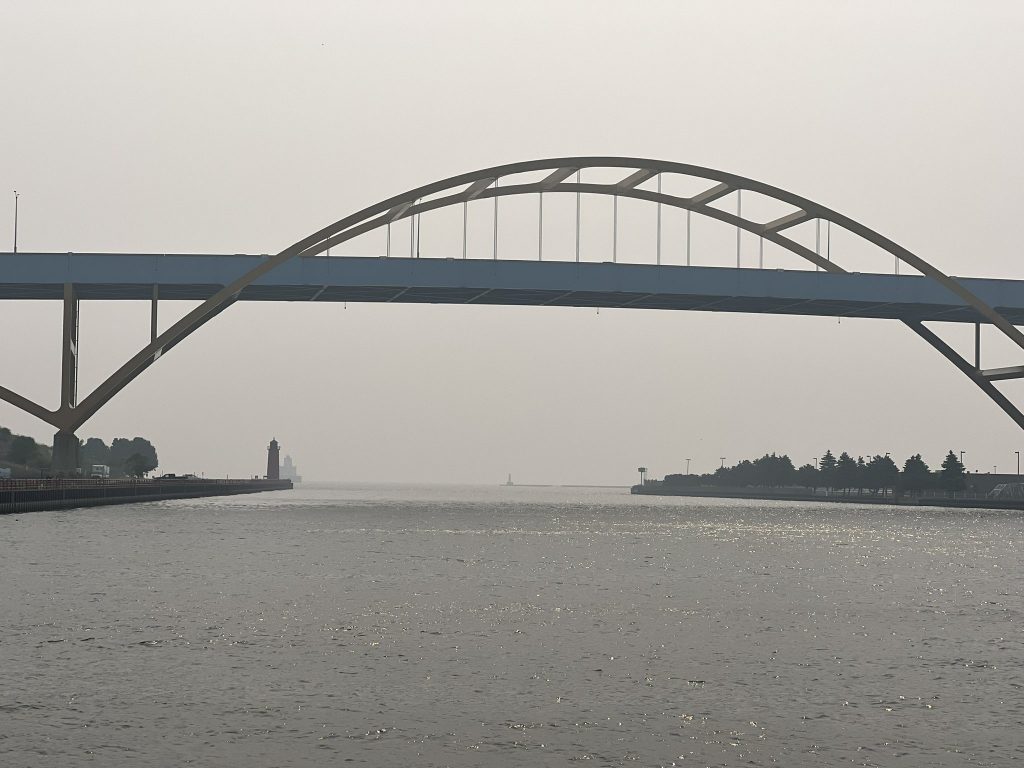
The Hoan Bridge and Lake Michigan becoming hidden by smog. Photo by Jeramey Jannene.
Wisconsin would be allowed to redesignate areas that aren’t meeting federal smog regulations if it can show most pollution is coming from outside the state under a new bill introduced by Republicans.
U.S. House Republican Reps. Bryan Steil, Scott Fitzgerald, Glenn Grothman and Tom Tiffany introduced the Fair Air Standards Act on Monday. The legislation is the latest development amid years of legal challenges and regulatory efforts to bring the state in line with ground-level ozone standards updated by the Obama administration in 2015.
Often called smog, ozone pollution occurs when air pollutants like nitrogen oxides and volatile organic compounds from industry, power plant or vehicle emissions interact with heat and sunlight. The Environmental Protection Agency has designated seven southeastern Wisconsin counties in “nonattainment” or not meeting national air quality standards for ozone pollution.
In a news release, Steil said Wisconsin families shouldn’t be paying for pollution that crosses state lines.
“The Fair Air Standards Act ensures that Wisconsin’s non-attainment status is tied to activity originating in our state not those in other areas,” Steil said. “Our bill reduces burdens for families, employers, and workers across Southeast Wisconsin while holding out-of-state polluters responsible for their actions.”
Areas that are not meeting ozone standards include all of Milwaukee and Ozaukee counties and parts of Kenosha, Racine, Sheboygan, Washington and Waukesha counties. The Wisconsin Department of Natural Resources said lakeshore areas are susceptible to high ozone levels because of meteorological and other factors that carry pollution from out of state.
A DNR spokesperson said only about 10 percent of the ozone pollution affecting the counties comes from Wisconsin sources. The rest comes from other states, with Illinois and Indiana having the largest impact, contributing about 35 percent.
Under the bill, a state’s governor may submit evidence that an area would meet ozone limits if not for outside sources, and the EPA administrator could grant or deny any redesignation. Republican congressman Tom Tiffany co-sponsored the bill, and he’s the GOP frontrunner in the race for Wisconsin’s governor.
Tiffany has also called for an end to “costly and time-consuming” vehicle emissions testing for hundreds of thousands of drivers. Testing is required due to the state’s ozone nonattainment status, which could end if the bill advances. Nearly $300 million in state and federal funding has been allocated for the state’s vehicle emission inspection program since 1984, according to the Legislative Fiscal Bureau.
Environmental group Clean Wisconsin has previously sued to enforce smog regulations. The group’s general counsel, Katie Nekola, said it’s a bad bill that doesn’t reduce pollution from other states.
“If Tom Tiffany cares about Wisconsin, he should want to actually cut the pollution that’s coming into our state with the tools that are available already, rather than just draft a bill that says we’re going to pretend like the pollution isn’t there,” Nekola said.
She argued the bill would not improve air quality for children and people who are suffering health impacts from ozone pollution, which can trigger breathing problems, asthma attacks and other respiratory diseases.
The Clean Air Act already allows the EPA to craft regulations that require states to control pollution affecting others downwind, including Wisconsin. However, the U.S. Supreme Court put an EPA rule on hold that would limit cross-state pollution. The Trump administration is now rolling back limits under the so-called “good neighbor” plan, which the Biden administration estimated would save lives and bring billions of dollars in benefits.
As cross-state pollution continues unabated, the EPA upgraded southeastern Wisconsin counties to “serious nonattainment” of federal ozone standards last year. The state has sought judicial review of that move, and a federal appeals court postponed it from taking effect.
The designation would mean industry could face tighter limits on emissions, operation and mandatory pollution controls to meet the standards. The DNR has estimated 382 businesses may need new or updated permits if the state’s ozone status were elevated, which could cost businesses as much as $6.9 million.
The state’s largest business lobby Wisconsin Manufacturers and Commerce backs the bill, said Adam Jordahl, WMC’s environmental and energy policy director. He said every factory or power plant in those counties could shut down and still not meet the ozone standard, saying the regulations threaten to harm economic development and jobs in the region.
“From our point of view, this bill is about creating an avenue for individual states, who are being treated unfairly under the federal regime, to find some relief,” Jordahl said.
Republican bill could allow Wisconsin to skirt federal smog regulations was originally published by Wisconsin Public Radio.
If you think stories like this are important, become a member of Urban Milwaukee and help support real, independent journalism. Plus you get some cool added benefits.