City Unveils New Rooftop Solar Installation
Latest sustainability push aims to reduce carbon footprint and utility costs. Homeowners can benefit, too.
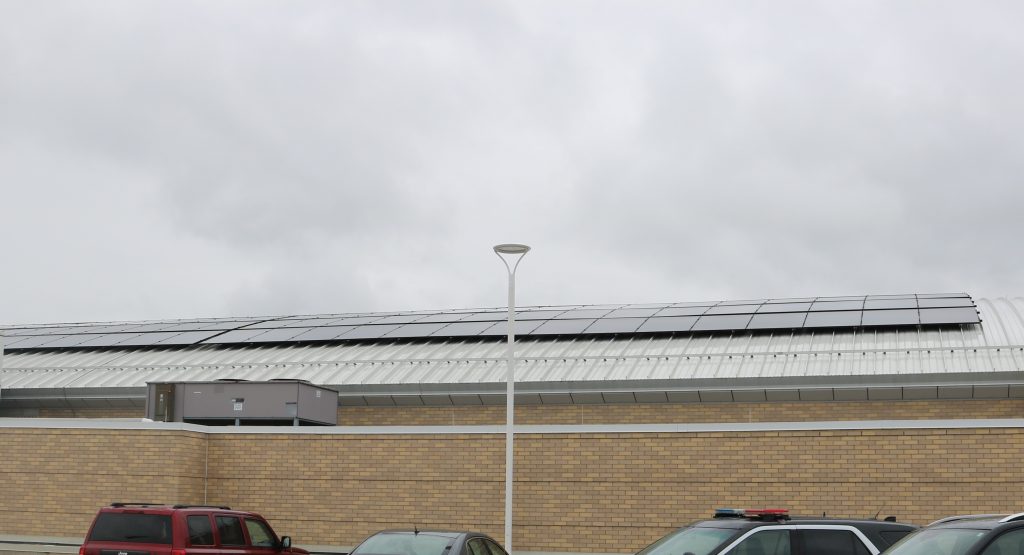
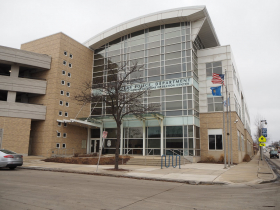
Rooftop solar array at the Milwaukee Police Department’s District 3 station and communications operations center. Photo taken April 29, 2026 by Sophie Bolich.
Under cloudy skies and occasional bouts of cold rain, city officials unveiled a rooftop solar array at the Milwaukee Police Department’s District 3 station and communications operations center.
Completed in March as part of a broader series of sustainability upgrades, the installation is expected to generate about 10% of the building’s annual energy needs at 2333 N. 49th St.
During a news conference highlighting the project, Mayor Cavalier Johnson framed it as a step toward reducing the city’s carbon footprint while also lowering utility costs.
“All of us have a role to play in combating climate change … we need to source as much power as possible from clean, renewable energy sources,” he said. “These projects protect the city from rising electric rates, and as those continue to rise, the power coming from these rooftop systems will save even more money each year — they really are cost-effective.”
Eagle Point Solar installed the panels at the police station. The building also received LED lighting and HVAC upgrades. Similar improvements were made at the Department of Public Works field headquarters at 3850 N. 35th St. and the central repair garage at 2142 W. Canal St.
Together, solar arrays at the station and DPW headquarters total 360 kilowatts — enough to power the equivalent of about 67 homes annually, Johnson said.
Police Chief Jeffrey Norman pointed to additional efforts at MPD, including the use of electric vehicles. “We understand our fiduciary responsibility, or our financial responsibility, to lean into being more green,” he said.
The city is also working with We Energies to expand a large-scale solar installation on a city-owned landfill near Milwaukee Mitchell International Airport. Once complete later this year, that project, combined with all other solar initiatives across greater Milwaukee, is expected to generate enough renewable energy to power 80 city-owned buildings.
Funding for the sustainability upgrades includes a $2.6 million city investment, along with borrowing, lease-purchase agreements and federal tax credits.
Erick Shambarger, director of the city’s Environmental Collaboration Office, said the solar panels are expected to last 20 to 30 years, noting that the city is using 15-year financing to make the projects “cash flow positive.” Federal tax credits are expected to produce a sizable rebate once the projects are filed, he added.
How homeowners can add discounted solar
In a related effort, officials also announced the 2026 Grow Solar campaign, organized in partnership with ECO and the Midwest Renewable Energy Association.
“As you can see, we are leading by example on climate action,” Johnson said. “But we want to take it even further and make it easier for homeowners and businesses to install solar on their own roofs.”
The program uses a group-buying model to help homeowners and small businesses secure discounted solar installations, said Jeff Schneider, the MREA’s solar program coordinator.
Past campaigns have brought more than three megawatts of renewable energy to the region, Schneider said. “Every year, those arrays save local residents hundreds of thousands of dollars collectively on their energy costs.”
The initiative began in Milwaukee 13 years ago and has since expanded to multiple states. Locally, it now serves residents and small businesses in Milwaukee, Waukesha, Jefferson, Ozaukee and Washington counties.
Program information, including a schedule of upcoming events, is available online.
Summit Credit Union has worked with the city on solar efforts since 2013 and is expanding its options to make solar power more affordable for homeowners, said Vincent Rice, vice president of community and business impact.
The expanded program allows homeowners with home equity lines of credit to lock in a portion of their available equity to purchase solar systems. Participants who opt in will receive a 0.25% discount. “We look forward to seeing folks reducing their energy costs and improving the environment,” Rice said.
More information about the city’s solar facilities and their outputs is available on the Renewable Energy in City Operations webpage.
Photos


Existing members must be signed in to see the interactive map. Sign in.
If you think stories like this are important, become a member of Urban Milwaukee and help support real, independent journalism. Plus you get some cool added benefits.