Milwaukee Plans 60 Traffic Safety Projects for 2026
Where will projects occur and what will be the impact?
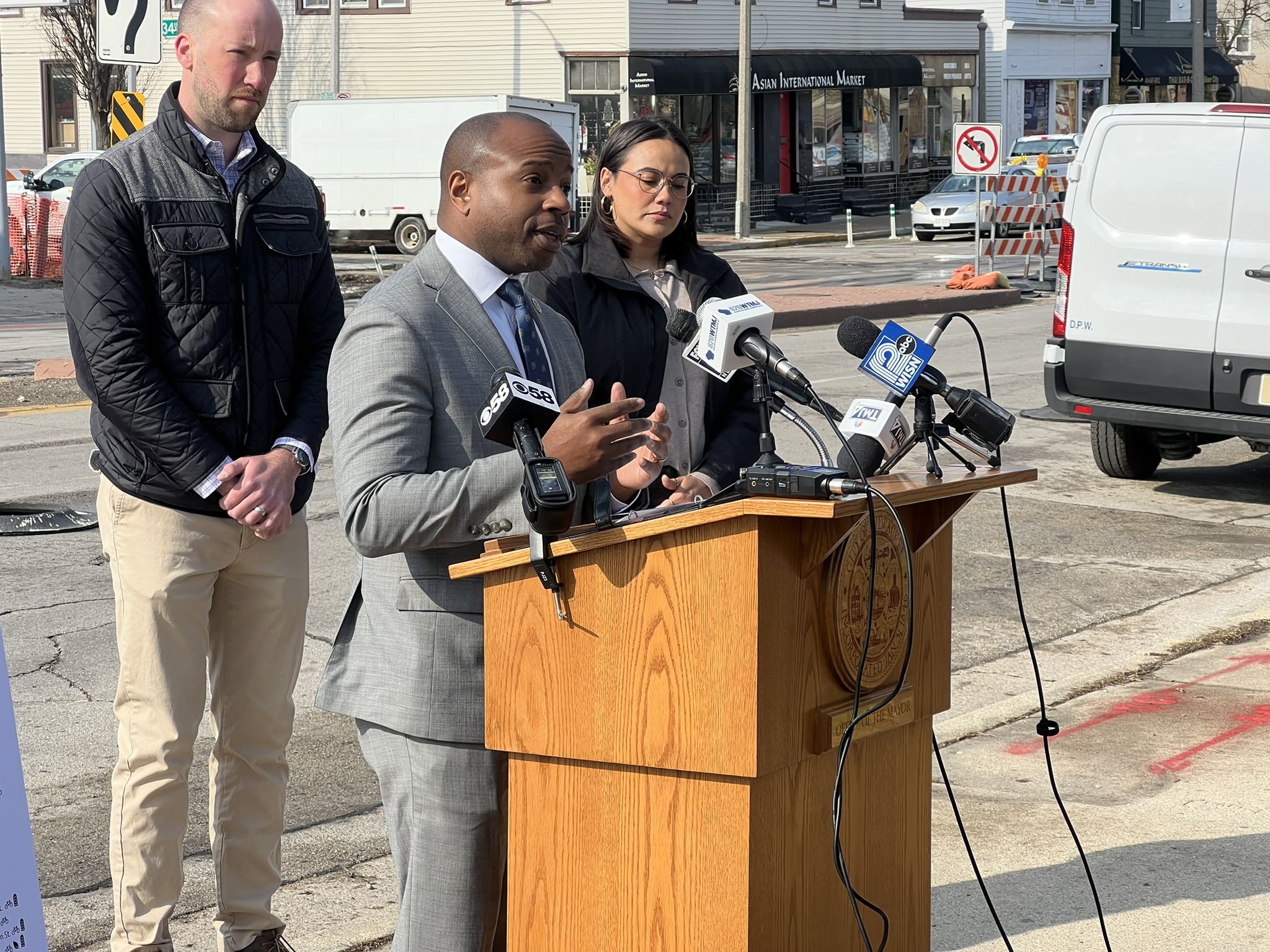
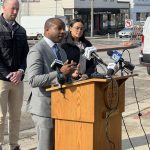
Mayor Cavalier Johnson speaks at an April 8, 2026 press conference. Photo by Jeramey Jannene.
As contractors hammered on W. National Ave. behind them, Mayor Cavalier Johnson and City Engineer Kevin Muhs unveiled a plan Wednesday morning to build 60 traffic-calming projects in 2026.
Projects proposed range from big, such as the $50 million National Ave. reconstruction, to small, like Safe Routes to School improvements near Alexander Mitchell Integrated Arts School.
Johnson said all of the projects are part of the city’s commitment to its Vision Zero initiative, which calls for eliminating all traffic deaths by 2037, and a nearly decade-old Complete Streets policy intended to make streets safe for all types of road users.
“We’re not just simply rebuilding the street; we’re thinking about how the street actually works for the people who reside in this neighborhood, who call this neighborhood home, who do business right here along the corridor on National Ave.,” said the mayor. He singled out improved pedestrian crossing safety, protected bike lanes and bus-boarding improvements. “We know that safer streets also mean stronger neighborhoods.”
Funding for the 60 projects comes from a wide variety of sources, including federal grants, state funding, tax-incremental financing districts, assessments on nearby property owners and city borrowing.
“All of these projects contribute to a safer, more connected city,” said Muhs. “We’re building a transportation network that gives people options and helps ensure that every trip can be made more safely.”
The projects include multiyear street reconstructions, such as National and Lisbon avenues; upgrades to painted bike lanes to install concrete-protected lanes, including on Oklahoma Ave., Jefferson St. and Hopkins St.; targeted interventions through Safe Routes to Schools and Parks projects; and traffic-calming infrastructure on key corridors like Brady St. and Kinnickinnic Ave.
Not all of the 60 projects are likely to be completed in 2026. The city also had hopes of constructing 60 projects in 2025, but only managed to complete 36. Those remaining were rolled over to future years.
A range of issues, from contractor capacity to bureaucratic red tape, prevents projects from being completed on the planned timeline. A two-way protected bike lane for S. Water Street appeared on the project map for each of the past two years, but the city has been stymied by delays at the state Office of the Commissioner of Railroads. After its ruling in 2025 favored the city, Union Pacific appealed the decision.
The Department of Public Works did not immediately have a cost estimate available for all of the planned 2026 projects.
During a March press conference, Johnson touted early success on the city’s Vision Zero effort.
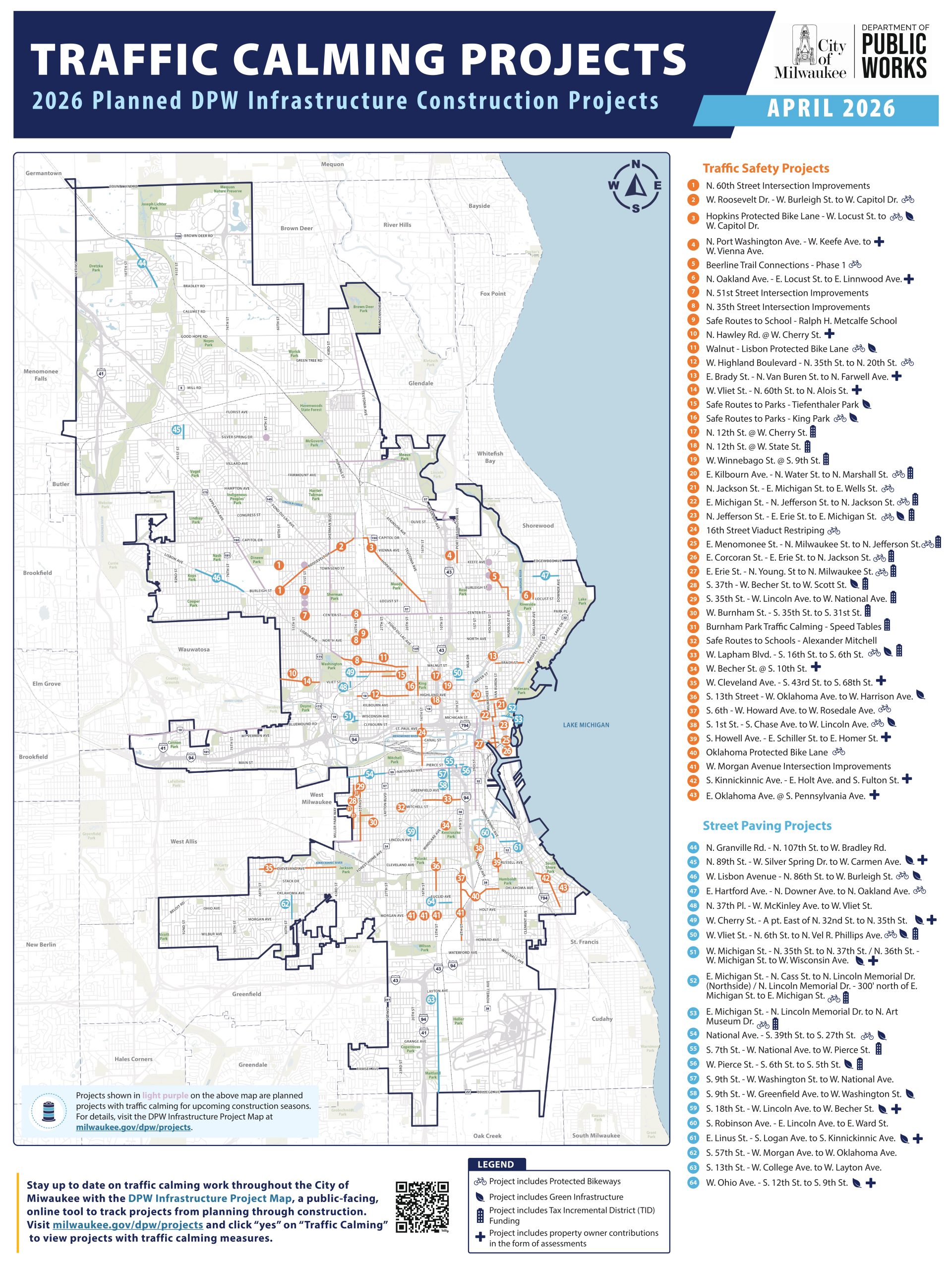
2026 traffic calming project map. Image from Department of Public Works.
National Avenue concerns remain
VIA CDC Executive Director JoAnna Bautch said the three-year National Avenue project marks a major investment in the future of the South Side, but also brings risks during construction.
“We know that construction is challenging, it disrupts routines, impacts foot traffic and creates uncertainty, especially for small businesses who are already navigating so much,” said Bautch.
Her organization is helping connect business owners to a grant program that provides capital funding to adapt spaces.
“These businesses are not just storefronts, they are employers, they are community anchors, and they are essential to the economic health and cultural identity of this neighborhood,” said Bautch.
VIA, said Bautch, is also working with area business improvement districts and the Hmong Wisconsin Chamber of Commerce on low-interest loans to support operations. “They’re all sort of strategizing with us so we can get dollars into the hands of these businesses so they can survive this impact,” she said.
The project will be built in phases, with 2026 construction focused on the area between S. 27th and S. 39th streets. The 2027 construction season will be centered on the stretch between S. 1st and S. 11th streets, and work in 2028 will fill the gap between the two segments.
“National Ave. is still open for business. Now more than ever, our small businesses need us,” said Bautch. She called for people to be intentional in shopping and dining at area businesses while construction is underway. “How we support them during this time will determine what this corridor looks like when this construction is done.”
“There is disruption with construction; even so, National Ave. remains open for business,” said Johnson in encouraging people to patronize the businesses.
The National Ave. project is part of a state formula funding program that has a five-year development timeline. Other streets that have also received state funding and are at various points in the five-year process include N. Sherman Blvd. and N. Farwell and Prospect avenues.
Existing members must be signed in to see the interactive map. Sign in.
If you think stories like this are important, become a member of Urban Milwaukee and help support real, independent journalism. Plus you get some cool added benefits.


Transportation
-
State To Reveal New I-794 Cost Estimates
 Apr 7th, 2026 by Jeramey Jannene
-
Bus Riders Can Finally Pay With Credit Card
 Apr 6th, 2026 by Graham Kilmer
-
County Preparing Final Phase of Costly Lakefront Parking Lot
 Apr 2nd, 2026 by Graham Kilmer