
Warner Theater Is a Spectacle of Artistic Tiles
The experience feels like arriving from somewhere far away via a magic flying carpet.
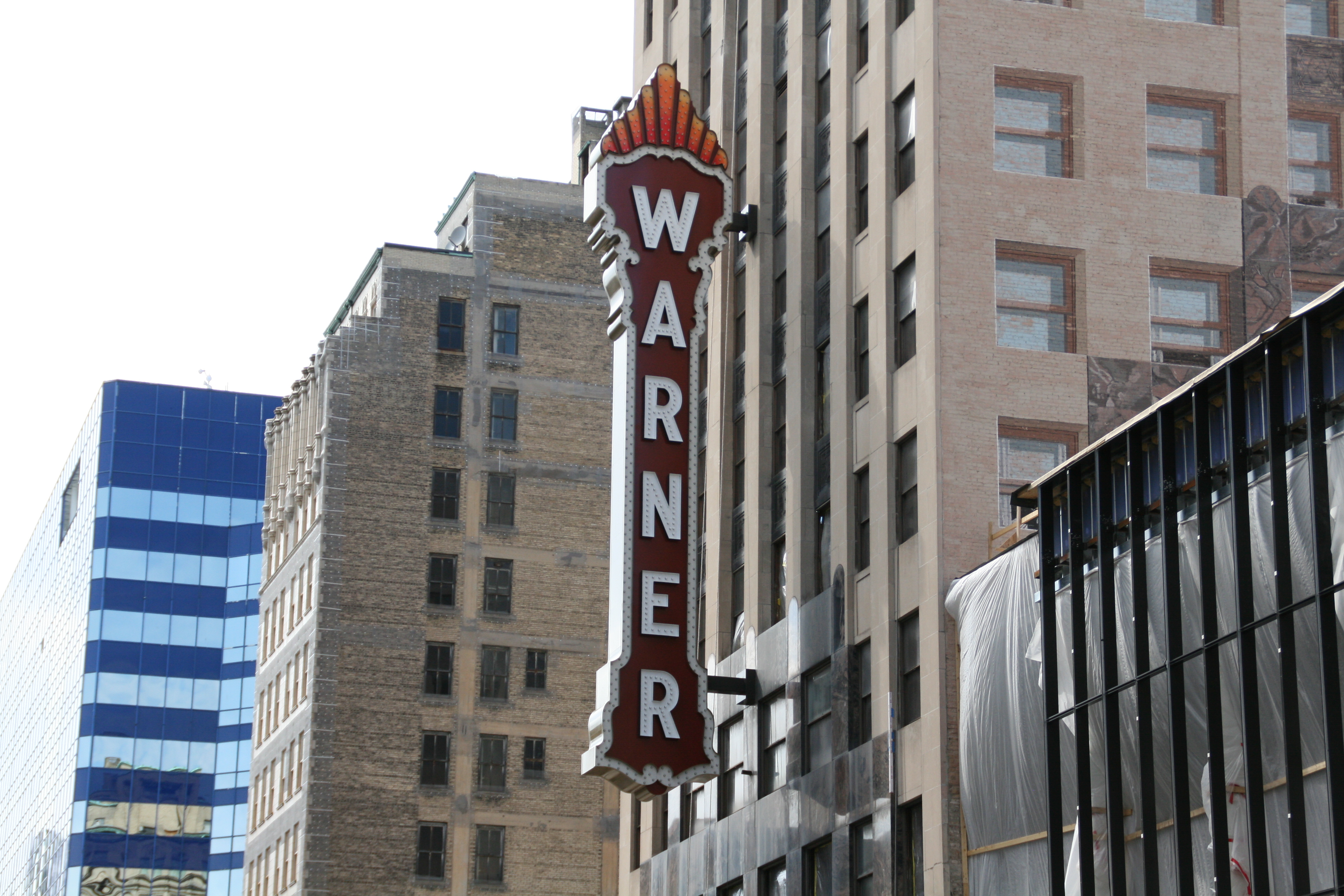
“Warner” sign on the Bradley Symphony Center. Photo by Jeramey Jannene.
Entertainment is in crisis. Decades of building carpeted warehouses filled with lounge chairs have created theaters that are no longer attracting mass audiences for movie premieres. Too many producers lack the imagination or courage to create truly new films. And new theater buildings boasting enormous screens and cushions are selling their venues all too much like furniture and electronics stores.
Brick-and-mortar is losing its character and appeal, but not entirely in downtown Milwaukee. Here, brick-and-mortar is a spectacle that has history, inspiration and can be transformative.
Milwaukee is privileged to have several entertainment venues that can change your life, even with an empty stage or blank screen. The Pabst Theater and Riverside are two. But there is another, one whose design synthesizes the coziness of Arts & Crafts and the elegance of Modernity. One where the textures of nature are arranged in a composition like the melodies of Mozart or Debussy. One that would even flatter the grandiose taste of Louis XIV. This is Milwaukee’s historic Warner Theater.
Named after the owners, Warner Bros., the Warner Theater on N. 2nd Street and W. Wisconsin Avenue is one of those places where opening the door is like arriving somewhere far away via a magic flying carpet. It’s a sensation! A nickel-ornamented ceiling sparkles with floral patterns like blossoming stars. Chandeliers produce a dazzling effect of lamp beams reflecting into walls of mirrors. Marble pillars cut by the local Andres Stone & Marble Co. appear as if polished and carved by the renowned crafts-dwarves of Khazad-dûm.
Then there are the faience tiles.
The historic tiles at the Warner Theater were extraordinary and the top of the line in the tile manufacturing industry. They were as close to hiring an individual artist for a custom work of tile art as you could get. They were tiles from the Continental Faience & Tile Co. in South Milwaukee.
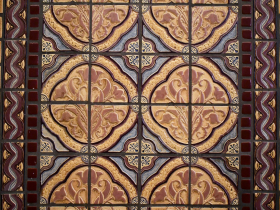
The first encounter with these quality tiles is a wall of pink tulips. Cobalt blue ossekops, a signature corner motif on Dutch tiles inspired by the ox-head, are interlaced between medallions of flowers dancing as if ballerinas posing for Degas. A stream of purple waves cascade around the flower bed: an undulating harmony of aubergine, cranberry, and cassius blue.
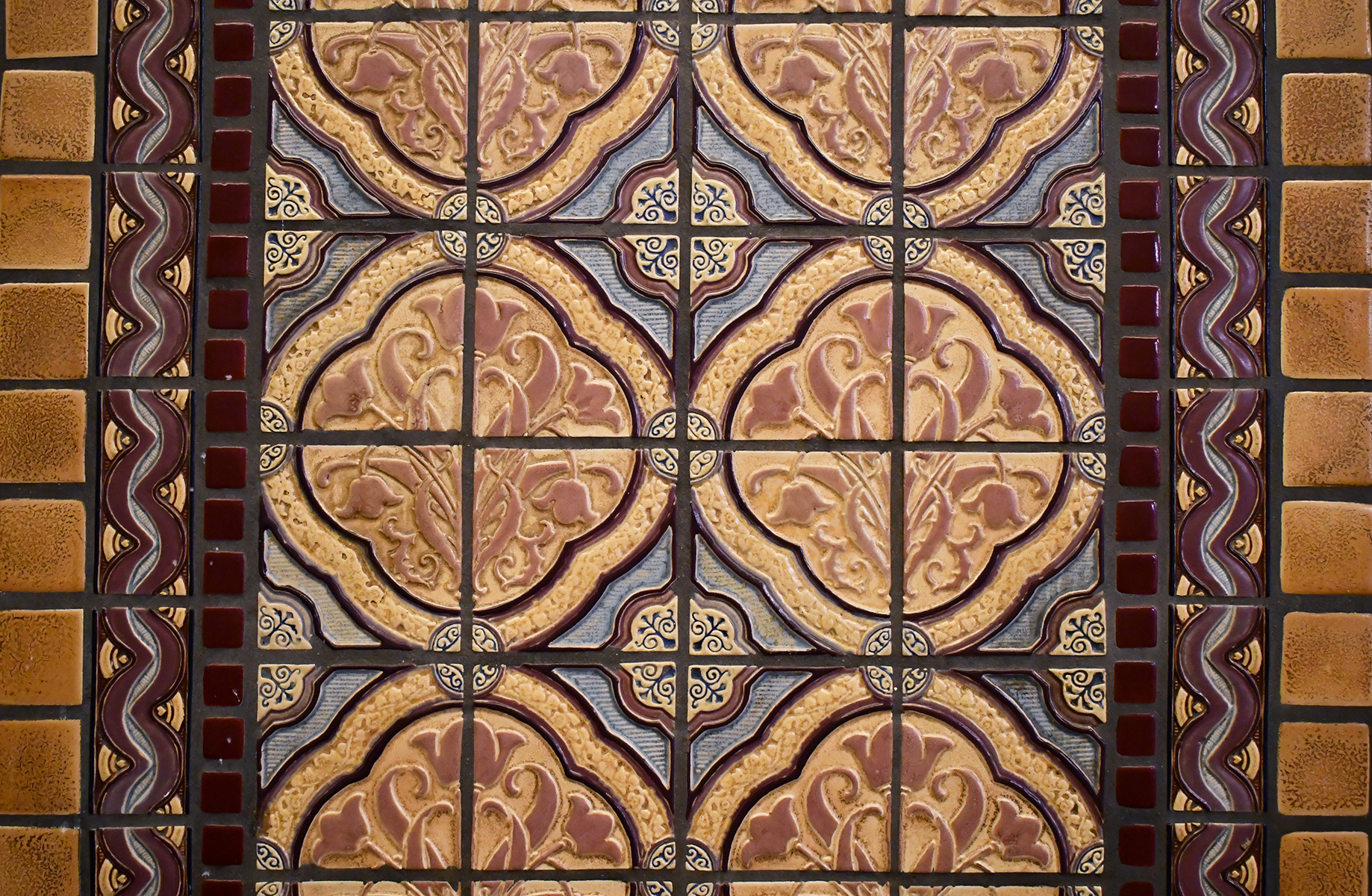
Detail of the “tulip medallions” also found in the non-extant office of company President Carl Bergmans. Photo by Ben Tyjeski.
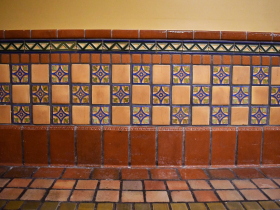
In the men’s lounges, blue and yellow tiles with chartreuse tulips are sprinkled on the walls in a neatly arranged checkerboard, patterned but free-spirited and lively like a field of blossoming flowers. The floor tiles have plain surfaces but possess earthy, rich textures that simulate field stones on a French Riviera terrace.
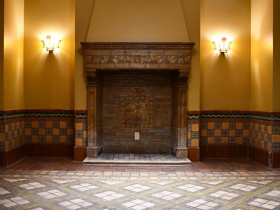
Another feature unique in each of the two lounges is a fireplace, not created in Milwaukee but manufactured by the eminent Batchelder-Wilson Tile Company in Pasadena, California. One fireplace romanticizes a maritime quest blessed by regal patrons, while also teasing the idea of immortality with two peacocks drinking from a fountain. The other fireplace depicts St. George of England slaying the dragon, a classic motif of the Arts & Crafts movement.
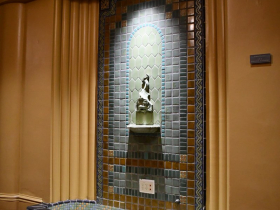
Yet there is more, tucked away in a secretive corridor on the uppermost floor. A refuge from the spectacle is a once-trickling fountain with a Renaissance-styled dolphin. Opposite this is another wall of tulips, the memory of the European continent, composed in a floral bliss.
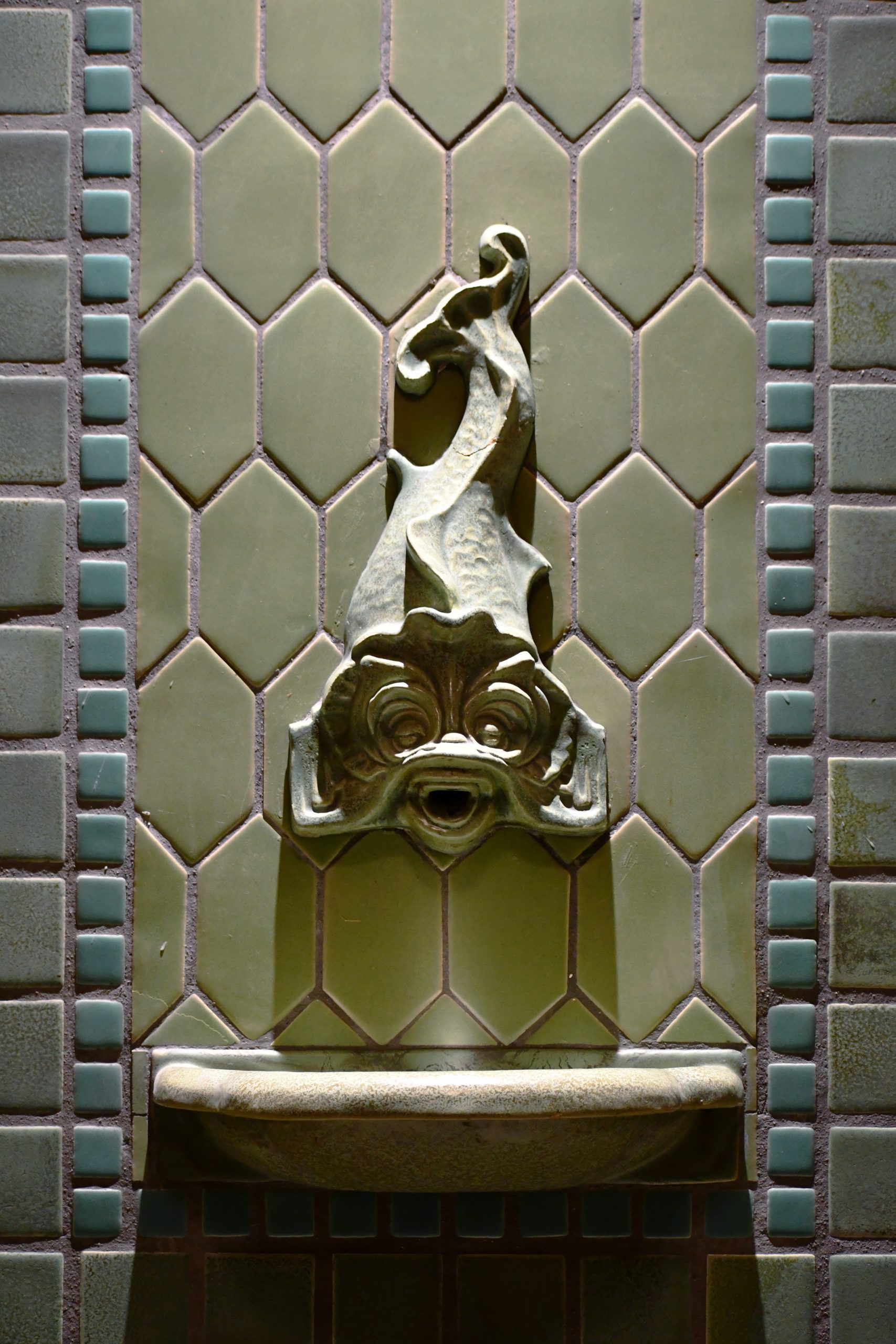
A detail image of the dolphin spout created by the Continental Faience & Tile Co. Photo by Ben Tyjeski.
The handmade tile decorations at the Warner Theater are sumptuous and vibrant, and the theater is one of the best places to see the work of the Continental Faience & Tile Co. But their significance is not in how pretty they are, but in their quality that is missing from the way so much entertainment is consumed today. For the most part, there is no experience. Entertainment is on that screen in your living room, a tablet installed in a vehicle or the device in your hand, perhaps that you are using to read this article. Entertainment is a sedentary viewing activity too often in your own element. It is convenient, but it lacks community and is a viewing without the theatrical spectacle.
At the Warner, the entertainment begins immediately at the illuminated front door, greeting you with the element of fantasy. The architectural program of the theater is part of the production, too. These decorations — nickel ornament, paintings and tiles — deliver an escape from reality, opening the mind to new possibilities so that when you return to regular life, you can approach life’s problems with a new perspective or spirit. This is the power of art, found not only inside a picture frame but throughout the entire house the art lives in.
To go out and see a show is to be a part of the performance, too. There is the opportunity to dress to impress and revel in the convergence of individual styles and fashion. It may be comfortable at home, but it’s also isolating oneself from the joys of life and the thrill of community. The spectacle of a theater is enhanced by the people who show up.
In 1995, the Warner Theater ceased showing movies. But Milwaukee has been fortunate, as the Milwaukee Symphony Orchestra has taken ownership of the building, opening its doors again in 2021. The stewardship of this company has allowed for the transformative experience of the building to be felt by its patrons, all the while supporting the incredible talent that performs on its newly configured stage.
Its tile decorations have survived as part of a wonderful renovation of this unique building. Too many theaters and venues of today have mass-produced materials that are void of imagination, handmade art and natural surfaces with character. Yet Milwaukeeans can still experience an escape –in the heart of Downtown– where the design is a fantasy and artistry transports the mind.
Tile Gallery

To learn more about the Warner Theater and buildings alike, you can read Ben Tyjeski’s Carl Bergmans and the Continental Faience & Tile Co., available at www.tyjeskitile.com/books.

Existing members must be signed in to see the interactive map. Sign in.
If you think stories like this are important, become a member of Urban Milwaukee and help support real, independent journalism. Plus you get some cool added benefits.