Wisconsin Supreme Court Race Pivotal for Election Policy
Court could face issues like noncitizen voting, 2028 presidential election disputes.
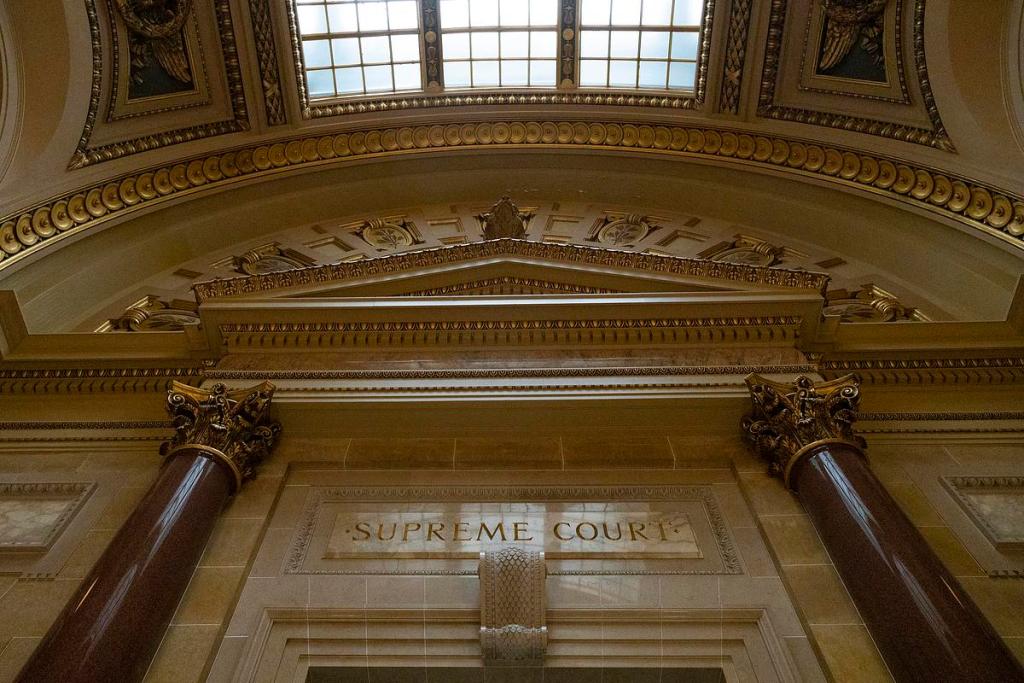
This Nov. 18, 2024, photo shows the Wisconsin Supreme Court chambers at the State Capitol in Madison, Wis. (Joe Timmerman / Wisconsin Watch)
In under two weeks, voters will head to the polls to select a new Wisconsin Supreme Court justice. The winner will likely play a role in how voters cast ballots for the subsequent decade.
That’s because the Wisconsin Supreme Court plays a key role in settling voting disputes, particularly when state government is divided between a Democratic governor and a Republican-controlled Legislature.
In the past few years, the court has issued a series of high-stakes rulings on election administration — banning and then unbanning ballot drop boxes, ordering new legislative maps, limiting who can bring voting-related lawsuits, and allowing the state’s top election official to remain in her role.
While the Wisconsin Supreme Court race is officially nonpartisan, candidates have become increasingly willing to embrace partisan views and often campaign on their records as liberals or conservatives. In this race, Appeals Court judges Maria Lazar and Chris Taylor are squaring off. Taylor is a former Democratic member in the state Assembly, while Lazar is a member of the conservative Federalist Society.
Although there are exceptions, justices’ votes on election cases often align with their ideological backgrounds.
Unlike the past two Wisconsin Supreme Court races, though, this contest won’t determine ideological control of the court. Liberals already hold a 4-3 majority, and the outcome will either preserve the liberal majority or expand it to 5-2 by replacing retiring conservative Justice Rebecca Bradley. As a result, the race has drawn significantly less attention and spending than the last two contests, which decided the court’s ideological balance.
Even so, the winning candidate in that person’s upcoming 10-year term is likely to weigh in on a range of voting battles currently playing out in lower courts. Those may include cases over whether voters with disabilities can cast electronic ballots, the legality of Wisconsin’s membership in the multistate Electronic Registration Information Center, a demand for the Wisconsin Elections Commission to audit the citizenship of registered voters, and whether voters can spoil a ballot that they’ve already returned and cast a new one.
Critically, the winning justice will also be a member of the court for the 2028 presidential election, when voting disputes often intensify and escalate to court challenges.
“There’s a lot of importance just because of the length of the term,” said UW-Madison political science professor Barry Burden, who noted that the Wisconsin Supreme Court in the past 10 years has weighed in on absentee voting rules, the legality of postponing elections because of the pandemic and President Donald Trump’s effort to overturn the results of the 2020 election.
Because Wisconsin is a consistent battleground state, Burden said, the court becomes a frequent venue for efforts to change election rules for national races. Some of those potential lawsuits may be hard to predict, he added, because developments in technology and AI in campaigns over the next decade may require new rules or changes to current laws.
Although liberals have a firm hold on the court now, Burden said, they shouldn’t take that for granted. Ten years ago, conservatives had a clear court majority, so much so that liberals didn’t even field a candidate in the 2017 race. Now, liberals have a hold on the court and could extend it with a win.
With Wisconsin politics frequently switching from one side of the aisle to the other, he said, this election may be pivotal for the balance of power down the road.
Candidates’ pasts reveal stark contrast on elections
The candidates’ records — from their rulings, prior public-facing jobs and campaign positions — reveal sharp divides in how they each approach election law.
For example, as an assistant attorney general for the state under GOP Attorney General J.B. Van Hollen, Lazar defended Wisconsin’s voter ID law and Republican-drawn legislative maps, which critics have described as among the most gerrymandered in the country.
Taylor took the opposite stances on both issues. During her time in the Legislature, she called for repealing the voter ID law, which has since been enshrined in the Wisconsin Constitution. She also derided the Republican redistricting effort as a means to do “whatever it takes to amass and protect their power.”
More recently, Lazar was involved in an unusual case in which two state appeals courts issued conflicting opinions on the same election issue: In November 2023, one court found that a conservative group wasn’t entitled to obtain information related to people deemed by judges to be incapable of voting. The next month, Lazar joined the majority in a second court that reached the opposite conclusion — despite a Wisconsin Supreme Court precedent stating that only the high court can overturn appellate decisions.
That case is now before the Wisconsin Supreme Court.
Both candidates have also played pivotal roles in more recent election rulings.
In one case involving absentee ballots, Taylor wrote the majority opinion rejecting the Legislature’s argument that an absentee voter’s address must include a street number, name and municipality. Instead, she adopted a more lenient standard for an address, requiring voters to provide enough information for a clerk to reasonably identify where a voter lives.
In a separate case, Lazar joined a panel rejecting a lower court opinion that voters with disabilities should be allowed to have electronic ballots sent to them electronically.
Cases on the Wisconsin Supreme Court horizon
Only a small fraction of cases heard in circuit and appeals courts ultimately come before the Wisconsin Supreme Court. The high court issued just 23 opinions in its 2024-25 term, and it’s hard to predict which cases will be taken up. At present, only one election law case is currently before the court.
That number may remain low following a 2025 Wisconsin Supreme Court ruling restricting who can file lawsuits over election rules and policies. Writing for the majority, liberal Justice Jill Karofsky said people must be personally “aggrieved” to bring election lawsuits.
In dissent, outgoing conservative justice Bradley wrote that the majority’s ruling “guts the People’s right of access to the courts in election law matters.”
Among the issues likely to reach the court in coming years are challenges to the state’s congressional boundaries, which liberals are trying to redraw ahead of the typical 10-year cycle. One such case is currently slated for a jury trial before a three-judge panel in April 2027.
The court could also be asked to decide whether election officials can be sued for failing to count votes, a central issue in the ongoing lawsuit over whether Madison should be forced to pay out millions for disenfranchising nearly 200 voters whose ballots were misplaced in the 2024 presidential election .
Ultimately, the most consequential case the next justice could face may come in 2028, the next presidential election year. In 2020, the Wisconsin Supreme Court narrowly halted Trump’s attempt to throw out enough Democratic votes to change the outcome of the race. The 2024 election wasn’t extensively litigated in Wisconsin courts, but the potential for court challenges remains in future presidential contests.
Alexander Shur is a reporter for Votebeat based in Wisconsin. Contact Shur at ashur@votebeat.org.
Votebeat is a nonprofit news organization reporting on voting access and election administration across the U.S. Sign up for Votebeat’s free national newsletter here.
This article first appeared on Wisconsin Watch and is republished here under a Creative Commons Attribution-NoDerivatives 4.0 International License.