

Senate Stalls Justice For All Act, Court Backlog Fixes Pushed To 2027
Republican divisions and an unwritten rule leave new judges and defenders on hold statewide.
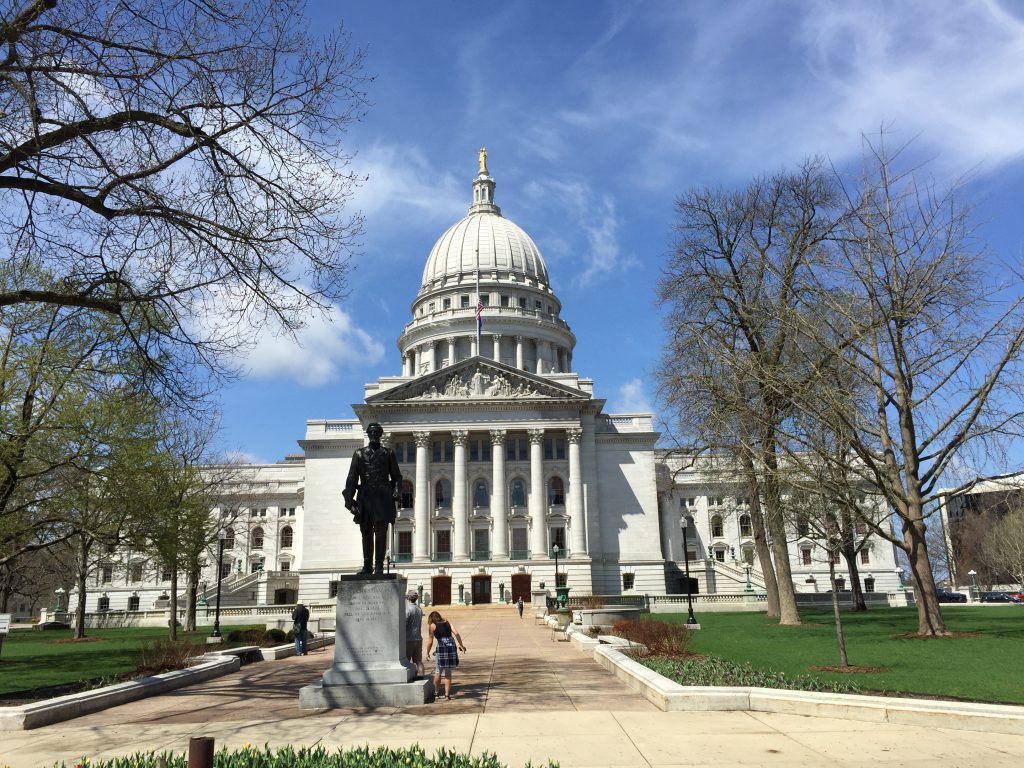
Hans Christian Heg Statue at the Wisconsin State Capitol. Photo by Mariiana Tzotcheva.
The Wisconsin State Senate did not vote on the “Justice for All Act” before it concluded regular work this week, likely punting the court staffing concerns addressed in the bill to the next legislative session.
In an interview with the Wisconsin Examiner on Wednesday, Rep. David Steffen (R-Howard) said that this issue didn’t get enough attention in the latest state budget process.
“We have criminals who will not be prosecuted, we have innocent individuals who will remain in jails and property taxpayers will be picking up a massive tab associated with this inaction,” said Steffen, one of the bill’s authors.
Steffen said that the issue will have to be addressed in the next budget process, in 2027, though the work done and awareness raised on this issue will make those discussions easier.
The “Justice for All Act,” or Assembly Bill 514, was introduced in October and passed the Assembly last month. It involves additional criminal justice system positions that would help address backlogs of court cases in Wisconsin. These include additional judges, assistant prosecutors and public defenders, court reporters and public defender support staff for the 2027-2029 and 2029-2031 bienniums.
Steffen said he thinks that if the bill had gone before the Senate, it would have passed. However, it didn’t reach the needed threshold of support from Republicans, he said. That threshold of GOP support is also known as the unwritten “rule of 17” which means obtaining the votes of 17 Republicans or an all-GOP majority to pass any bill through the Senate. (Senate Majority Leader Devin LeMahieu, who announced Thursday he is stepping down, drew criticism for allowing bills on sports betting and funding for the University of Wisconsin athletic department to come to the floor and pass on a bipartisan basis without garnering 17 Republican votes.)
Steffen said he’d heard that, as he understood it, some senators were concerned about handling this large of an expenditure outside of the budget process. However, Steffen called this “unfortunate, and likely more of a punt than a real reason.” He said exceptions are routinely made for important matters facing the state.
In an interview with the Examiner on Wednesday, Sen. LaTonya Johnson (D-Milwaukee) said that at some point, Milwaukee County “is going to have to file a lawsuit to recoup some of the money that they’re spending on our criminal justice system.”
“We’re forced to come to the state to beg for resources that they should be voluntarily giving us, and they have the nerve to tell us no,” Johnson said.
Will the new positions be delayed?
The bill would provide authority for some of the new positions beginning in July 2027, while for others, it would be the summer of 2028 or 2029.
A staff member from Steffen’s office told the Examiner that if the proposal is taken up next session, Steffen would not expect the timing of the positions related to the judges and court reporters to be affected. However, Steffen would anticipate that the other positions in the bill — positions related to assistant district attorneys, assistant public defenders and public defender support staff — would be pushed back by a year.
Steffen expects the same timing would apply if the measure is introduced as a standalone bill, like the Justice for All Act, or through the state budget.
Next time, how will Milwaukee fare?
An amendment to the Justice for All bill stripped additional public defender and public defender support staff positions for Milwaukee from the bill, the Examiner reported last month. The bill still held additional prosecutor positions for Milwaukee.
“In order for me to get the support I needed in the Assembly, it was necessary for me to hold back those public defender positions in Milwaukee County,” Steffen said.
Steffen said that next year, he hopes to include the public defender positions for Milwaukee that were in the original version of the bill he crafted.
Sen. LaTonya Johnson said that the motivation to cut those Milwaukee positions out stemmed from a conflict involving the district attorney’s office, public defender’s office and Enough is Enough, a court watch group, the Examiner reported last month. Rep. Bob Donovan (R-Greenfield) criticized the public defenders, who said the court watchdog group was operating as an extension of the district attorney’s office.
Steffen said that some in the Assembly had concerns that were particularly about Milwaukee public defenders “displaying a lack of attention on the core responsibilities of defending the indigent versus some of their comments and actions against community watchdog groups who were in Milwaukee County.” Asked if this was about what the public defender’s office put out regarding Enough is Enough and that controversy, Steffen said that was correct.
Steffen said some lawmakers took issue with what the defenders’ letter represented, that more time was being spent “worried about some retirees sitting there in the courtroom than they were focusing on defending the rights of the accused.”
Steffen said he was very interested in working with the state public defender’s office to address the issue, but “we were unable to do so” before the end of the session. He said that the removal of the Milwaukee positions wasn’t a barrier to the bill going up for a vote on Tuesday.
Johnson opposes the idea that the Milwaukee positions shouldn’t have been included due to the controversy involving public defenders and Enough is Enough and said it speaks of overreach. She also argued that if the public defenders were honest about how they felt in the letter, they did their job.
Johnson said she and her Milwaukee colleagues weren’t supportive of the Justice for All Act because of the removal of the Milwaukee public defense positions.
Johnson said she spoke with one of the bill authors about why the bill wasn’t on the floor of the Senate on Tuesday. She said that he highly doubted “that Milwaukee would be a part of that process even next year, because if it was, then they would have people who would be unwilling to support it in the Senate.” Johnson hopes that when legislators return, Republicans will no longer hold the Senate majority.
In Milwaukee County, the backlog of unresolved felony-related matters is more than 10,000, as of Oct. 13, Wisconsin Watch reported.
“How do you remove public defender support and staff support from the largest county in the entire state?” Johnson said.
What was the conflict involving the court watch group?
Regional manager Angel Johnson and deputy regional manager Paige Styler of the public defenders’ office signed a letter sent to judges in Milwaukee County Circuit Court’s criminal division, the Milwaukee Journal Sentinel reported.
The letter alleged that Enough is Enough “functions more as an extension of the DA’s office” and that the group’s activities and formation have been closely coordinated with the DA’s office, the Journal Sentinel reported. It argued that “Enough is Enough” shouldn’t be seen as an independent, grassroots organization.
Johnson and Styler asked judges to consider that context when evaluating impact statements or the presence of the group in court, the Journal Sentinel reported. The group’s president called the public defenders’ allegations “false, exaggerated and without merit.”
The letter highlighted Assistant District Attorney Joy Hammond and retired Assistant District Attorney Thomas Potter, who public defenders said “reviewed, drafted, and edited letters for Enough is Enough addressed to the judiciary,” according to the Journal Sentinel.
Public defenders claimed that emails obtained from a public records request outline extensive meetings between the DA’s office and Enough is Enough, the Journal Sentinel reported. In a memo to a judge, Milwaukee County District Attorney Kent Lovern described the emails public defenders received as “mostly logistical in nature” and nothing “nefarious,” according to the Journal Sentinel.
Public defenders call for more positions
The lack of a vote on the bill creates uncertainty for the Wisconsin State Public Defender’s Office, according to a spokesperson for the office.
“We’re still hopeful that we can obtain the resources we need in the next state budget, but without the Justice for All Act in place as a bipartisan consensus to build from, the path forward is significantly less clear,” the spokesperson told the Examiner in an email.
In a press release on Tuesday, the Wisconsin State Public Defender’s Office argued that “lawmakers cut short a lifeline for Wisconsin’s overburdened public defense system” by not putting the bill on the calendar.
“Our attorneys are drowning, and it’s Wisconsinites who pay the price when constitutional rights are treated as an optional expense,” State Public Defender Jennifer Bias said.
The public defenders said that public defenders and Wisconsinites who rely on them will have to wait almost a year and a half for the next budget cycle to offer another chance at relief.
The Justice for All Act would have given public defenders an additional 18 attorney positions and 35 support staff positions in the next budget biennium, the agency’s largest staffing increase since 2009, the public defenders said.
The public defenders argued that these resources would have allowed the agency to confront growing case delays brought on by prosecutors charging more crimes and by “an explosion of digital evidence in criminal cases.”
In a press release in January, the public defender’s office said that criminal cases in Wisconsin have become increasingly complex over the past two decades — that cases once involving a few police reports now regularly involve hundreds of hours of body camera footage and thousands of pages of digital records.
A lack of sufficient support staff forces public defenders to take on “vast amounts of extra work outside the courtroom,” the agency said in January, adding that in its Stevens Point region, 30 attorneys covering 13 counties share only one paralegal.
According to Bias’s testimony in January, the lack of support staff positions is a consistent reason attorneys give for leaving the public defender’s office. While an attorney shortage makes it difficult to fill attorney roles quickly, the agency has very little trouble finding qualified support staff, she testified.
In testimony on the bill, Bias said the agency recently had a case in which police misidentified a suspect. The client had been sitting in jail for six months by the time the attorney was able to review the bodycam footage and see that the video didn’t show the client. She said the client was released but had already lost a job and housing.
Senators didn’t vote on bill addressing court backlogs was originally published by Wisconsin Examiner.
Political Contributions Tracker
Displaying political contributions between people mentioned in this story. Learn more.





















Nice work Republicans. State coffers sit at 7 BILLION!! Couldn’t find money for this either?
Republican state legislators have used Milwaukee as a whipping post for decades.
We’ve been cheated out of Shared Revenue.
Racial Profiling continues. It led to Mass Incarceration. Destabilizing POC’s Communities…
“Plea Bargans” are over used.
Lack of adequately funding Public Defender’s violates peoples’ Constitutional Rights.
Instead, Republicans prefer to spend $55,000 per year to Incarcerate each individual.