WI Senate Depends on Democrats to Pass Online Sports Betting Bill
Bill part of lengthy agenda as senators race to finish final day of 2026 session.

Mobile phone. Commons Zero (CC0)
Republican Senate Majority Leader Devin LeMahieu relied on help from Democrats Tuesday to pass legislation that would legalize online sports betting in Wisconsin.
Half of all Senate Republicans voted against the measure, with opponents arguing it will hurt residents by enabling gambling addiction. Democrats in support say it will benefit Native American tribes in Wisconsin instead of out-of-state companies. It now heads to Democratic Gov. Tony Evers’ desk.
It was a long day on the Senate floor for senators considering more than 80 bills on what was the chamber’s last day of its legislative session. The bipartisan bill to legalize online sports betting in the state would only apply if wagers are made on computer servers located on federally recognized tribal lands.
National gambling companies, like DraftKings and FanDuel, have lobbied against the plan. While it would not ban them from offering online sports betting in Wisconsin, an industry group representing the companies told lawmakers it would require them to pay 60 percent of all revenue to tribes.
The legislation faced strong opposition from some Republicans and even led to a warning from Sen. Chris Kapenga, R-Delafield. During a Sunday appearance on WISN-TV’s UpFront, Kapenga said LeMahieu, a Republican from Oostburg, that he risked losing his leadership spot if he relied on Democratic votes to pass the bill.
The message didn’t sway LeMahieu, who went ahead anyway. The bill passed by a vote of 21-12. Nine Republicans voted against it including Sen. Steve Nass, R-Whitewater, who called the bill “another example of what’s wrong with politics.” He cited a February poll by the Marquette University Law School that found 64 percent of respondents opposed legalizing online sports betting.
“Voters didn’t elect Democrats and Republicans to bring more gambling to the state of Wisconsin. In fact, public revenue built on addiction, family disintegration and predatory practices is neither moral nor sustainable,” said Nass.
All but three Democrats voted in favor of legalizing sports betting, citing benefits to Wisconsin tribal governments. Sen. Kristin Dassler-Alfheim, D-Appleton, supported the bill and told colleagues that online gaming already exists “on the edges, behind closed doors.”
“It’s already there, and it’s already being abused by some, and that’s not going to change,” said Dassler-Alfheim. “I would rather us put as many parameters around it as we can to take care of our consumers and keep the revenue in with the family, who are local tribes, who also are then sharing back to the state.”
While Evers has indicated general support for allowing online gambling with tribal control, it’s unclear whether he backs the specifics of this bill. Asked Tuesday whether the governor would sign the plan, a spokesperson referred to comments Evers made last month when he said he wanted all of Wisconsin’s tribes to support the bill.
“Some of them haven’t,” Evers said at the time. “We have to get everybody there.”
Republicans split, but bill spending millions to offset Badgers’ NIL deals passes
Democratic senators lent a hand to Republicans again by providing the votes to pass a bill giving more than $14 million to the University of Wisconsin-Madison for athletic facility costs so the school can free up money to pay student athletes name, image and licensing deals, known as NIL.
Those NIL deals are the result of a NCAA decision in 2021 to allow college athletes to make money for their names, images and likenesses.
In 2024 a federal settlement let schools like UW-Madison pay student athletes directly.
The bill cleared the senate with a vote of 17-16. Republicans made up seven of the no votes.
After major makeover, GOP food assistance bill passes Senate with bipartisan support
What started last year as a Republican bill banning Wisconsinites from buying soda, candy or energy drinks with federal fund assistance also passed the Senate on a bipartisan vote.
The plan was amended in the Assembly to add dozens of staff to the state Department of Health Services to comply with new requirements under President Donald Trump’s “One Big Beautiful Bill Act.”
The soda ban portion of the bill is part of a national push by U.S. Health and Human Services Secretary Robert F. Kennedy Jr. encouraging states to get waivers in order to block taxpayer-funded assistance from going toward the purchase of unhealthy products.
In February, the Assembly approved a major reconstruction of the bill with an amendment providing nearly $73 million in state funds to the state DHS for 28 federally funded positions to ensure compliance with federal law. That was after warnings from Democrats that federal funding could be at risk if Wisconsin’s food assistance error rate got too high.
Those changes garnered some Democratic votes in the Assembly. The Senate passed the bill with a vote of 25-8. It now heads to Evers’ desk.
Republicans also approved another bill requiring the Wisconsin Department of Health Services to share data about FoodShare recipients with the federal government.
Constitutional amendment question responding to Evers’ 400-year veto sees final passage
For nearly three years Republicans have railed against Evers’ partial veto of the 2023 budget that extended a temporary school funding increase by 400 years. On Tuesday, they took a step that could prevent similar vetoes in the future.
Evers accomplished his “400-year veto” by deleting digits and a hyphen in the state budget. Republican legislators tried to override the veto, but fell short on votes.
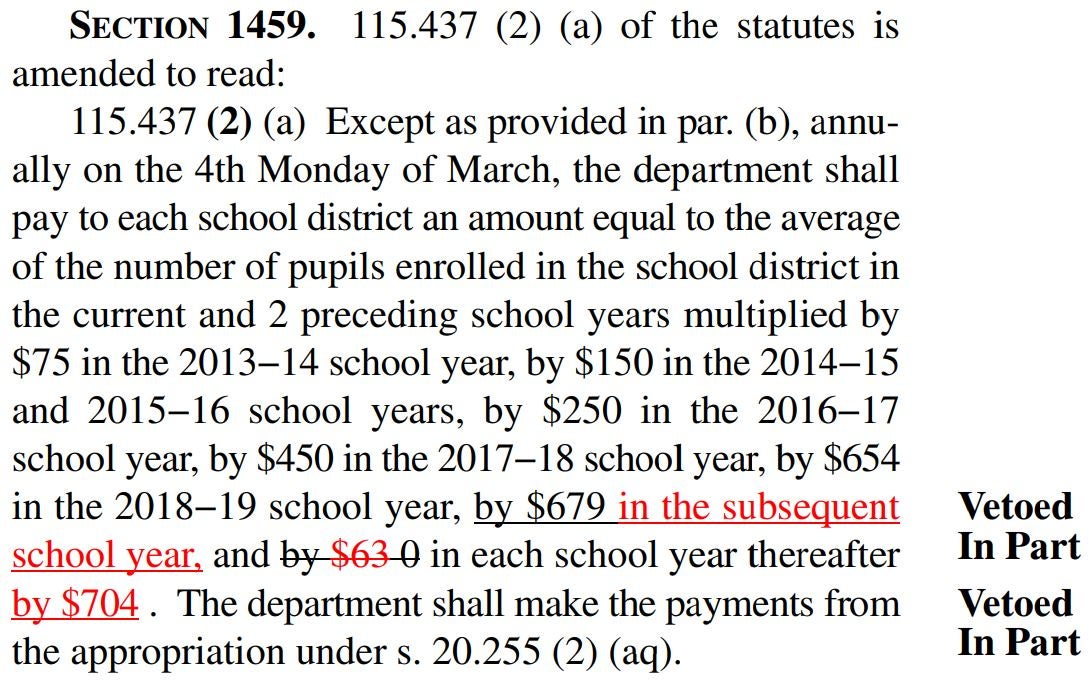
Courtesy of the Wisconsin Legislative Reference Bureau
A lawsuit claimed Evers’ veto was unconstitutional, but the Wisconsin Supreme Court’s liberal majority disagreed last year and ruled in the governor’s favor.
On Tuesday, Republican senators gave their final approval to a proposed constitutional amendment preventing future governors from using the state’s unique partial veto power to increase taxes or fees. It passed on a party line 18-15 vote, which means voters will be asked whether to amend the constitution on their November ballots.
Senate passes legislative package boosting response to internet crimes against children
With one of the day’s few unanimous votes, Republican and Democratic senators approved an additional $400,000 for the Wisconsin Department of Justice’s efforts to combat internet crimes against children.
It was followed by voice votes on related legislation adding four new staff positions focused on the crimes, giving state prosecutors power to subpoena businesses like hotels or internet companies for records relevant to ongoing investigation into suspected internet crimes against children and authorizing an online safety awareness campaign.
Vos bill requiring sheriffs to verify citizenship of inmates, report to ICE clears Senate
Wisconsin sheriffs would be required to verify the citizenship of individuals incarcerated in their jails on felony charges and notify the U.S. Department of Homeland Security if it can’t be proven under a bill passed by the Senate.
The bill, coauthored by Assembly Speaker Robin Vos, R-Rochester, would also require sheriffs to comply with federal immigration detainers and administrative immigration warrants.
Democratic senators attempted to add several amendments to the legislation, including a requirement that officers identify themselves when detaining individuals and prohibiting local governments from participating in arrests of people solely on suspicion they’re in the country illegally.
Those amendments were rejected by Republicans, and the bill was passed with a voice vote. It now heads to Evers where it faces a likely veto.
Despite GOP defections, online sports betting bill passes Wisconsin Senate was originally published by Wisconsin Public Radio.
If you think stories like this are important, become a member of Urban Milwaukee and help support real, independent journalism. Plus you get some cool added benefits.