
Wisconsin High Court Race Is Quieter, With Less Spending
With court majority not at stake turnout in April election expected to be lower.
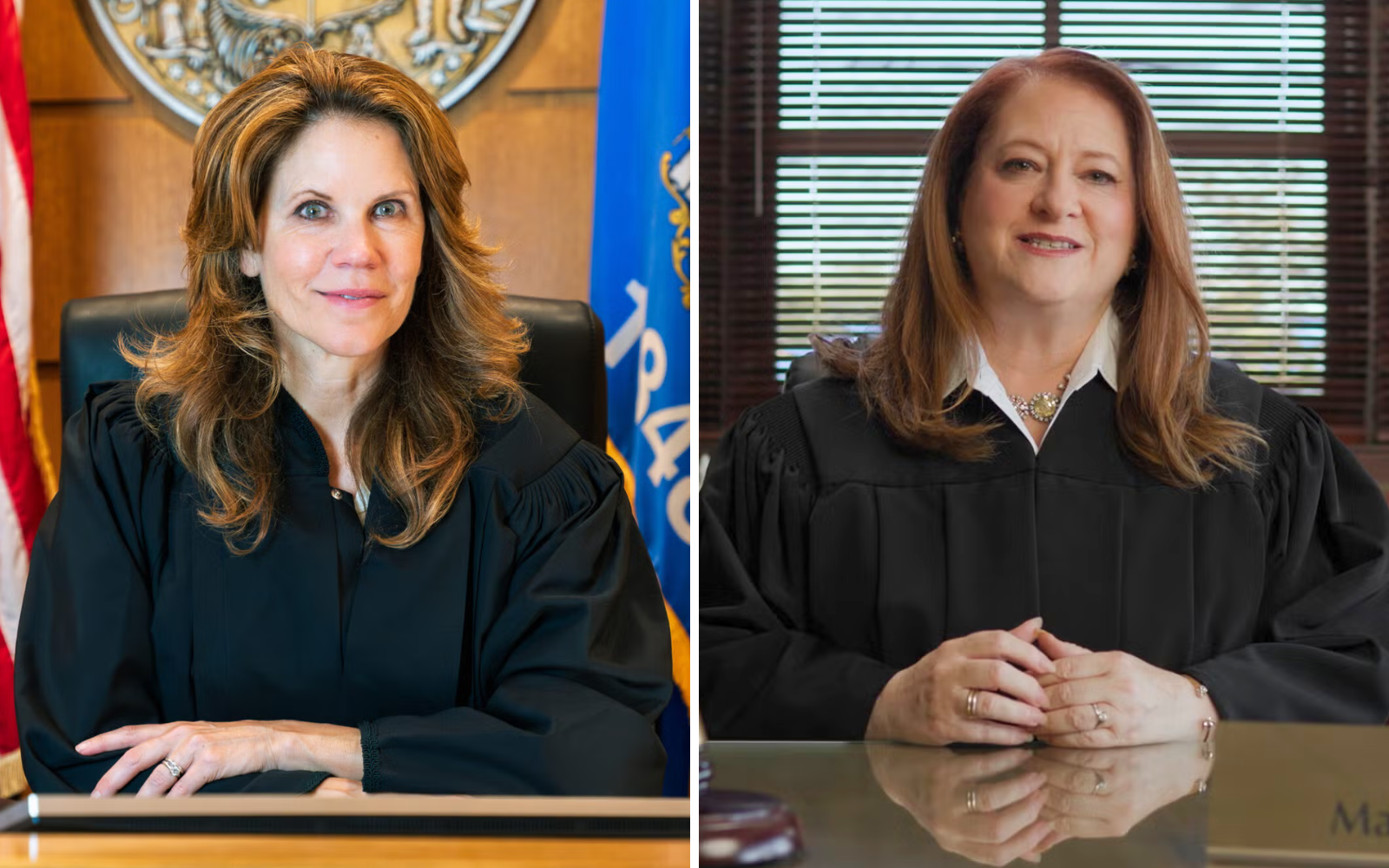
Judge Chris Taylor (left) and Judge Maria Lazar (right) are running for the Wisconsin Supreme Court in 2026. Courtesy of the campaigns
Earlier this week, the ACLU of Wisconsin announced a nearly half-million dollar ad buy in the upcoming Wisconsin Supreme Court race.
It’s an amount that’s nothing to sneeze at. But compared to this time last year — when out-of-state billionaires were pouring money into an advertising arms race — it’s a relative drop in the bucket.
Overall, the matchup between Chris Taylor, a liberal Dane County appeals court judge, and Maria Lazar, a conservative Waukesha County appeals court judge, is a quieter affair. That’s reflective of the lower stakes this year compared to last.
“The obvious thing that’s missing is that majority control is not up for grabs,” said Anthony Chergosky, a political scientist at the University of Wisconsin-La Crosse.
Last year, Elon Musk flew to Wisconsin to hand out million-dollar checks to voters, arguing that the “course of Western civilization” was in the balance. What he meant was, the ideological balance of the highest court in one of America’s swingiest states was up for grabs.
But a liberal judge — now-Justice Susan Crawford — clinched that race, shoring up liberals’ hold on the court for years to come. The contest between Taylor and Lazar, by contrast, is an effort by conservatives to maintain a relatively competitive minority, and by liberals to cement their majority even further.
In a press release announcing their ad buy, the ACLU and ACLU of Wisconsin said they’d be spending $450,000 on radio and digital ads and mailers sharing where each candidate stands on issues like abortion and voting rights. While not endorsing either candidate, the organizations frame their advocacy as an effort to defend civil liberties.
“As the federal government continues to overstep its authority and undermine core constitutional protections, it is more important than ever that we have a state Supreme Court that will relentlessly defend our rights,” said ACLU of Wisconsin Executive Director Melinda Brennan in a statement.
Still, the advertising push in the campaign’s final four weeks is smaller than similar ACLU ad campaigns in either the 2025 Supreme Court race or the 2023 race between now-Justice Janet Protasiewicz and former Justice Dan Kelly.
And while a number of outside groups and PACs have gotten involved, donations across the board reflect the lower temperature on this race. Of the top 100 largest gifts made to the Democratic Party of Wisconsin — which backs Taylor, and which is allowed to make unlimited transfers to candidates — only one took place this election cycle. That was a donation of $750,000 from the liberal financier George Soros. By comparison, by this time last year, he had given $2 million to the party. Other big names in the Democratic fundraising world, like Illinois Gov. JB Pritzker, had not yet donated in this race as of the last fundraising reports.
Likewise, while the Republican Party of Wisconsin backs Lazar, their fundraising game is different than last year, too. In the fundraising period that ended on Feb. 17, they reported no fundraising on Lazar’s behalf.
Similarly, big Republican donors, like Diane Hendricks and Richard and Elizabeth Uihlein, have made smaller contributions. Hendricks gave $800,000 to the Republican Party since Lazar entered the race, compared to $3.6 million from January through March of last year, when the GOP was backing conservative judge Brad Schimel’s bid for the Supreme Court.
Taylor’s campaign has substantially outraised Lazar’s, however, with numbers approaching Crawford’s campaign at this time last year. That’s partly because Taylor has been in the race since May, whereas Lazar jumped in in October, after incumbent conservative Justice Rebecca Bradley announced she wouldn’t run again.
Chergovsky, the political scientist, predicts that all these differences will lead to lower turnout than recent April elections.
“The massive amount of cash from donors, the personality factor of Elon, and the idea that majority control was at stake, where this time it’s not … it’s different,” he said.
The next filing deadline for campaign finance reports is March 30. That will give the last major disclosure before voters go to the polls on April 7.
This year’s Wisconsin Supreme Court fundraising fight is comparatively calm was originally published by Wisconsin Public Radio.
If you think stories like this are important, become a member of Urban Milwaukee and help support real, independent journalism. Plus you get some cool added benefits.