Wisconsin’s Economy Lags Behind Most States, Report Shows
From 2017-2024 Wisconsin ranked 38th nationally in real GDP growth.
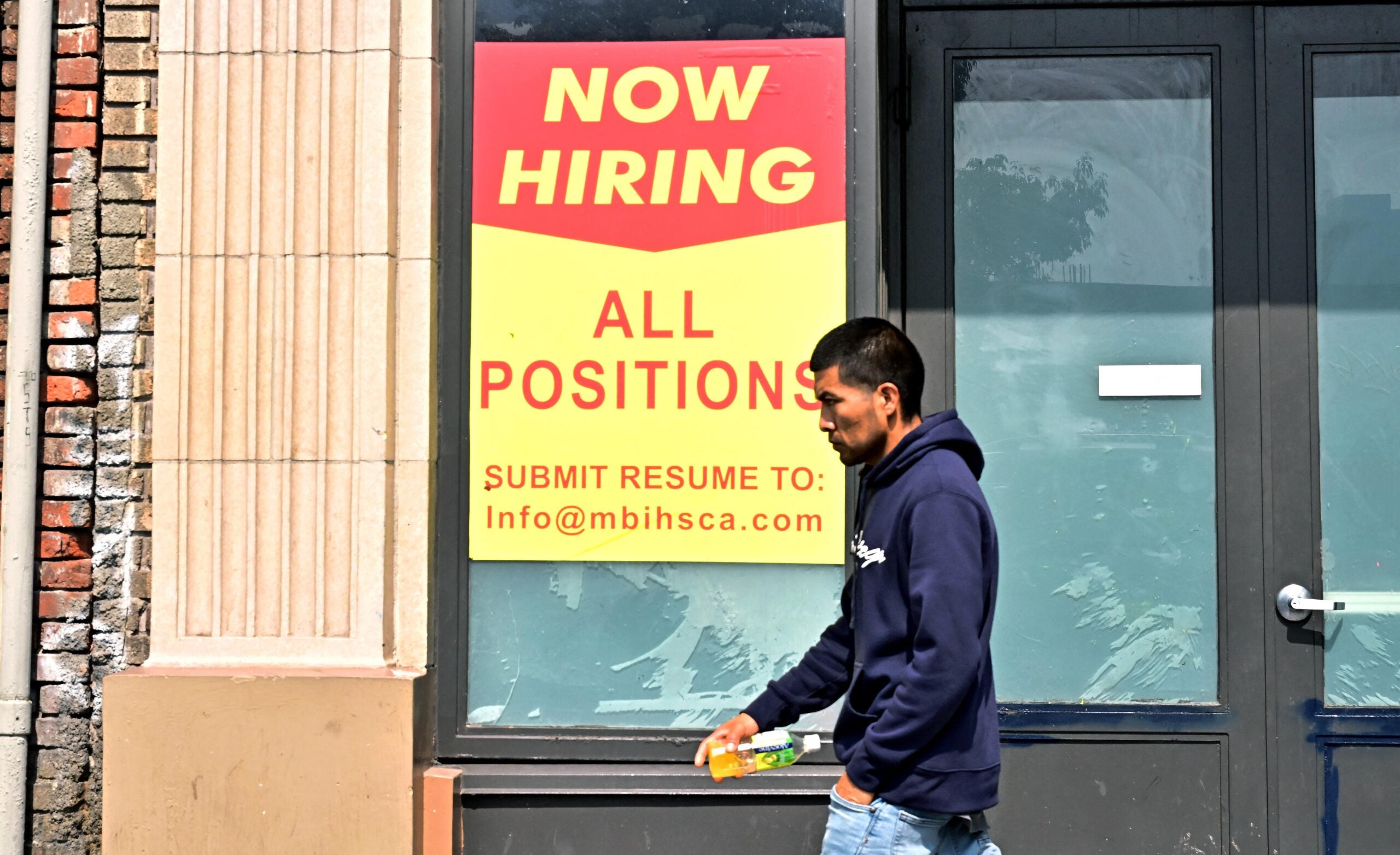
Hiring slowed over the summer. A report from the Labor Department Thursday will show whether that trend continued in September.
Wisconsin’s economic growth lags behind the rest of the nation. That’s a top line takeaway from a new report by Forward Analytics, a nonpartisan research organization within the Wisconsin Counties Association that advises policymakers on issues affecting the state.
The researchers used six indicators to evaluate the health of Wisconsin’s economy, looking at the period from 2017 to 2024. In almost every measure of growth Wisconsin fell behind much of the country including areas like labor force participation, real gross domestic product, population and household income.
Kevin Dospoy is the director of Forward Analytics. He spoke with WPR’s “Wisconsin Today” about the report.
Kate Archer Kent: How are we lagging and in what areas, according to the report?
Kevin Dospoy: The report covers six different economic measures that we think are important for measuring economic prosperity. We measure median household income per capita, personal income, population growth, labor force growth, the poverty rate and real Gross Domestic Product — GDP. And we’re lagging other states in almost all of them.
Now if you look at Wisconsin, specifically, we’re doing pretty well. We’re growing in population, our GDP has grown, the labor force is growing — with its challenges — our poverty rate is declining. So it looks good if you look at Wisconsin in isolation, but when you expand that view and look at other states and the U.S. average, then you start to see that Wisconsin, while growing, is lagging.
KAK: Prior to 2017, was Wisconsin doing better economically relative to the rest of the country? When do you notice the state starting to fall behind?KD: One of the things we looked at was real GDP growth, and we adjust that for inflation. Wisconsin has trailed the national average slightly since 2004 when we started measuring. What we saw, though, is that post 2015, 2016, those two paths have diverged pretty significantly. And every seven-year period since then, we’ve been trailing the national average by more and more. So that gap is widening.
The other thing that I think is important is we measure inputs — population growth and labor force growth. Labor force growth is one area where Wisconsin has historically struggled, and it’s getting more challenging as the years go on. We saw in the past seven years, the labor force growth in Wisconsin grew by about 1.1 percent compared to a national average of about 5 percent, so there’s a significant gap there.
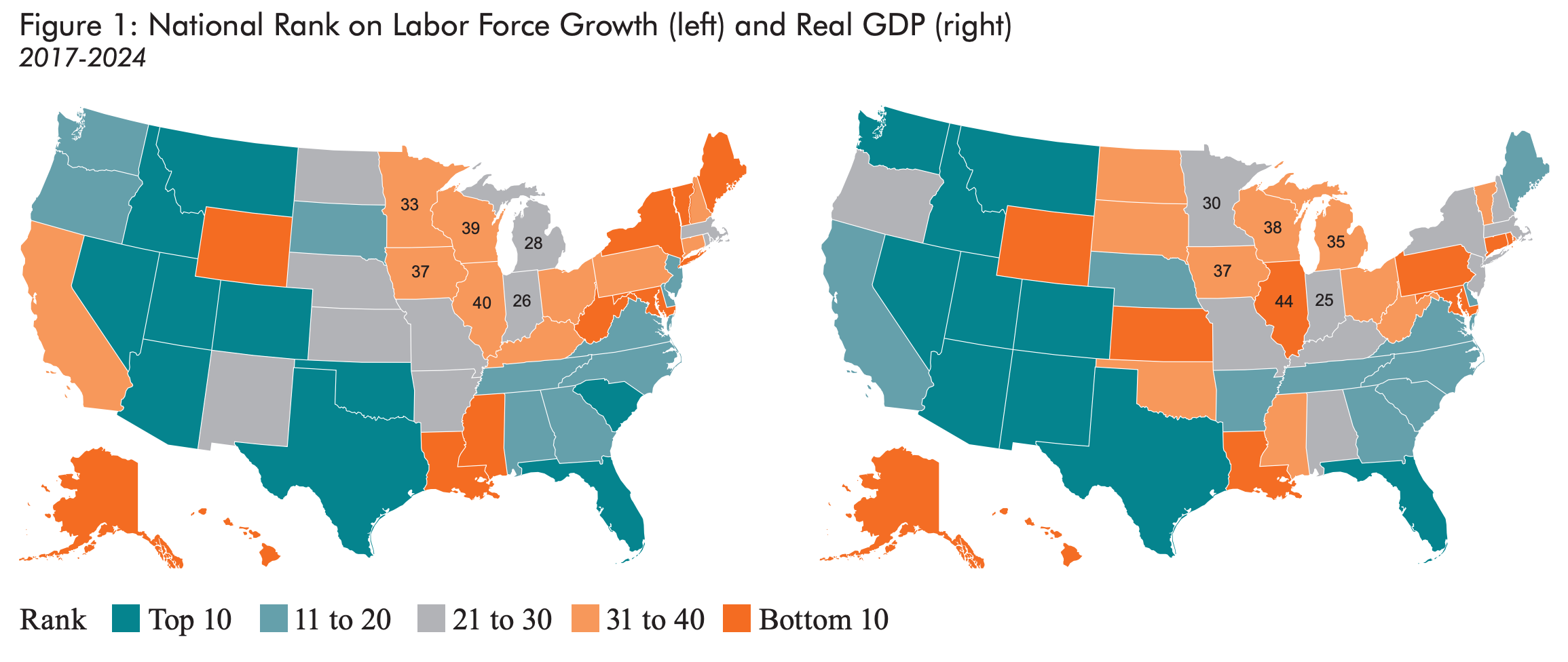
Map courtesy of Forward Analytics
KAK: Does that mean your prime age workers are moving out of Wisconsin to work in other states?
KD: It could mean a number of things. It means that the share of the population in that prime working age, 25 to 64, is shrinking as a share of the whole population.
In Wisconsin it’s a combination of factors. We’re not attracting as many people to Wisconsin as we once were. If you look at the decades from 1990 to 2000, 2000 to 2010, Wisconsin did quite well in attracting people to the state. And those numbers have shrunk (compared with) the previous decades.
What that means is that the share of the population that would be considered prime working age is getting smaller.
KAK: Were there key differences in the economies of counties versus the state as a whole?KD: There are some differences. If we look at some rural northern counties, we see interesting patterns. We see some population growth in some rural counties. We had seven counties that were in the top 20 percent of population growth of all counties and county equivalents in the country. We had no counties that were in the top 20 percent of labor force growth.
So again, this ties back to the divergence between population growth and labor force growth. We’ve seen a lot of growth in the population — outside the labor force in Wisconsin. We see that growth is from those 65 and older, retired and out of the labor force. We saw that at the county level, which is kind of a divergence from the state level, in that it’s very regional.
KAK: What does Wisconsin need to do to keep up and be part of this global economy?
KD: It’s a challenging question that not just Wisconsin is facing. It’s a region-wide issue and it’s a national issue.
One of the things we’ve looked at in recent reports is housing affordability. If you talk about attracting young people, working professionals, young families to your communities and to your states, I think affordable housing is a huge issue.
Now, part of that is due to increased housing costs, part of it’s due to increased interest rates. So there’s a number of factors that go into that. But ultimately, housing affordability is a major issue.
Wisconsin’s economy lags behind the rest of the country, new report shows was originally published by Wisconsin Public Radio.
If you think stories like this are important, become a member of Urban Milwaukee and help support real, independent journalism. Plus you get some cool added benefits.