
Wisconsin’s Tax Burden Plunged Most In Nation, At A Cost
Wisconsin Policy Forum links historic tax decline to weaker K-12 funding and other local services.

dcJohn (CC-BY)
The state and local tax burden in Wisconsin reached a record low in the 2023 fiscal year, but a decades-long trend of declining tax burden may soon be coming to an end.
That’s according to a new report the Wisconsin Policy Forum released Thursday. It looked at the latest data from the U.S. Census Bureau from July 2022 to June 2023, helping to put the state’s burden in national context.
In fiscal year 2023, Wisconsin had the 34th highest tax burden of all 50 states, slightly higher than the previous year when it ranked 35th, the report noted.
The report found state and local taxes declined to 9.77 percent of personal income in Wisconsin during that period, just below the 9.83 percent of income they accounted for in the 2022 fiscal year.
Wisconsin’s taxes as a share of income were also roughly one percentage point below the national average of 10.7 percent, according to the report.
“As our tax burden has declined, so too has our rank among the states throughout the 21st Century,” said Mark Sommerhauser, a spokesperson for the Wisconsin Policy Forum.
In the late ’90s and early 2000s, Wisconsin regularly ranked among the top-five highest tax burden states in the country, the report notes. The state had the third-highest tax burden in 2000 at 12.5 percent, behind only New York state and Maine.
But from 2000 to 2023, the state’s tax burden experienced “the largest decline in the nation,” the report notes.
“There are not many states that are even approaching as big of a decline in the tax burden as Wisconsin,” Sommerhauser said. “There are only a handful of states that are even in the ballpark of the size of the decline that we’ve seen in the 21st Century.”
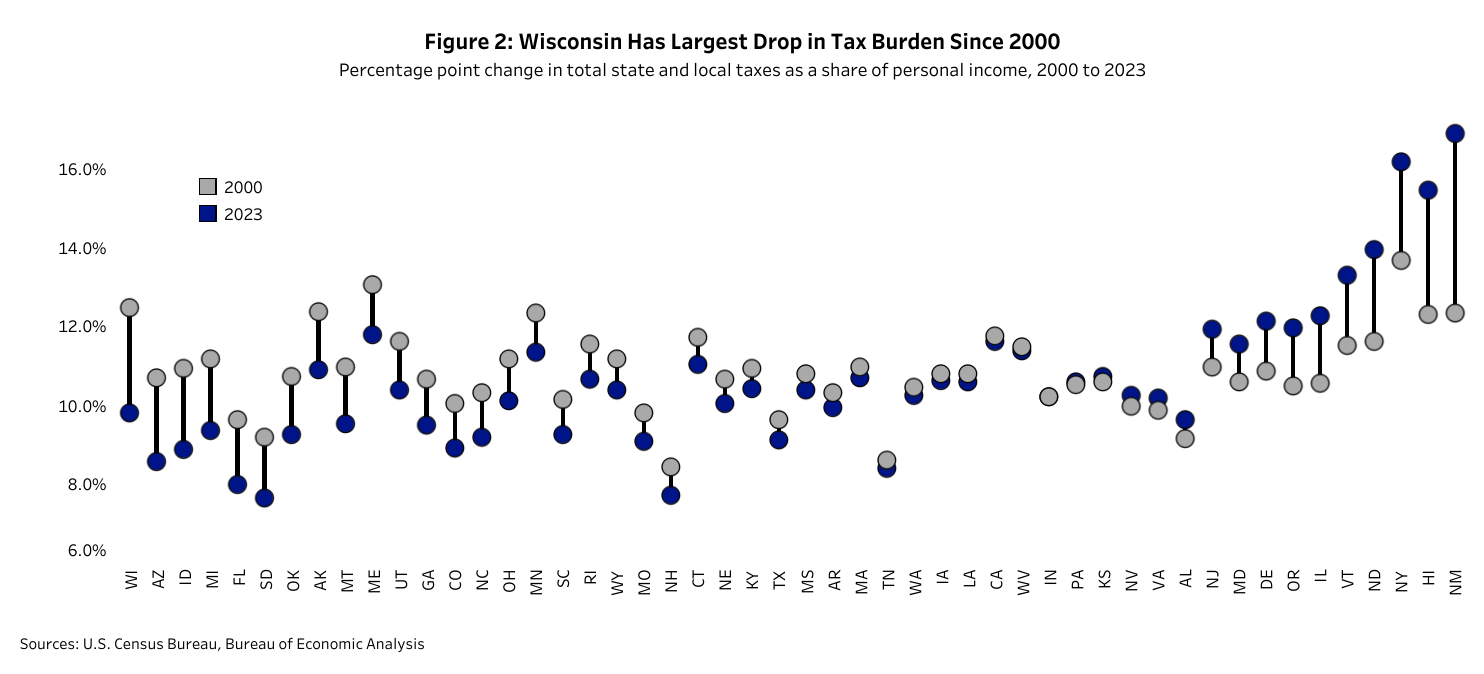
This graphic compares the change in tax burden between Wisconsin and other states. Graphic courtesy of the Wisconsin Policy Forum
But the decline “has translated into a decrease in overall state and local spending levels,” most notably in K-12 education, the report notes. Wisconsin dropped from 11th in per-pupil spending in 2002 to 26th by 2023, according to the report.
Sommerhauser said education is the single largest area of state and local spending, but it isn’t the only area where the amount of income residents are paying toward has fallen.
“For instance, in the area of public safety, our state’s police spending as a share of income, has declined significantly over time,” he said. “You can see this in a number of areas. Education is probably the most notable, but it’s definitely not the only area.”
After years of the state and local tax burden trending downward, it hardly changed from 2024 to 2025.
Separate research from the Wisconsin Policy Forum shows the 2024 and 2025 tax burdens were roughly the same at around 9.6 percent.
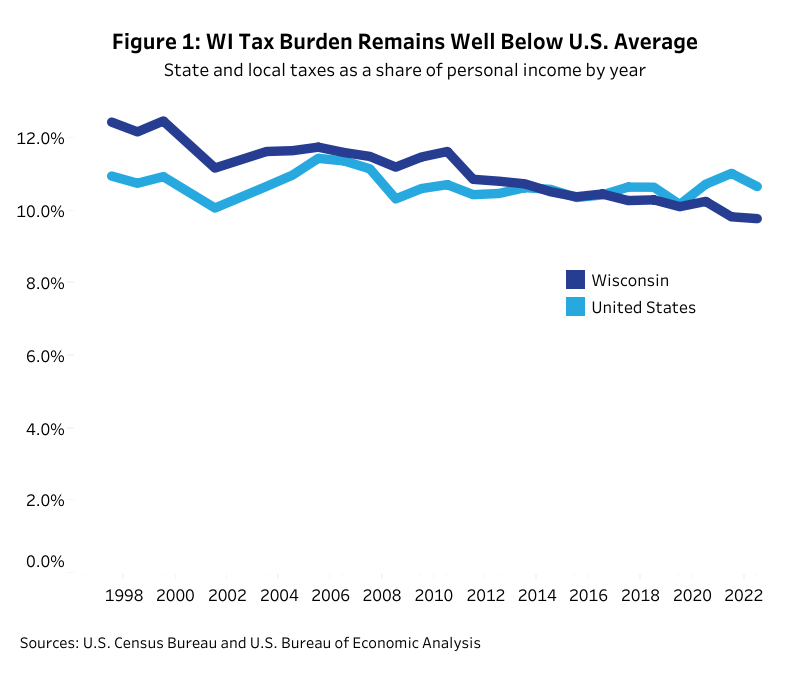
This graphic compares the change in Wisconsin’s tax burden over time to the change nationally. Graphic courtesy of the Wisconsin Policy Forum
The report notes that increased sales taxes in Milwaukee have boosted revenues for the state’s most populous city and county, while school districts in all corners of Wisconsin continue using referendums to increase property taxes and fund operations.
Sommerhauser said it’s “very possible” that Wisconsin is nearing the end of its decades long trend.
“More factors have arisen now that are going to make it more difficult to continue to decrease our state’s tax burden in the way that we have over the last two decades,” he said.
K-12 tax levies increased by 7.8 percent across the state on December 2025 tax bills, boosted “by referenda and frozen state aid to schools,” the report notes. Additionally, income growth in Wisconsin lags income growth nationally.
“If we don’t do anything, we kind of keep on our current trajectory, it seems very likely that property taxes are going to continue to increase, probably by sizable amounts,” Sommerhauser said. “We’re kind of on a course here where schools especially are going to see that as the main avenue that they have to kind of grow their revenues.”
Without state action or an economic upswing, the report says the pressure to fund schools, public safety and infrastructure could put upward pressure on taxes, especially property taxes, the report noted.
“Some voters and elected officials may see that as an acceptable tradeoff,” the report states. “Others may wish to continue to hold the line on taxes.”
The report says choosing to avoid raising taxes would require either significant cuts to services or some sort of innovation by state and local governments through technology or consolidation of services.
Wisconsin’s state, local tax burden hits record lows, but decades of declines could soon end was originally published by Wisconsin Public Radio.
If you think stories like this are important, become a member of Urban Milwaukee and help support real, independent journalism. Plus you get some cool added benefits.