

City Receives $400,000 Grant For Lead Screening
Monthly clinics focus on early intervention following MPS lead crisis.

A student’s blood lead levels are tested at Keefe Avenue Elementary School. Photo taken Feb. 24, 2026 by Sophie Bolich.
Testing vials, alcohol pads and patterned band-aids lined tables at Keefe Avenue Elementary School on Tuesday, where students took part in a lead screening clinic — the third in a new round of testing funded through a $400,000 grant from the Centers for Disease Control and Prevention.
The Milwaukee Health Department (MHD) has organized three clinics with Biotechnology company Novir since receiving the grant last fall, testing about 240 additional children and bringing the total screened since March 2025 to more than 900.
That number is expected to rise over the next year, with an additional $750,000 from the U.S. Department of Housing and Urban Development contributing to monthly pop-up clinics.
Using finger-prick tests with near-instant results, the screenings are free and open to all students at Milwaukee Public Schools. Mayor Cavalier Johnson said the no-cost resource makes child blood lead tests “more accessible now than ever.”
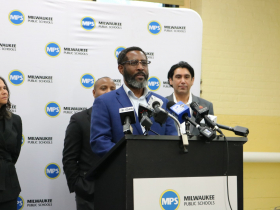
“Instead of scheduling a separate appointment or traveling to a doctor’s office, parents in Milwaukee can simply sign off on their children getting screened for lead in school,” Johnson said during a press conference at the elementary school, 1618 W. Keefe Ave. “I think this is a great example of what can happen when people come together and recognize that the health of our children has to be paramount.”
The effort comes nearly a year after the Trump administration cut — and later reinstated — the CDC Childhood Lead Poisoning Prevention Surveillance Branch in April 2025, slowing progress in Milwaukee.
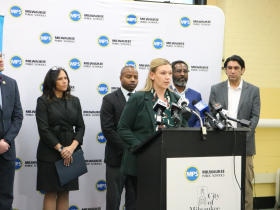
“It certainly caused delays,” Totoraitis said. “But we’re really grateful to move forward now with this funding and with the support of my colleagues here.”
The federally funded effort aims to strengthen early detection and interventions for high blood lead levels, continuing a targeted increase in testing after “dangerous levels of lead contamination” forced the temporary closure of nine MPS buildings last year.
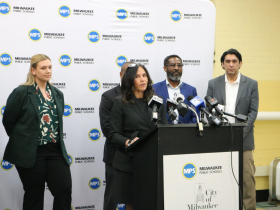
“Early identification can prevent long term health consequences that no child should have to face,” said Milwaukee Health Commissioner Michael Totoraitis. “We know that this has been an incredibly stressful time for [parents], and we’re grateful that we were able to show up and work alongside the school and with our partners to make sure students are safe.”
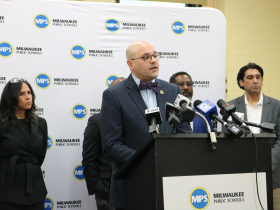
Lead stabilization work in 99 schools was completed in December — ahead of schedule, officials said. Now, the focus shifts to precautionary actions. “Together, we have moved from response and emergency to prevention and care,” said MPS Superintendent Brenda Cassellius. “We’re keeping our focus where it belongs, which is on our kids, so that they can learn in clean, safe environments.”
“We’ve taken the necessary steps to make our school safe, and the board will get an annual update and continuously work to make sure they stay that way,” added MPS Board President Missy Zombor.
Lead dust is often created by friction on surfaces painted with lead, including windows and walls. Along with professional abatement measures, regular cleaning of nearby surfaces can further reduce risk. As part of its lead action plan, MPS has added 39 school-based custodial positions to prevent lead-contaminated dust from building up in areas where kids play.
Though city officials have long maintained lead paint poses a greater health risk than lead-contaminated water, the Milwaukee Water Works previously replaced all lead service lines connected to MPS schools.
Children six and under are to be screened for their blood lead level during annual checkups and those with levels above an intervention threshold are referred to the city’s Childhood Lead Poisoning Prevention Program for review and investigation. No level of lead is considered safe.
A portion of the funding will also support the Coalition on Lead Emergency (COLE) to assist with education and outreach to families about upcoming screening clinics.
Officials said there has been a strong response to the latest round of opt-in testing, which has so far yielded a “pretty low percentage” of elevated lead levels.
Though children under six are at highest risk, CDC Lead Poisoning Prevention and Surveillance Branch Chief Paul Allwood recommended participation for all ages.
“It’s very, very important, because when we find the lead early, there’s a lot that we can do in terms of putting the child in touch with the appropriate services to reduce harm,” said Allwood, who also encouraged families to monitor children’s levels during and after home renovations — especially for residences built before 1978.
Along with financial support, partnering with the CDC grants city officials access to guidance and expertise, Totoraitis said, noting that teams have brainstormed ideas for long-term surveillance and other opportunities for improvement.
A full schedule of upcoming clinics, including screenings open to the community, is available online, along with resources and additional information on MPS’s lead safety plan.
Photos


If you think stories like this are important, become a member of Urban Milwaukee and help support real, independent journalism. Plus you get some cool added benefits.
More about the Lead Crisis
- Gov. Evers Signs New PFAS, Lead Regulations - Danielle Kaeding - Mar 2nd, 2026
- City Receives $400,000 Grant For Lead Screening - Sophie Bolich - Feb 24th, 2026
- Rep. Madison Proposes Restoring Local Control Over Lead Inspections - State Rep. Darrin Madison - Jan 6th, 2026
- $43 Million Later, MPS Says Classrooms Are Safe From Lead Dust - Corrinne Hess - Dec 18th, 2025
- MPS Buildings Cleared of Lead-Paint Risks after 10-Plus Months of Work - Milwaukee Public Schools - Dec 17th, 2025
- Wisconsin Moves to Require Lead Service Lines Replaced By 2037 - Danielle Kaeding - Dec 11th, 2025
- Gov. Evers, DNR Announce More Than $159 Million to Ensure Clean, Safe Drinking Water for Wisconsinites in 29 Municipalities - Gov. Tony Evers - Dec 10th, 2025
- EPA Announces $3 Billion in New Funding for States to Reduce Lead in Drinking Water - U.S. Environmental Protection Agency - Nov 25th, 2025
- Wisconsin Communities Get $282 Million for Drinking Water Projects - Danielle Kaeding - Nov 19th, 2025
- MKE County: County Launches Lead Abatement Program - Graham Kilmer - Nov 9th, 2025
Read more about Lead Crisis here





















And again. While we need to screen kids for lead poisoning, we can SEE the children who are being or have been ABUSED by their BEHAVIOR Yes it is the simple. Kids whose BEHAVIOR is not socially acceptable have been or are being abuses. They are NOT choosing their behavior. Free will has little to do with socially unacceptable behavior. The alcoholic is trying to hide or cover up the PAIN of past ABUSE. A person who sees someone killed is abused which causes a trauma. We have a simple test to determine if someone has been abused by answering a series of questions called Adverse Childhood Experiences ACE’s.