At UWM Lecture, Angela Davis Weighs in on Campus DEI Debate
Civil rights icon also discussed collective care, modern justice movements and prison abolition.
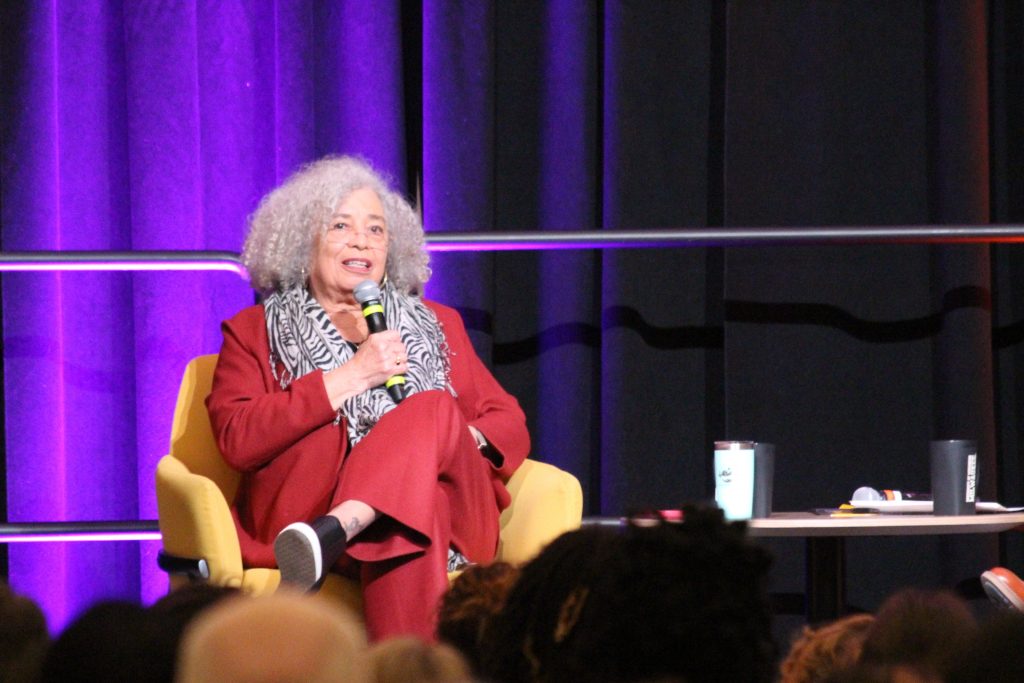
Angela Davis speaks at the University of Wisconsin-Milwaukee. Photo taken Feb. 17, 2026 by Sophie Bolich.
Before delivering a sold-out lecture at the University of Wisconsin-Milwaukee student union Tuesday evening, Angela Davis spoke with a small group of students.
Their discussion touched on the university’s controversial plan to consolidate eight cultural and resource centers into a new “unified, student-focused hub” — a topic that later resurfaced during Davis’ public appearance.
“Apparently, there are those in the administration on this campus who don’t like the idea that there is this amazing multiplicity of student organizations,” Davis, a renowned political activist and scholar, told nearly 1,000 attendees gathered in the conference room, prompting boos. “This is not a good move.”
UWM announced earlier this week it would close the First-Generation+ Student Center, the Black Student Cultural Center, the LGBTQ+ Resource Center, the Military and Veterans Resource Center, the Off-Campus Resource Center, the Roberto Hernández Center for Latino students, the Southeast Asian American Student Center and the Women’s Resource Center.
The school has said all current resources will continue in the new center, which aims to provide “holistic support”; however, the plan has sparked concern among members of current programs.
“We think that it may be coming — is probably coming — from the whole effort to get rid of DEI,” Davis said, referencing the Trump administration’s push to eliminate diversity, equity and inclusion programs, framed as “restoring merit-based opportunity.”
UWM confirmed the evolving federal landscape “was considered as part of the planning discussion,” but said improving student outcomes was the driving factor behind the decision.
“It’s weird because a lot of us were critical of DEI,” Davis said. “We need more than that. We need justice.”
As students prepare to push back against the change, Davis asked audience members to show solidarity. “Be ready to help them when they call for your aid, or maybe stand up and say, ‘This is not a good idea.'”
During the 90-minute conversation, moderated by professor Derrick Harriell, Davis also discussed collective care, anti-capitalism and modern justice movements. Even-toned and tangent-inclined, she often circled back to memories of Milwaukee. “I have a lot,” said the 82-year-old, who has maintained decades-long ties to the city, including with members of Milwaukee Alliance Against Racist and Political Repression.
When asked to compare the civil rights movement with modern causes like Black Lives Matter, Davis — a key figure in both — said she doesn’t view them as separate. “I think of it as all one movement, and I think of it as a freedom movement,” she said.
“We’re still living with the consequences of slavery today,” Davis continued. “As a matter of fact, in the summer of 2020, when so many people went out into the streets and protested, that was a moment of collective consciousness of what racism has done to this country. We’re still historically in that moment, and all of what we have experienced — the recent experience — is a reaction.”
It’s no accident that students are often at the forefront of political movements, Davis said, referring back to UWM. She praised pupils for establishing “Falasteen Lawn,” a two-week encampment demanding divestment from Israel, financial transparency and a ceasefire in Gaza.
When students and their institutions are at odds, there is an opportunity for progress, Davis said.
“It’s important not to assume that you can characterize this institution in a single, simplistic way,” she said. “We shouldn’t be afraid of contradictions, and we should learn how to glean from the contradictions those moments and those ideas and those ways of thinking about moving the world forward.”
She received a warm welcome from the crowd, earning a standing ovation as she walked to the stage, smiling and waving, and again at the end of her talk. More than once during the evening, Davis held her microphone out to audience members, asking questions and giving a platform to students, including one who offered a tribute to Nada Moubarak, a 24-year-old activist, organizer and UWM alumna.
Davis rose to prominence in the late 1960s as a Marxist, feminist and political activist after being jailed in connection with a Marin County courtroom shootout. Accused of murder, kidnapping and criminal conspiracy, she spent 18 months in jail before being acquitted of all charges in 1972.
She remains active in social justice movements today and is a vocal advocate for prison abolition — work she said draws on the same creativity that informs art.
“The process of art itself is to create something that has never been created before. That is what is so exciting about it — and we want to create a world that has never been created before,” Davis said. “Art is so important because oftentimes, even though we are not sure where we’re headed or we’re not sure exactly what this new world would look like, art can tell us how it might feel.”
If you think stories like this are important, become a member of Urban Milwaukee and help support real, independent journalism. Plus you get some cool added benefits.