
Small Set of Counties Could Pick Democratic Candidate for Governor
Tony Evers won just 16 of 72 counties in November 2022 election.
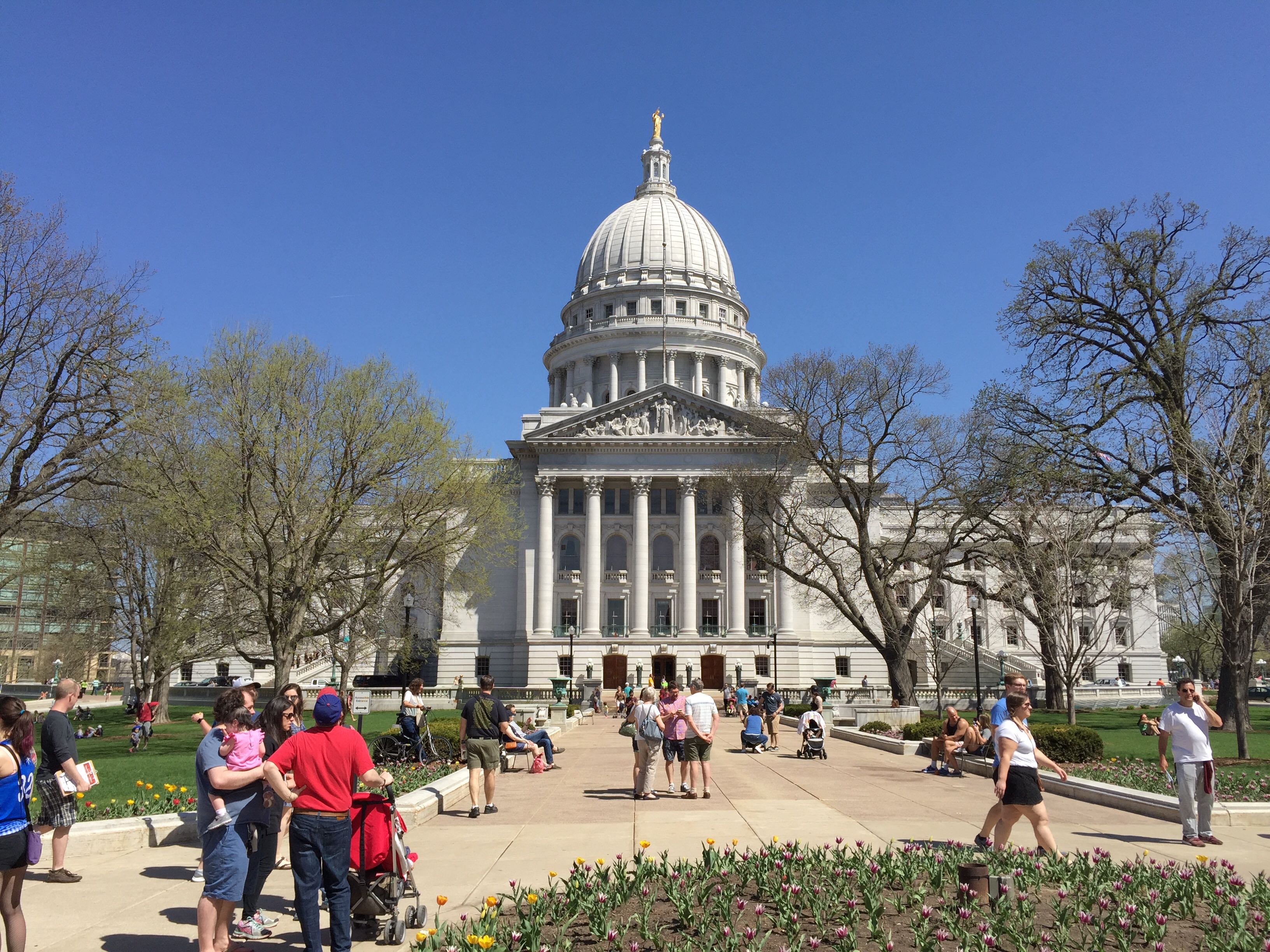
Wisconsin State Capitol. Photo by Dave Reid.
It was a poll of registered voters, but it suggests what major gains Democratic candidates for governor must make to win the party’s nomination in the Aug. 17 primary — only six months away. The November election will be the first vote for a governor with no incumbent since 2010.
In November 2022, votes for governor in only 11 counties — and four regions of the state — made up 54% of the statewide vote total of 2.65 million. Fine-print details of the October 2025 Marquette University Law School poll show how little-known six of the eight Democratic candidates for governor were to voters in those four regions.
Two disclosures: First, the Oct. 15-22 poll was conducted before two more Milwaukee County Democrats — former Lt. Gov. Mandela Barnes and former state Administration Secretary Joel Brennan — announced their runs for governor. Barnes announced on Dec. 2; Brennan, Dec. 12. And it was conducted before Washington County Executive Josh Schoemann dropped out as a Republican candidate, leaving 7th District U.S. Rep. Tom Tiffany as the presumptive Republican nominee for governor in November.
Still, even with those caveats, the low October name ID numbers of the six Democrats in those four regions of the state are notable.
Voters in five metropolitan Milwaukee counties (Milwaukee, Waukesha, Racine, Washington and Ozaukee) cast a total of 779,416 votes for governor, or 29% of the statewide total in 2022.
The October Marquette poll estimated these name IDs for the six Democrats in metropolitan Milwaukee: Milwaukee County Executive David Crowley, 42%; Lt. Gov. Sara Rodriguez, of Waukesha, 31%; state Rep. Francesca Hong, 27%; Missy Hughes, former CEO of the state Economic Development Corp.; and state Sen. Kelda Roys, both 20%; and former state Rep. Brett Hulsey, 19%. Hong, Roys and Hulsey are from Madison.
Neither Crowley nor Rodriguez was known by more than 50% of their neighbors in Wisconsin’s largest metropolitan area.
Dane County voters cast 301,033 votes for governor four years ago, or 11.3% of the statewide total. The fall Marquette University poll of Dane County voters found that none of the six Democrats had name IDs higher than 30%: Rodriguez was at 29%; Hong, 28%; Roys, 25%; Crowley and Hulsey, both 20%; and Hughes, 16%.
Voters in the northeast Wisconsin counties of Brown and Outagamie cast 200,307 votes for governor in 2022, 7.5% of the statewide total. The Marquette poll of registered voters in that region found that none of the six Democrats had name IDs of more than 20%: Rodriguez, 17%; Hong, 13%; Crowley, 12%; Hulsey and Roys, 10%; and Hughes, 9%.
Finally, the Marquette poll surveyed voters in northern and western Wisconsin. Voters in three of those counties — Marathon, La Crosse and Eau Claire — cast a total of 165,400 votes four years ago, or 6.1% of the statewide total.
Marquette’s survey found that none of the six Democrats had name identification IDs of more than 20% in that region: Crowley, Hong and Rodriguez, 17% each; Hughes, who is from Vernon County, 12%; Hulsey, 10%; and Roys, 9%.
Brennan and Barnes announced that they would also seek the Democratic nomination after the October poll suggested how open the race was for the party’s nomination. Barnes was the party’s November 2022 nominee for Senate, getting 48% of the vote against Republican Sen. Ron Johnson. A spokesman for Barnes’ campaign for governor said other polls have identified him as the best known Democratic candidate, giving him an advantage in the six-month race to win the primary.
Only Democratic voters will decide who wins the Aug. 17 primary for governor. In the 10-candidate Democratic primary for governor in 2018, 48% of the statewide vote was cast in just four counties — Milwaukee, 21%; Dane, 19%; Waukesha, 5.1%; and Brown, 3.1%.
And in the November 2022 election that gave Democratic Gov. Tony Evers and Rodriguez second terms, they won only three of the 11 counties — Milwaukee, Dane and La Crosse — of the four regions surveyed in the Marquette poll. In all, they won just 16 of Wisconsin’s 72 counties. Nowadays Wisconsin’s Democrats tend to be concentrated in urban areas, yet statewide elections are typically decided by independent voters.
Although Tiffany’s endorsement by President Donald Trump forced Schoemann out of the race, Marquette’s October poll also showed weakness in the statewide name ID of the Oneida County Republican.
Of registered voters surveyed in the four regions of the state, Tiffany’s name ID was 60% in northern and western Wisconsin, which he has represented in Congress since May 2020. But his name ID was 36% in Dane County; 37% in metropolitan Milwaukee, and 27% in the Green Bay area.
Lots of numbers. What do they all mean? The winner of the Democratic primary will almost certainly have to have a strong base in either metro Milwaukee or Dane County, and preferably both. And they need to do it quickly, with just six months before the August primary election. Tiffany, meanwhile, has until November to make himself and his issues known in the state’s urban areas.
Steven Walters started covering the Capitol in 1988. Contact him at stevenscotwaltrs@gmail.com
If you think stories like this are important, become a member of Urban Milwaukee and help support real, independent journalism. Plus you get some cool added benefits.
Political Contributions Tracker
Displaying political contributions between people mentioned in this story. Learn more.


The State of Politics
-
Why the Rise in Property Tax Anger?
 Mar 16th, 2026 by Steven Walters
-
WI Supreme Court Could Order More School Aid
 Mar 9th, 2026 by Steven Walters
-
GOP’s Rebate Checks Won’t Be in the Mail
 Mar 2nd, 2026 by Steven Walters













Sadly money will decide the winner.
Bet the number of counties this November voting for Democrats will be way higher than 11.
Sorry, KWH. WE are going to decide the winner.
Keep in mind that Milwaukee and Dane County together have more people than the smallest 50 counties combined. So while the Democratic candidates absolutely need to get out to all the counties and make their case to the voters, Milwaukee and Dane will play the biggest roles in who will win the primary and subsequently the general election in November.
Remember how Senator Russ Feingold visited every county in WI each year he was in office? I haven’t seen his successor Ron Johnson for the past 15 years…
Does it have to be said that the number of counties voting for a candidate for governor means *absolutely nothing*? Last time I checked, there are no electoral votes in a Wisconsin governor election. So whoever gets the most votes wins.