
Philomusica Explores American Roots
Works by Barber, Tate and Dvořák, the last based on American folk music.
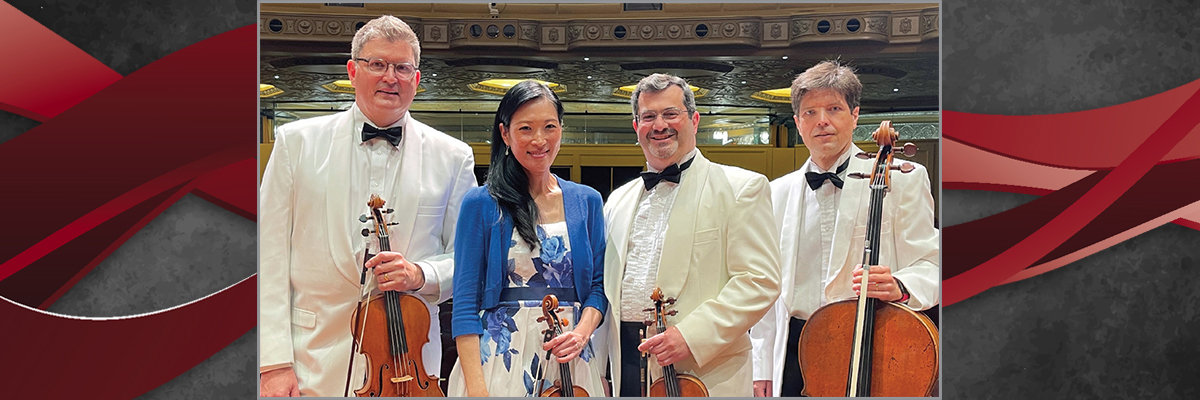
Provided by Philomusica Quartet
The Philomusica Quartet explores America’s evolving cultural identity through the lens of music for string quartet in a program titled American Roots on Monday, Feb. 2. Performing are violinists Jeanyi Kim and Alexander Mandl, violist Nathan Hackett and guest cellist Shinae Ra.
The program opens with the String Quartet, Op. 11 written in 1936 by American composer Samuel Barber (1910-1981). The audience will likely recognize the second movement. Voted by BBC listeners as the “saddest classical work” ever written, the Adagio for Strings is Barber’s own transcription of the quartet’s Molto adagio movement. Premiered in 1938, the transcription has been played by string orchestras to memorialize presidents, mourn those lost on 9/11, and mark countless other solemn occasions. Within the context of the quartet, however, the Adagio movement takes on a different role. It contrasts with a restless, unsettled first movement characterized by sharply articulated rhythms and tightly woven counterpoint, and an urgent, intense third movement with rapid figurations and biting accents. The quartet, says musicologist Kai Christiansen, “is often regarded as a two-movement work with the massive adagio rising out of the center of the single, interrupted ‘outer’ movement, a ternary form symmetrically balanced with matching endpapers.”
Jerod Impichchaachaaha’ Tate (born 1968) is a contemporary composer of Chickasaw and Manx descent and a citizen of the Chickasaw Nation. His works for symphony, chamber ensemble, film and voice are rooted in Indigenous culture and history, creating a distinctive musical voice for Indigenous Americans within classical traditions. Tate’s string quartet is titled Pisachi (a Chickasaw word meaning “reveal”) and draws from Hopi and Pueblo music, rhythms and form. The six-section composition was commissioned to accompany images of the American Indian Southwest for a 2013 multimedia performance by the ETHEL string quartet.
Czech composer Antonín Dvořák (1841-1904) served as director of the National Conservatory of Music in New York City from 1892 to 1895. He used that platform to actively encourage American composers to broaden their thinking beyond the European classical tradition. Known for incorporating folk tunes and rhythms of Moravia and Bohemia in his own work, Dvořák was particularly impressed by the spirituals he heard sung by Henry Burleigh, an African American student. In the New York Herald, Dvořák shared his conviction that “the future music of this country must be founded on what are called Negro melodies. These beautiful and varied themes are the products of the soil. They are American.”
Dvořák’s Quartet No. 12 in F Major, known as the “American” quartet, includes passages influenced by both spirituals and Native American musical traditions. He sketched out the work in a mere three days while taking a summer break in Iowa from his National Conservatory duties. The composition uses a pentatonic scale (F-G-A-C-D), incorporates folk-like themes and even features the birdsong of the scarlet tanager, heard by Dvořák while hiking.
The Philomusica Quartet presents this rich sampling of the roots of American classical music at 7:30 p.m. Monday, Feb. 2, at the Wisconsin Lutheran College Schwan Concert Hall, 8815 W. Wisconsin Ave. Tickets are available online.
If you think stories like this are important, become a member of Urban Milwaukee and help support real, independent journalism. Plus you get some cool added benefits.