

Microsoft Wants to Build 15 More Data Centers in Mount Pleasant
Would be part of two campuses worth more than $13 billion.
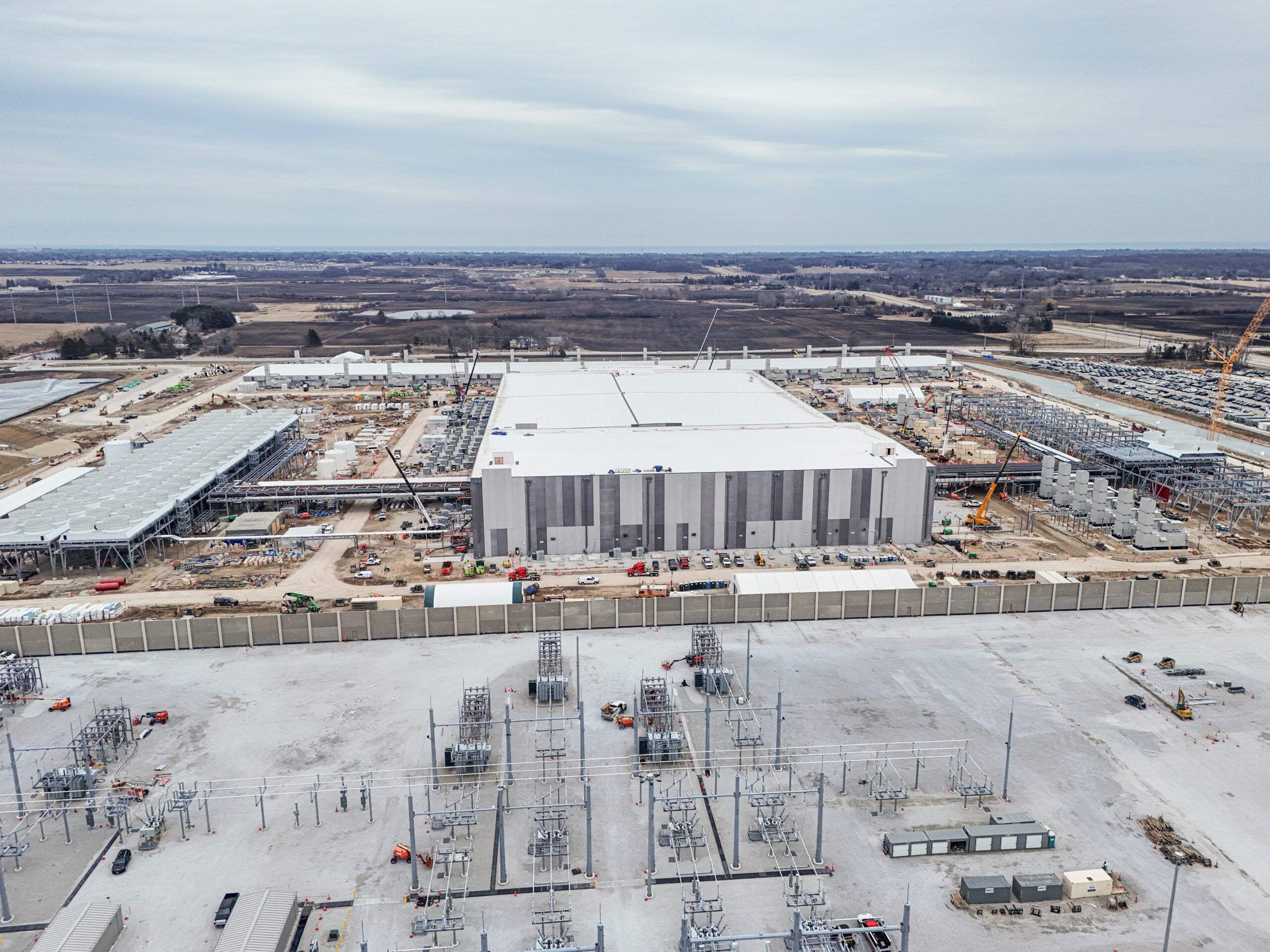
Construction is ongoing on the first phase of Microsoft’s data center project in Mount Pleasant on March 11, 2025. Photo courtesy of Microsoft
Microsoft Corp. is proposing to build 15 more data centers in Mount Pleasant as part of two new campuses worth more than $13 billion.
The news was first reported by BizTimes, and a Microsoft spokesperson confirmed the proposed expansion on land it purchased in 2024.
“These preliminary plans are the next step in our yearslong development process and we look forward to sharing more about our specific plans as we go forward,” a Microsoft spokesperson said in an email.
The company’s plans are under review by the village’s planning commission. The two data center campuses are being built on land either purchased from the village or private property owners, according to a spokesperson for the village.
The move comes as the tech giant is already investing more than $7 billion in two data center projects in the village. The company is also planning another data center campus in Kenosha.
According to planning documents, Microsoft submitted an updated site plan for the initial phase of a data center campus at Durand Avenue with a taxable value of more than $7.97 billion. It would include nine data centers, as well as a 96,000-square-foot office and other related buildings. The total development would span 5.2 million square feet on a 791-acre parcel.
Microsoft also submitted a site plan for the initial phase of another data center campus at International Drive with a taxable value of more than $5.3 billion. The proposed development would include six data centers, a 74,000-square-foot office and other buildings. The campus would cover more than 3.5 million square feet across around 530 acres.
Both developments would occur within tax increment financing districts. The Durand Avenue site would generate around $45 million annually in village revenues once all debts are paid in the district, and the International Drive location is expected to generate around $30 million each year.
Planning documents state both projects are likely to contribute “far more tax revenue than (required) in adjacent public infrastructure liability and public service costs to the village.”
The village’s planning commission has recommended approval of Microsoft’s plans as long as it meets multiple conditions. Those include an analysis of traffic impacts from the proposed developments since both are expected to see 1,000 or more vehicles each day. Microsoft must also meet all local and state rules regarding water use by its data centers.
If approved, the company may submit engineering plans that would be followed by building permit applications to begin constThe commission is set to meet at 1 p.m. Wednesday at the village hall.
The proposed expansion comes as Microsoft has faced concerns surrounding the energy and water demands of its data center campuses, including worries over rising electric rates. A Microsoft spokesperson said an estimate of energy use by the proposed data centers was unavailable at this time.
Brad Smith, Microsoft’s president and vice chair, told WPR last week that he supports regulation of data centers, as well as a proposal from We Energies for a “Very Large Customer” rate for data centers in the state.
“We want to pay a higher price so that our data center does not increase the price of electricity for consumers,” Smith told WPR.
Microsoft has previously stated their data centers in Mount Pleasant would use up to 8.4 million gallons annually at full buildout. A Microsoft spokesperson confirmed that the company expects its expansion plans would be included in that estimate. If not, Microsoft would need to obtain additional approval from local authorities.
Microsoft wants to build 15 more data centers in Mount Pleasant was originally published by Wisconsin Public Radio.
If you think stories like this are important, become a member of Urban Milwaukee and help support real, independent journalism. Plus you get some cool added benefits.























Lets all together grab hands and chant “kumbaya”,
OpenAI CEO Sam Altman,
“If we have to spend even 1% of the world’s electricity training powerful AI, and that AI helps us figure out how to get to non-carbon-based energy or to do carbon capture better, that would be a massive win,”
“It can be great, we have the potential to eliminate poverty, solve climate change, cure a huge amount of human disease, like educate everyone in the world phenomenally well”.
Meta CEO Mark Zuckerburg,
“Advances in technology have freed much of humanity to focus less on subsistence and more on the pursuits that we choose. And at each step along the way, most people have decided to use their newfound productivity to spend more time on creativity, culture, relationships, and just enjoying life. And I expect superintelligence to accelerate this trend even more”.
Palantir CEO Alex Carp,
“AI makes America the dominant country in the world. So just start there. Every other country in the world — like, I spent half my life in Europe — they’re whining and crying. We have the right chips. We have the right software. We have the right engineers. We have the right culture. We have the right people”.
How come these supposedly brilliant men sound so foolish? Blinded by greed perhaps?
Current AI has no intent and no motive other than that given to it. Studies have shown limited utility for ‘discovering’ anything.
It _is_ good for pattern-matching, which, considering Palantir’s business model, means we’re being asked to allow effectively unrestrained, mega resourced, mega corporations to exploit our energy and water to build a ubiquitous surveillance system that may be used against us.
The Village of Mount Pleasant board barely tried to conceal that they sold themselves in exchange for their own short-term enrichment. They want to allow Microsoft to offload the cost of power and environmental consequences onto the greater state, through inevitable electric rate increases and further degradation of Lake Michigan.
Is that fair? One village holding sole decision-making over ventures that will have state-wide impact?
At a minimum, new data center builds should be mandated to use closed-loop cooling and to include the costs of constructing offsetting renewable energy plants. Only then will corporations like Microsoft be paying the true cost of AI.
So who’s left holding the bag when the AI bubble pops? Ah yeah of course.
One very suspicious reason to expand data centers is to accommodate the huge
AI-directed bot swarms that various groups want to use to clog the entire digital world with contrived “truths”, “majority” opinions and narratives, beginning with polls and social media.
Submissions will be customized for the topic, size, tone & character of each forum to be invaded.
. ————————- .
Data ceners are often characterized/zoned as warehouses.
However they are 100% involved with off-premise entities functions and purposes.
They can be the invisible hearts & arteries of crimes from pornography through the overthrow of governments, but on a huge scale.
Between file transmissions and deletions, investigations could become the world’s largest games of Whack-a-Mole!