

Milwaukee Police Send Out the Drones
120 flights in first week of use, usually beating squad cars on 911 calls.
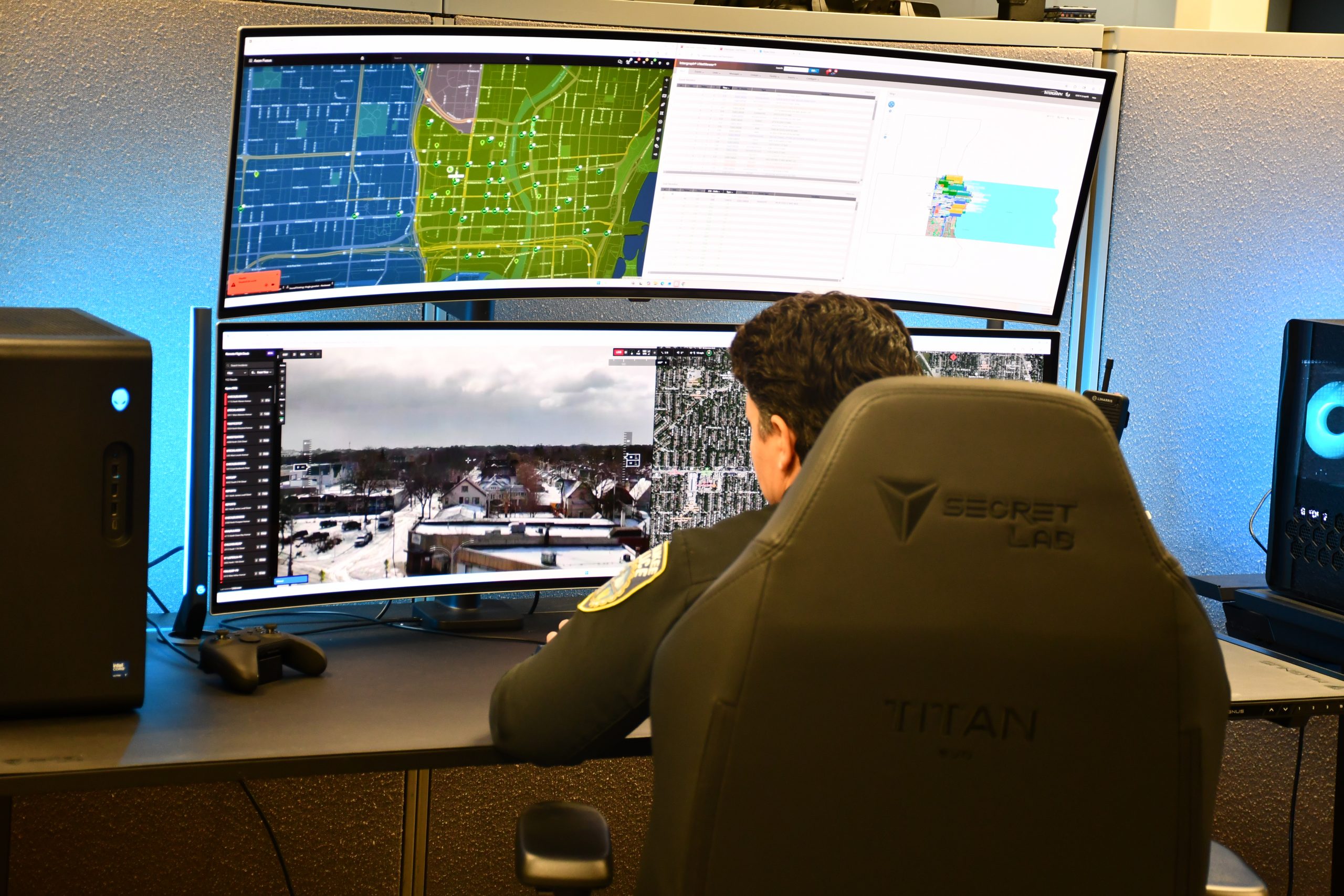
Lydia Rivera pilots a drone from a desk. Photo by Jeramey Jannene.
It’s a bird, it’s a plane, it’s a… police drone?
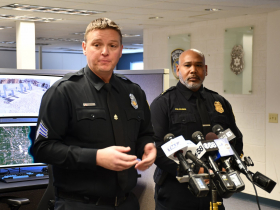
The Milwaukee Police Department‘s new Drone First Responder program (DFR) took to the skies on Jan. 1. According to unit commander Sgt. Christopher Boss, officers flew drones 120 times in its first week.
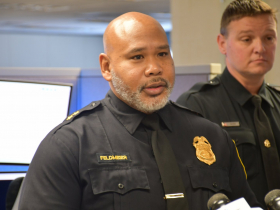
For Chief Jeffrey Norman, it’s a force multiplier tool that is about speed and safety. “We can get out there quicker and use these resources in a way that helps us do the best work for our city,” said Norman at a press conference Wednesday morning.
In a nondescript West Side office building, 1150 N. Alois St., with an interior that resembles an unusual cross between a cubicle farm and a teenager’s gaming setup, a five-person squad aims to be the first eyes on the scene without ever needing to stand up.
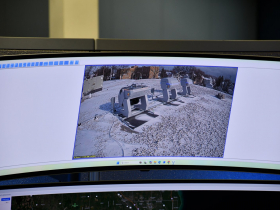
In a matter of seconds, the DFR team can go from monitoring police radios and calls for service to remotely launching a drone from an enclosed bay on the roof of MPD’s District 7 station, 3626 W. Fond du Lac Ave.
From there, it’s a fast flight, in virtually any weather condition, to anywhere in the middle of the city. Once coordinates are entered, the drone can pilot itself to the location.
“We don’t have traffic at this point, stop signs or stoplights either,” said Boss. “It’s a very fast response.”
Once a drone arrives on the scene, the operator is able to monitor the scene from their computer monitor bay and relay to approaching officers what they see. They can also use a spotlight or issue commands from a speaker.
“Just knowing somebody might be there ahead of me and they’re going to tell me what’s going on before I get there is relatively comforting,” said Boss.
The sergeant said the team is already delivering results.
A drone arrived at a call for a restraining order violation before an officer could arrive on foot. Boss, who was operating the drone remotely, made his presence known and then followed the suspect as they fled on foot to a nearby gas station, where an on-the-ground officer made an arrest.
“We’re seeing that a lot. That’s not an isolated incident,” said Boss.
MPD has worked for years to get to this point.
“It has been a three-year labor,” said Inspector David Feldmeier.
When asked for the cost, Feldmeier laughed and said “a lot.” MPD used $295,000 in asset forfeiture funds to acquire the equipment through a three-year contract with Skydio. It has dedicated five sworn officers to the squad.
The effort has expanded pre-existing but limited, on-scene use of drones.
MPD is already looking at how to scale up to around-the-clock staffing and more deployment locations to cover the entire city.
“The goal is to reach the incident, to respond as quickly as possible so that we can make better, more informed decisions and ultimately protect the public that we serve, our officers and anyone else who might be involved in an ongoing incident,” said Boss.
Feldmeier said MPD would continue to use sworn officers at the moment versus less-costly civilian personnel. “That’s something we always consider,” said the inspector. But he said the on-street experience of the officers piloting the drones allows them to know what kind of information those responding in person will want.
The three drones are currently responding to calls in districts three, five and seven, which covers roughly W. Silver Spring Drive to W. National Avenue and from the Milwaukee River to the city’s western limits.
MPD believes it is the only law enforcement department in Wisconsin with remote deployment capabilities and one of only 50 in the country.
Feldmeier said the department is exploring sending drones to respond to incidents without an immediate plan to send actual officers. He said for low-priority calls that have already gone multiple hours without an in-person response, the department is considering sending a drone first to confirm if there is still a situation to respond to without the need to dispatch an in-person squad.
MPD previously committed to publishing drone flight paths and a standard operating procedure prevents it from using drones for facial recognition. The footage is subject to the same storage requirements as the department’s body camera footage.
Photos
Existing members must be signed in to see the interactive map. Sign in.
If you think stories like this are important, become a member of Urban Milwaukee and help support real, independent journalism. Plus you get some cool added benefits.
















Expensive and dystopian.
Not a fan of police state.
If the videos are subject to the same storage requirements as body cams, let’s see some video!
Wow….?!
“Send Out The Drones”, dude, that’s a Stephen Sondheim song!
Sorry, my dear
But where are the drones?
Quick, send in the drones
Don’t bothеr, they’re herе
Using drones can make a positive difference such as following a fleeing suspect. However, the use of drones can also be used in nefarious ways such as monitoring the move of individuals–including politicians–that have made uncomplimentary remarks, participated in a protest, or who are concerned rabble-rousers. Before the end of this pilot project, the concerns of Milwaukee residents must be heard and the development of clear, actionable policies that prevents the use of drones in unconstitutional ways.