

AI Boom Hits Home in Waldo, WI
Pristine creek, protected woods and wetlands caught in a spreading network of high-voltage power lines.
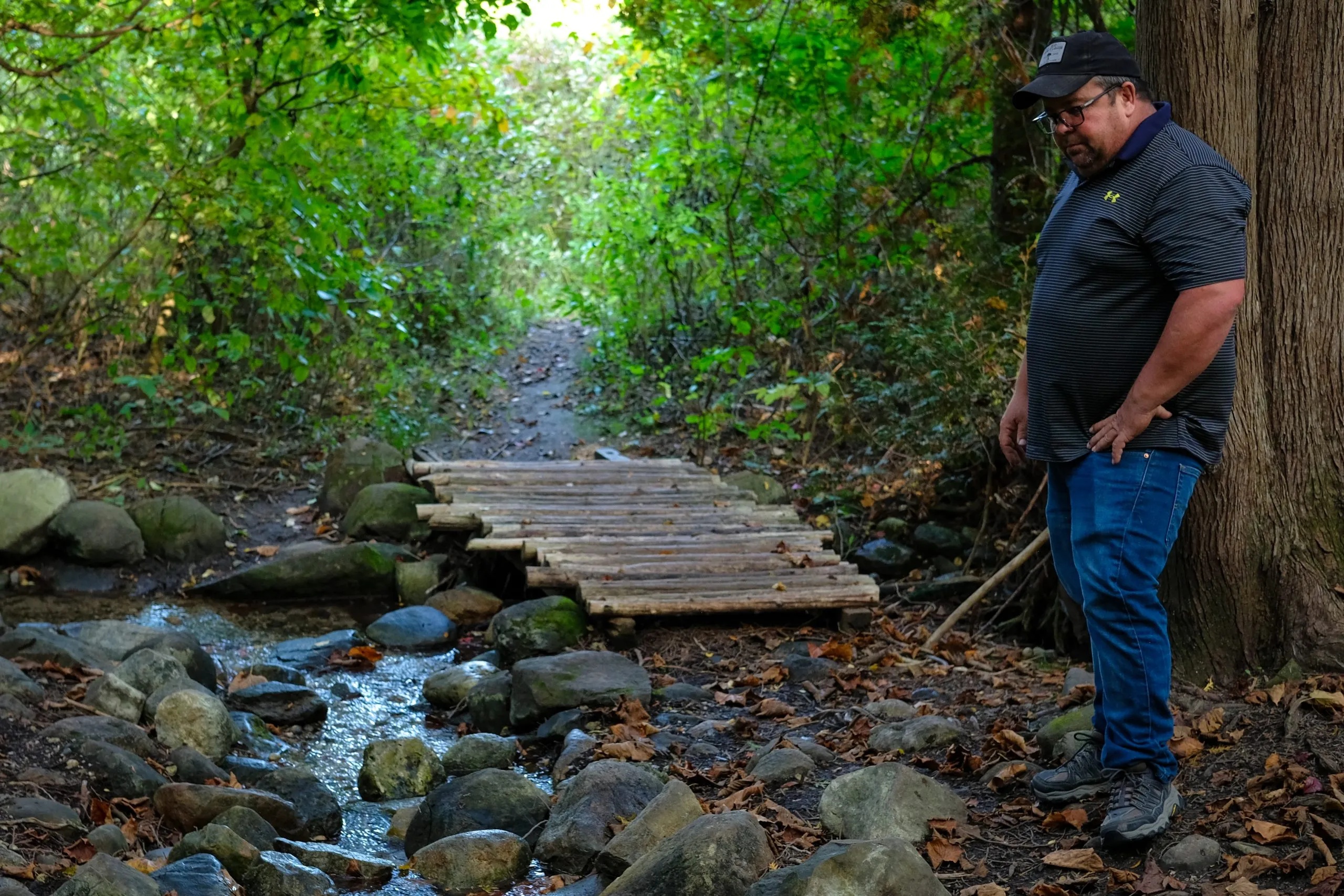
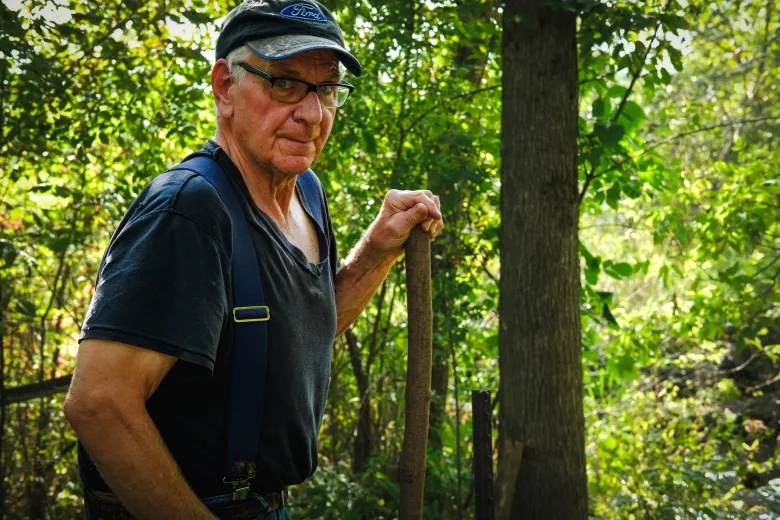
Chris Kestell. Photo © Christian Thorsberg/Circle of Blue
PLYMOUTH COUNTY, WISCONSIN — On a warm fall afternoon, dairy farmer Chris Kestell pushes through prairie brambles taller than himself, tracing a path overgrown with thickets and swarming with bees as he hikes toward a hidden waterway.
Though the route is unidentifiable to the untrained eye, Kestell, 47, has lived here, in the small town of Waldo, Wisconsin, for nearly all his life. His father first walked this path 70 years ago, and his two young boys, 8 and 10 years-old, mark the third generation to follow this practiced journey.After several minutes, he comes to rest beside a fallen tree. In its petrified tangle of roots, guarded by a tiny plastic gnome, a collection of spoons, bowls, and mugs fit like perfect puzzle pieces. Kestell takes a silver ladle from the snarl and kneels over a wall of dirt, from which a steady trickle emerges.
These are the headwaters of the Milwaukee River, known locally as Nichols Creek. According to Milwaukee Riverkeeper data, it is the “most pristine” monitored waterway in the entire 900 square-mile rivershed, and one of the only regional waters where brook trout reproduce naturally.
As he has done since he was a young boy, Kestell brings the water to his lips. “By a certain age, everybody drinks here,” he says. “The creek is a landmark for this area. When you’re a kid, you’re like, ‘Wow, this is pretty awesome.’ It’s a special place.”

Chris Kestell drinks from Nichols Creek. Photo © Christian Thorsberg/Circle of Blue
Deep in this quiet wooded alcove, Nichols Creek is a cultural touchstone and habitat of ecological importance. Safe and secure for generations, it is suddenly at risk of severe damage from a new era of energy transition in Wisconsin.
The waterway — along with drinking water wells, protected woods and wetlands, and newly restored floodplains — is caught in the spreading network of high-voltage power lines.
According to Public Service Commission documents, more than 400 miles of new high-voltage power lines are either under review or approved in Wisconsin. Similar projects have also been greenlit in Minnesota, Michigan, Illinois, Ohio, and the other three Great Lakes states in recent months, together totaling well over 1,000 miles.
As part of its Plymouth Reliability project, the American Transmission Company (ATC), a local electric utility, plans to install seven miles of high-capacity lines through the Waldo area. Part of the route would pass directly over Nichols Creek, raising concerns over electrical contamination and deforestation around the county’s only stream designated as “outstanding” by the Wisconsin Department of Natural Resources.
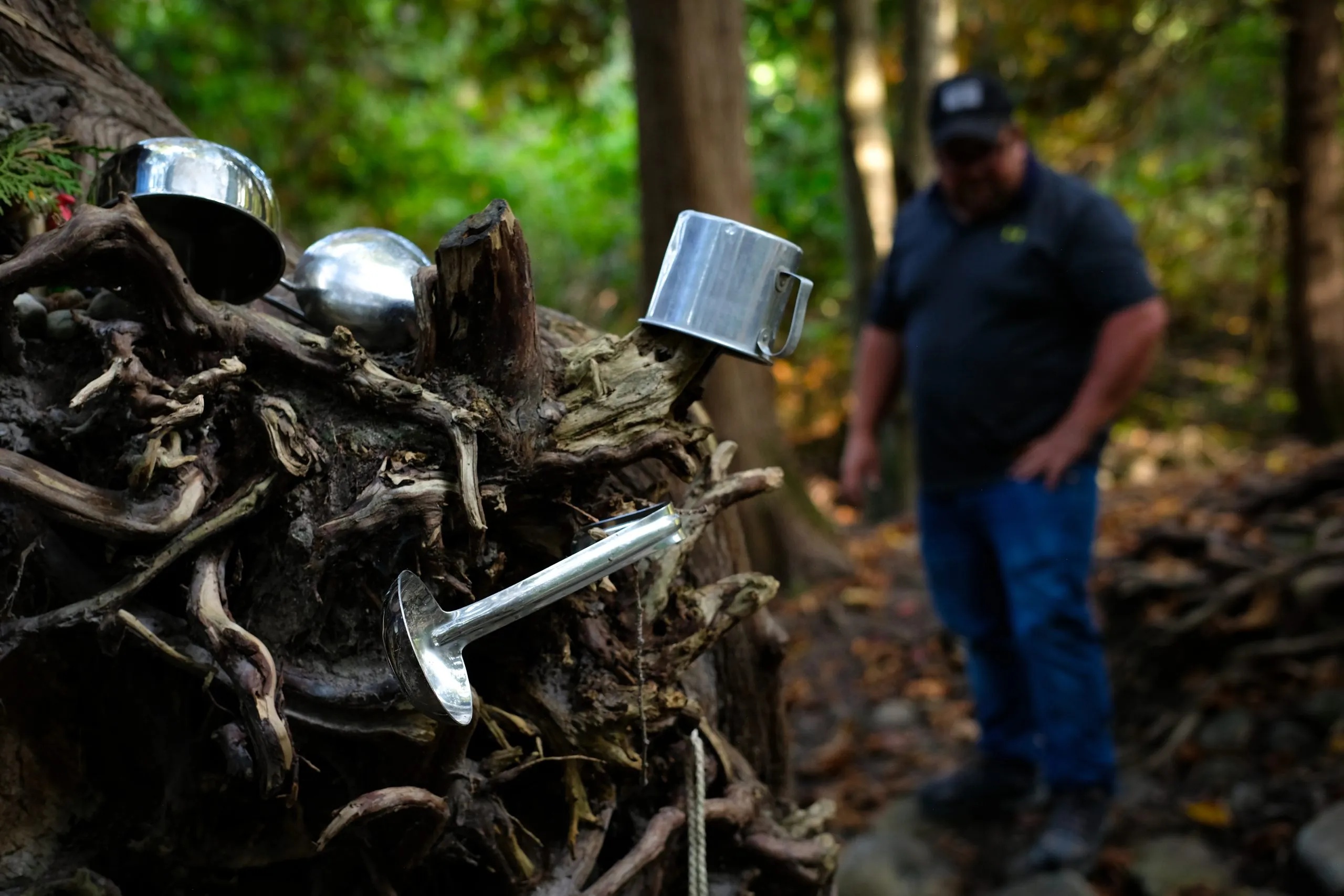
Chris Kestell at Nichols Creek. Photos © Christian Thorsberg/Circle of Blue
Meanwhile, a second ATC expansion, the Ozaukee County Distribution Interconnection project, proposes the construction of five new energy substations and corresponding transmission lines just southeast of Waldo. The preferred route would require the clear-cutting of old-growth forest and intersect the Cedarburg Bog Wilderness — “the most intact large bogs in southeastern Wisconsin,” according to the Wisconsin DNR, and a registered National Natural Landmark by the U.S. Department of the Interior.
“Our entire business is based on people coming away from the city and spending the weekend here in the trees,” said Katy Rowe, who co-owns Abloom Farms, a resort and wedding venue located on the northern edge of the bog. “Eminent domain should not be used as a weapon against normal American citizens that have decided to live a quiet life in the country.”
According to ATC’s website, these projects are “needed to ensure electric reliability and address current and future energy needs in the community and the surrounding area.” But those needs aren’t due from the smattering of dairy farms, lonely county roads, and modest old homes that comprise rural Waldo, population 467.
Nearly two dozen data centers in southeastern Wisconsin alone are either proposed, built, or in-development, but the two newest are not like the others. More than 20 miles away, in the city of Port Washington, a 672-acre campus built by Vantage Data Centers is scheduled to break ground before year’s end. Even farther, some 70 miles south, Microsoft is building a 315-acre facility near Racine.Though seemingly far enough away to be irrelevant to Waldo, the new sites’ thirst for power knows few bounds. When fully built, the Vantage and Microsoft locations will together require a 24/7 electricity supply totaling 3.2 gigawatts — greater than all of Wisconsin’s homes combined.
Power generated by natural gas, nuclear, coal, solar, wind, and battery storage stations across the state’s central and eastern regions are all in the mix to bring data center campuses online. Transmission lines, running through Waldo, will transport the electricity they demand.
When reached, ATC declined to comment on the Plymouth Reliability project.
Waldo’s story is not a one-off. New state and federal legislation are incentivizing data center development and encouraging power lines’ rapid rise across the region, potentially running roughshod over other communities.
In February, Illinois — which by one count leads the Great Lakes region with more than 200 data centers — enacted a law allowing tax incentives for the construction of new battery storage facilities and high-voltage transmission lines. A month later, lawmakers in Indiana (75 data centers) enacted a law aiming to make transmission lines more efficient and cost-effective to construct. Similar legislation went into effect in Ohio (192 data centers) in August.
On a national scale, President Donald Trump signed an executive order this January declaring an energy emergency and ordering agencies to “expedite the completion of all authorized and appropriated” energy infrastructure. The order directs the U.S. Army Corps of Engineers to speed up their review of permit applications to develop wetlands for transmission lines and other energy projects. The Corps is reviewing such permits for new lines in Wisconsin and other states.
In late October, U.S. Secretary of Energy Chris Wright directed the Federal Energy Regulatory Commission to change permitting and rulemaking procedures to “significantly reduce” the amount of time and oversight required to bring data centers onto the grid.Literally caught in the middle of a new epoch of surging energy demand and supply in the Great Lakes region, residents say they are contending with powerful economic trends that could be devastating to the environment, and already are weighing on their spirits.
Back at his family home, Kestell points to a large rock on his front lawn. The new power lines, Kestell said, would run right over his uncle’s final resting place.
“This is not rural electrification anymore, bringing power to poor farms” said Kestell’s father, Tom, also a farmer in Waldo. “This is an elite, wealthy class of people who are invested in these power stations and data centers, who are going to make probably trillions of dollars off this. And the people who they infringe on in the meantime? They’re just collateral damage.”
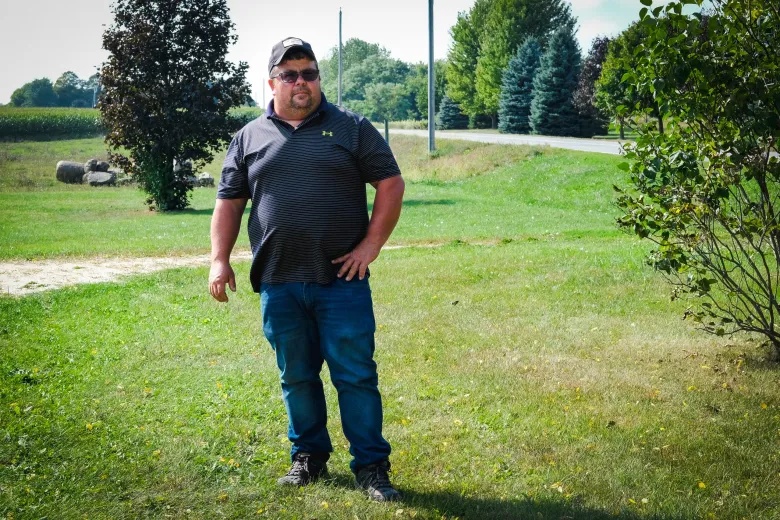
Chris Kestell stands on his front lawn in Waldo, Wisconsin. Photo © Christian Thorsberg/Circle of Blue
Homes and Ponds at Risk
What’s developing in Waldo is a case in point. The wetland area through which Nichols Creek flows is the source of local residents’ well water.
“Water comes, goes back down into the ground, and then becomes a collection of underground springs,” said JoAnne Friedman, the town chairperson of Lyndon, Wisconsin. “When you try to imagine how much water is underground here, it is a phenomenal amount.”The water recharge process, and the natural filtration trees and other plants provide, is threatened by the right-of-way easements that the 138-kilovolt power lines require. All vegetation between 60 feet and 110 feet to either side of the lines would need to be cleared during their construction.
The loss of maple and cedar tree cover, Kestell said, threatens both the warming of Nichols Creek and soil erosion on the side of county roads that already slump and flood when storms roll through.
“With all of these projects, they don’t realize how much mitigation people who have these properties have done to prevent erosion,” said Friedman, who has needed to enlarge her property’s 20-foot-deep retention pond from half an acre to two acres to manage gushing ephemeral streams during springtime snowmelt and heavy rains.
Living at the bottom of a small sloped valley, she said she has planted so many trees she “lost count,” all to help redirect flows from damaging her home. If ATC’s transmission line route is built, she said, this cover would all be clear-cut.
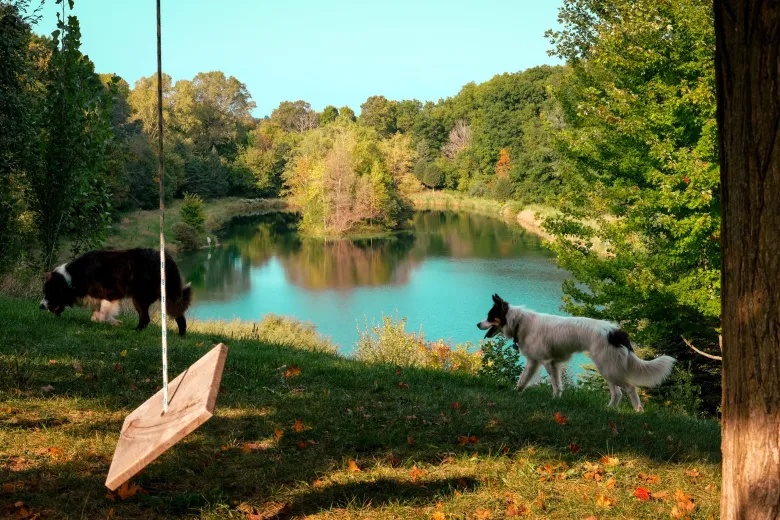
JoAnne Friedman’s two-acre retention pond. Photo © Christian Thorsberg/Circle of Blue
Hundred-year-old trees would also be razed from the backyard of Randy Pietsch, a retired dairy farmer who has lived along the banks of Nichols Creek for more than 50 years. The trout pond he keeps on his property has long been open to friends and family for fishing, though he closed it several years ago and has no plans now of reopening.
“I’m not hopeful for anything,” he said. “Why they have to come through here is beyond me. I can’t imagine that electric line’s good for fish. They just want to steal the land, that’s all. It’s sad, it’s stressful. You lose a lot of sleep at night.”
Randy Pietsch stands on the banks of Nichols Creek, which flows through his backyard. Photo © Christian Thorsberg/Circle of Blue
Most startling, residents say, are the effects of ATC’s preferred route on their properties, many of which have been in their families for multiple generations.
In some cases, the transmission lines’ right-of-way easements extend several feet inside peoples’ homes. One resident, Nolan Harp, said that the lines would run within 40 feet of his front door, placing half of his house within an easement. As a result, five 40-foot tall trees in his yard would be cut down, and his private well would need to be moved.
“That’s my sole source of water. It’s an old well, but it works, it’s clean, and it’s good,” Harp said. “But you can’t have something like that under power lines.”
Harp said that ATC has offered to dig up the open well, its casing, tank, and pump, and replace them elsewhere on his property. But the headache of additional construction, and the obvious hazard of power lines running above his house, has him considering other options.
“I don’t want to move, but if they insist on putting that power line up, I don’t think I can live here,” Harp said.
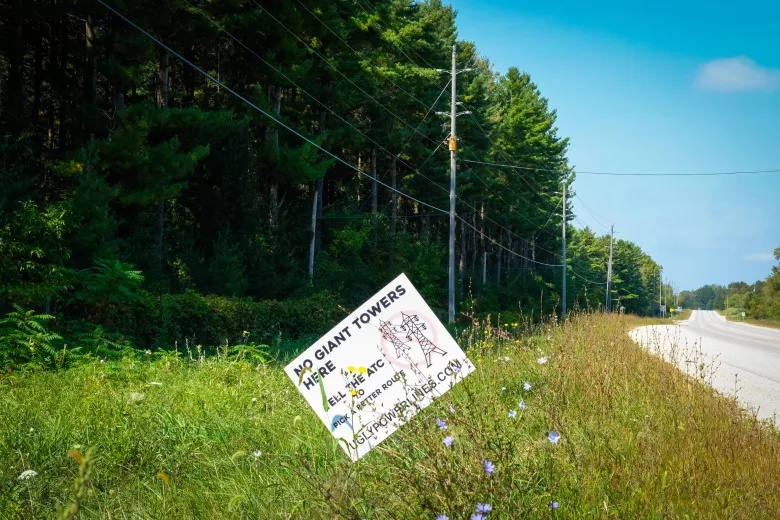
Existing transmission lines near Abloom Farms in Saukville, Wisconsin. Photo © Christian Thorsberg/Circle of Blue
In late January, the $33.5 million Plymouth project was approved by Wisconsin’s Public Service Commission (PSC), though they added a condition that prevents ATC from using eminent domain to build their power lines. ATC subsequently petitioned to reopen the application on the grounds that PSC cannot revoke that right, which is protected under Wisconsin state law. In April, this petition was granted.
Kestell, who founded an organization called Neighbors 4 Neighbors to fight against the project in court, estimates that residents have spent $250,000 of their own money on legal fees.
At the end of the day, their homes and health are the most important concerns.
“When they put these towers in, some of them are going down 30 or 40 feet, possibly hitting the aquifer when they’re digging foundations,” said Kestell, who estimates his own front door will be within roughly 20 feet of an easement. “We’re just not sure about contamination.”
Read more stories from The Great Lakes: Unprotected series:
This article first appeared on Circle of Blue and is republished here under a Creative Commons Attribution-NonCommercial-NoDerivatives 4.0 International License.
If you think stories like this are important, become a member of Urban Milwaukee and help support real, independent journalism. Plus you get some cool added benefits.





















Will ATC be held accountable for all the flood damage its clear cutting caused? Probably not. ATC and the data centers are all about sharing costs for building and maintaining infrastructure they need. Corporations are all too happy to offload on individuals and the public, the liability for the destructions of essential flood plains and wetlands. However, sharing the profits is out of the question.
This is what corporate welfare looks like. This not what Adam Smith’s capitalism/free market system is all about. It is NOT a “free market” when corporations take land and resources from farmers and rural communities without any compensation. It is not a “free market” when these corporations refuse to pay living wages to workers. It is not a “free market” when corporations merge into monopolies whose sole objective is maximizing shareholder profits. It is not a “free market” when government agencies like the PUC turn their backs on the people they are tasked to protect. This fascism.
This is important reporting. Thank you both Circle of Blue and Urban Milwaukee.
What do we know about the next steps or status in potential eminent domain actions?
Looks like this is the PSC docket for those who want to follow up. https://apps.psc.wi.gov/APPS/dockets/content/detail.aspx?id=137&case=CE&num=221
I also understand there was recently a story in Ozaukee Press.
Does the use of everyday technology feed the AI boom? If so, how?