Is ‘Hamnet’ Best Picture of the Year?
It would be my choice. And Jessie Buckley a front runner for Best Actress.
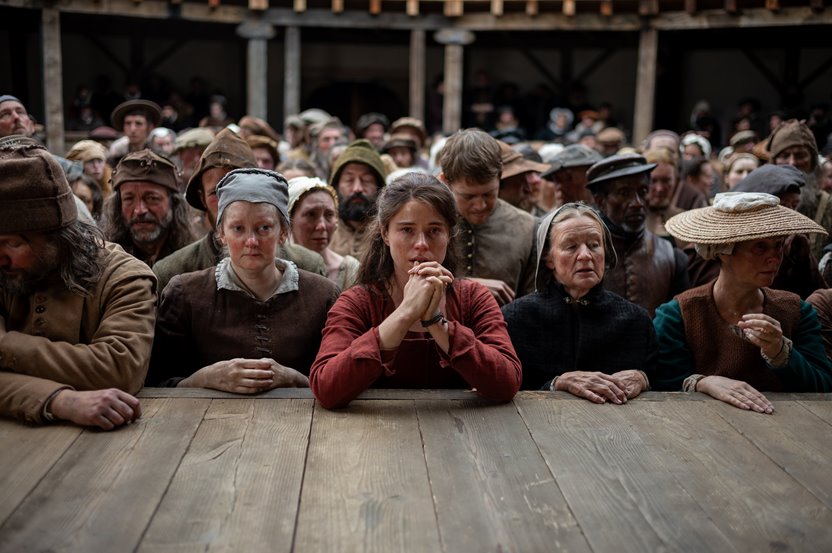
Elbows firmly on the stage’s edge at the Globe Theatre, Jessie Buckley as Agnes, the mother of the deceased “Hamnet, ” awaits her husband’s “Hamlet.” Photo courtesy of Milwaukee Film.
With Hamnet, my choice so far for best picture of 2025, director Chloe Zhao has conjured a heartbreaking vision of rustic life in 16th century Britain.
It is a domestic world of pain and grief, a slow, mounting awareness of the real emotions behind theatrical performances and of country characters melting into nature — here the primeval woods, the farm rooms and, at the end, the Globe Theatre in London where common folk surge toward the stage.
There will be patrons going to the movie looking for some revelation about William Shakespeare’s life before fame. This is instead a work of hypnotic imagination using scant historical facts, with a script co-written by Zhao and author Maggie O’Farrell, whose 2020 novel Hamnet was widely acclaimed. The father is just Will, an impulsive, ruddy-faced rustic who lives as a glove maker and home-tutors neighborhood children. Later, some internal demon spurs him to commute to London’s Globe to make a career.
Shakespeare’s sonnets and plays may be famous, but the historical facts of his domestic life are so slim that the libraries are full of scholarly speculation that Shakespeare was the uneducated rustic beard for Walter Raleigh or Francis Bacon or on and on, widely speculating that a country kid couldn’t write like this or think so deeply.
Another historical thread was spun into the film’s most distinctive character, calling Will’s wife Agnes, a name she was referred to just once in an old document, though history and other documents give her name as Anne Hathaway.
Agnes is Jessie Buckley. She dominates the film — her eyes searching the world around her, her body thrown into extensive scenes of howling childbirth, the slight smile when she looks at Will, the gutsy determination to confront the world. Every moment adds to the likelihood that she is the actress to beat at the Oscars.
We know Will fathered twins Judith and Hamnet, and that Hamnet died at age 11 from the pestilence. The film invents Hamnet clinging to a sickly Judith on his deathbed with the father absent.
Judith recovers, he doesn’t. Will is berated by Agnes for not being there.
Four years after Hamnet’s agonized death in his mother’s arms, Will (now Shakespeare) presents London with what became his most famous tragedy — Hamlet, a name commonly interchanged with Hamnet.
But frankly that’s it for a basis in facts. Those bookish scholars had less to go on arguing that famous erudite courtiers of the era were actually the real Shakespeare.
These threads were enough to spark Chloe Zhao’s filmic imagination as we meet Agnes huddled under a gnarled tree in the forest where she flies her hawk. The tree, the hawk and the foliage play an enormous visual part in this story.
Agnes is a primeval spirit; some call her a witch. She lives in touch with the forest. She’s expert in home remedies and wary but graphic when plunging into sex with Will. He marries her against family objections, starting his trips to London that he can’t fully explain.
Agnes with passion and fury is clearly a force to reckon with, having her first child alone in the woods, then surrounded by farm midwives for future births.
Children abound in the story, including the three Will and Agnes have. They play games of being witches, of inventing stories with their father, of concocting potions out of forest greens, of further reminding every Shakespearean in the audience of what poetic memories can be woven out of a familiar word or phrase. These are subtle reminders, peppered into commonplace dialogue.
Agnes is angry that Will was absent in London when Hamnet died, and her chilliness is formidable. Years later she learns he has written a play called Hamlet. Technically that drama’s plot — the Danish court and royal players, the evil uncle and the wayward queen, the ghost of the king (both legend and this movie have Shakespeare portraying the ghost) — may be far removed from what happened to Hamnet. But the melancholia, the doubt, the ghost, betrayal, remorse and dreams are certainly touchstones.
These days, films gain attention for slam-bang theatrics and crazy chases. Not here. Hamnet may strike some patrons and awards people as too slow, mystical and domestic oriented (as if a mother’s passion for a dead child was something too trivial for drama). But Hamnet delves deep into primitive emotions, how the agony over a child’s birth or a child’s death can reach into our souls and our artistry.
If films are to be judged by how originally they create their own world and still touch the well of human truth, this one is gigantic, though far different than a lot of other films seeking commercial favor.
But this is not an unknown director. Born in Beijing in 1982 as Zhao Ting, she has made a potent mark in independent film. Her fictional Nomadland (2021) won best film and best director at the Oscars.
Along with the lively children used, her main cast catches the aura. A vocally forceful Emily Watson appears as Will’s mother whenever there is a birth or illness in process. She makes us feel her soliloquy about rearing children.
Close behind Buckley in impact is Paul Mescal’s Will, charming and quirky in the early going. Mescal has the chops to range from seducer to angry son to world-class poet.
He keeps a mystery that even time hasn’t fully answered. What possesses a man to chase a wood nymph, enthuse over their children, yet leave for London because he can’t write at home?
Mescal captures those moods and handles some later shifts to the stage, almost casually demonstrating his skill at the Bard’s language. But a half hour before the film’s end, there are two minutes of Will directing Hamlet that director Zhao should have cut, because it smacks too much of how Method actors work in modern times. It briefly lifted me out of her otherwise mesmerizing world.
By the actual end, though, the primitive stagecraft at the Globe brings the movie audience and the screen actors together in common purpose and acceptance. Little moments gain major importance: The painted green trees surrounding the stage entryway, the plaster of paris used to cake the face of the ghost, the shock moment when the actor playing Hamlet looks to Agnes like an adult version of Hamnet. This is a movie where moments mount into deep memory.
Hamnet won’t be streaming until late January of 2026, probably on Peacock. It has been in Milwaukee theaters since before Christmas.
Dominique Paul Noth served for decades as film and drama critic, later senior editor for features at the Milwaukee Journal. You’ll find his blog here and here. For his Dom’s Snippets, an unusual family history and memoir, go to domnoth.substack.com
If you think stories like this are important, become a member of Urban Milwaukee and help support real, independent journalism. Plus you get some cool added benefits.


Movies
-
Oscar Show Catches Hollywood in Transition
 Mar 16th, 2026 by Dominique Paul Noth
-
Can Film Incentives Turn Wisconsin Into A Movie Hub?
 Mar 10th, 2026 by Sophie Bolich
-
‘Nuremberg’ Tries To Indict Us All
 Jan 25th, 2026 by Dominique Paul Noth
Review
-
Honeypie Cafe Boasts Good Home Cooking
 Mar 14th, 2026 by Cari Taylor-Carlson
-
‘Ain’t Misbehavin’ Is High Quality Fun
 Mar 9th, 2026 by Dominique Paul Noth
-
Sobelman’s Offers Classic Burgers
 Mar 7th, 2026 by Cari Taylor-Carlson