

Chadha’s Shadow Over Wisconsin’s Legislative Veto
Courts are dismantling veto power. Some legislators still trying to use it.
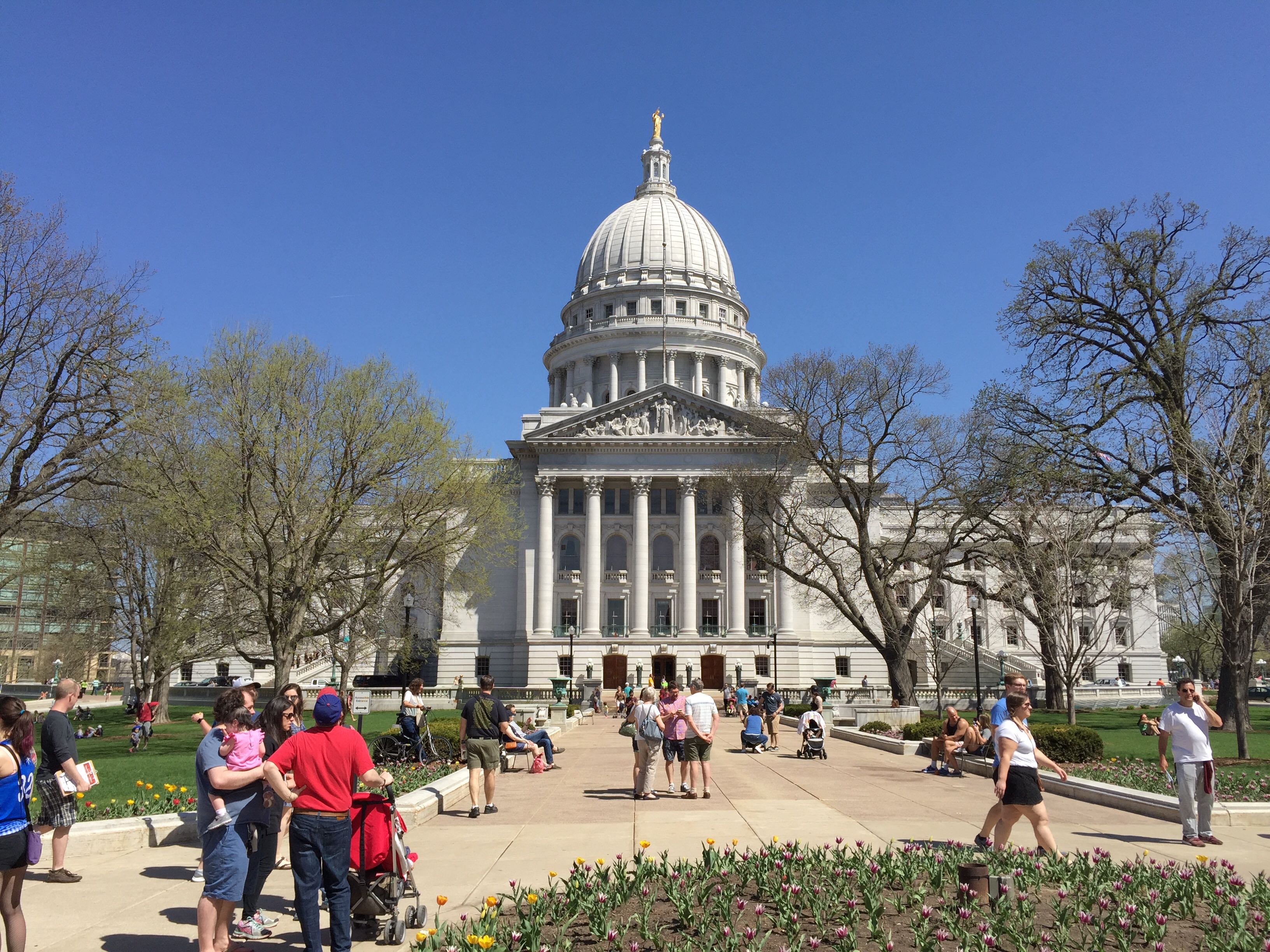
Wisconsin State Capitol. Photo by Dave Reid.
In a 1983 case called Immigration and Naturalization Service (INS) v. Chadha, the U.S. Supreme Court outlawed legislative vetoes in federal laws. Such vetoes were provisions placed in laws that allowed Congress, or committees of Congress, to veto the implementation of the laws.
The court ruled that such provisions are invalid because they are an exercise of legislative power, which makes them subject to the bicameralism and presentment requirements in Article I of the Constitution. The first requirement refers to passage by both the House and Senate; the second requirement refers to being presented to the President for approval. At the time of the Chadha decision, it was estimated that almost 200 federal laws contained legislative veto provisions.
Chadha, who overstayed his student visa, was threatened with deportation by the INS. He successfully appealed that decision to an Immigration Judge. As required by a provision of immigration law, that decision was reported to Congress. Thereafter, the House of Representatives passed a resolution vetoing the judge’s decision.
Chadha’s appeal eventually made it to the Supreme Court, which ruled that the “congressional veto provision … is unconstitutional.” It ruled that the prescription for legislative action in Article I of the Constitution, requires that all legislative powers to be vested in a Congress consisting of a Senate and a House of Representatives and requiring every bill passed by both bodies before becoming law, to be presented to the President, and, if he disapproves, to be re-passed by both bodies — and that this represents the framers’ decision that the legislative power of the federal government be exercised in accord with a single, finely wrought and exhaustively considered procedure. “This procedure is an integral part of the constitutional design for the separation of powers.”
In essence, in the framers’ view, the core task of the legislature is to write laws, while that of the executive is to execute the laws. The legislative veto places the legislative branch squarely in the middle of the job of the executive.
Today, 40 years after the U.S. Supreme Court decided Chadha, the legislative veto is under attack in Wisconsin. The federal court’s decision in Chadha was binding only regarding federal law, leaving state versions of the legislative veto — including Wisconsin’s — free to establish their own legislative vetoes, often in secrecy.
The first challenge to Wisconsin’s legislative vetoes came in a 2023 case called Evers v. Marklein. Wisconsin Gov. Tony Evers, along with administrative departments, challenged situations where legislative committees were blocking efforts by executive bodies to implement laws.
The Wisconsin Supreme Court chose initially to consider only one of these controversies, which challenged the ability of the Joint Finance Committee to block grants under the Knowles-Nelson Stewardship Program to purchase land or disburse state funds to local governments and nonprofit organizations to acquire land for nature-based outdoor recreation.
Included on the list of stalled grants was one to establish the Cedar Gorge Clay Bluffs Nature Preserve on Lake Michigan just south of Port Washington. The committee never disclosed who had requested the hold on this proposal but there were rumors about a proposal to use the land for luxury housing.
In a 6-1 decision written by Rebecca Bradley and joined by Justices Ann Walsh Bradley, Rebecca Dallet, Brian Hagedorn, Jill Karofsky, and Janet Protasiewicz, the court ruled against the committee’s legislative veto. Quoting James Madison’s concern about “a gradual concentration of the several powers in the same department,” the court wrote that the “preservation of liberty requires that the three great departments of power should be separate and distinct.”
Justice Annette Ziegler wrote a dissenting opinion. She accused her colleagues of “rushing to judgment” and “taking this case out of turn.”
The next challenge to Wisconsin’s legislative vetoes came in the form of Kaul v. Wisconsin Legislature (2025). Representing himself, Attorney General Josh Kaul challenged a provision in the state’s laws that required approval by the Joint Committee on Finance for the Department of Justice to settle certain civil lawsuits.
Hagedorn, writing for a unanimous Wisconsin Supreme Court, delivered the majority opinion striking down the requirement and affirming that such settlement power is a core executive function.
In its first consideration of Evers v. Marklein, described above, the court left open the question of whether a legislative committee can unilaterally block administrative rules. In July, in what is sometimes called Evers II, the court answered that question in the negative. It held that legislative vetoes over administrative rules violate the Wisconsin Constitution’s bicameralism and presentment requirements — that laws must pass both houses of the legislature (called “bicameralism”) and go to the governor for approval (“presentment”).
Two rules were at issue, one banning conversion therapy by therapist and social worker licensees in the state and the other updating the state’s commercial building code.
The majority decision was written by Chief Justice Karofsky, joined by justices Walsh Bradley, Dallet, and Protasiewicz.
Hagedorn concurred in part and dissented in part. He argued that the proposed rules could have been upheld without addressing the constitutionality of the committee’s intrusion.
But as reporter Laura Schulte has reported, some legislators are unwilling to give up on the legislative veto:
The Department of Safety and Professional Services, which is in charge of licensing professions from nurses and doctors to contractors and builders, in October requested nearly $2 million in funding to hire employees and employ new technology to reduce wait times for callers.
But a member of the state’s powerful Joint Finance Committee anonymously objected to the request, halting the agency’s ability to use the funding it had raised through licensing fees.
Republican legislators in Wisconsin have had a pattern of such actions, which led to the high court decisions striking down this use of legislative power. It appears that some are still intent on continuing to use the legislative veto and operate in secrecy in doing this.
If you think stories like this are important, become a member of Urban Milwaukee and help support real, independent journalism. Plus you get some cool added benefits.


Data Wonk
-
How Global Climate Change Affects Milwaukee
 Mar 11th, 2026 by Bruce Thompson
-
Will Lawsuits Demanding New Congressional Maps Succeed?
 Mar 4th, 2026 by Bruce Thompson
-
What the 2025 Elections Data Tells Us
 Feb 11th, 2026 by Bruce Thompson



















Most all rural areas are in need of the professionals that are licensed by the Department of Safety and Professional Services. If an applicant decides that a six month waiting period is not worth the trouble, they can look to other nearby States where getting licensed is easier. Again this shows that rural legislators do not take action to help their districts. The optics of the veto of the Cedar Gorge Clay Bluffs Nature preserve would indicate to the average voter that there likely was a bribe to a member of the Joint Finance Committee to have this initiative killed. There was never an investigation to determine publicly what happened which raises the question of the integrity of the Republican members of the Joint Finance Committee at that time.